
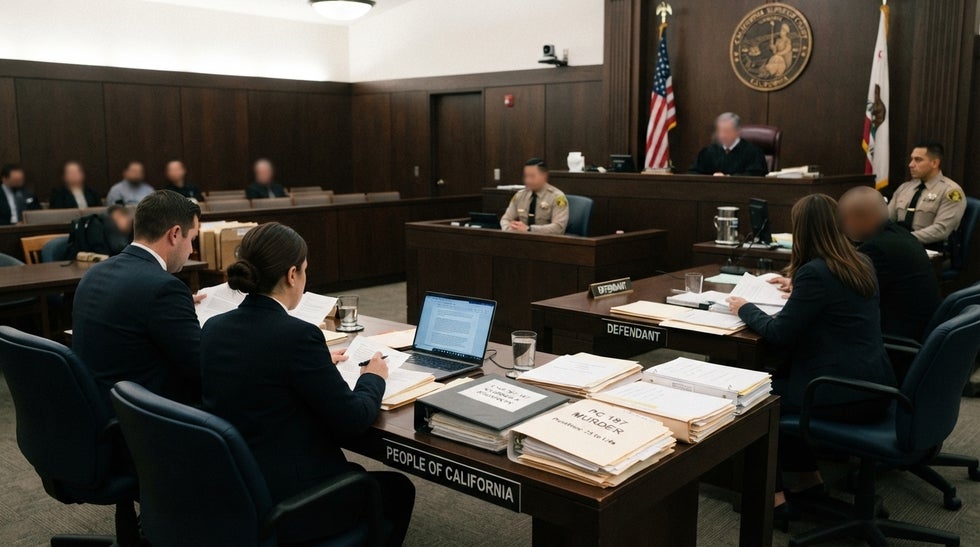
Murder is the most serious criminal charge in California. And it is also one of the most defensible, when the defense understands exactly what the state must prove and where those theories break down.
To convict someone of murder under California Penal Code 187 PC, the prosecution must prove three elements beyond a reasonable doubt: an act that caused the death of another person or a fetus, malice aforethought, and the absence of any lawful justification such as self-defense. First-degree murder carries 25 years to life. Second-degree murder carries 15 years to life. Murder with special circumstances carries life without parole or the death penalty.
If you or someone you care about is facing a murder investigation or charge anywhere in California, contact the criminal defense attorneys at The Bulldog Law immediately for a free, confidential consultation.
What Must the Prosecution Prove in a Murder Case?
Under Penal Code 187(a), murder is the unlawful killing of a human being, or a fetus, with malice aforethought. Following California's jury instruction CALCRIM No. 520, the prosecutor carries the burden of proving each of these elements beyond a reasonable doubt:
Causation. The defendant committed an act that caused the death of another person or a fetus. The death must be the direct, natural, and probable consequence of the act, and the death would not have happened without it.
Malice aforethought. The defendant acted with either express or implied malice. This is explained in detail below.
No lawful excuse or justification. The killing was not legally justified, for example, by valid self-defense or defense of another person.
If the prosecution cannot establish even one of these elements, there is no murder conviction. That is why murder trials so often turn on the defendant's mental state, the hardest element for the state to prove, and the one where the defense most often wins.
Express Malice vs. Implied Malice
Malice aforethought is what separates murder from manslaughter. It comes in two forms, and either one is enough for a murder conviction.
Express Malice
Express malice exists when the defendant intended to kill. The prosecution typically proves it through circumstantial evidence: statements made before or after, planning activity, the choice of weapon, the number and placement of wounds, or a demonstrated motive.
Implied Malice
Implied malice does not require any intent to kill. It exists when four things are true: the defendant intentionally committed an act; the natural and probable consequences of that act were dangerous to human life; at the time, the defendant knew the act was dangerous to human life; and the defendant deliberately acted with conscious disregard for human life.
Classic implied malice prosecutions include throwing heavy objects at moving cars, firing a gun into an occupied building, high-speed street racing that kills a bystander, and "Watson murder", a DUI killing committed by a driver who was previously warned, usually at a prior DUI sentencing, that impaired driving can kill.
One critical limit: under Penal Code 188(a)(3), as amended by Senate Bill 1437, malice can no longer be imputed to a person based solely on their participation in a crime. The state must prove the defendant's own individual mental state. Understanding exactly what malice aforethought requires, and what it does not, is covered in detail on the malice aforethought defense page.
First-Degree vs. Second-Degree Murder
Penal Code 189 divides murder into two degrees with very different consequences.
First-degree murder includes killings that are willful, deliberate, and premeditated, as well as killings carried out by specific means, poison, lying in wait, torture, a destructive device or explosive, or a drive-by shooting with intent to kill, and qualifying felony murders.
Second-degree murder is every other murder committed with malice. This most commonly means an intentional but unplanned killing, or an implied-malice killing.
Premeditation does not require days of planning. Courts look at planning activity, motive, and the manner of the killing. A cold, calculated decision made in seconds can qualify, but a rash, impulsive act does not. That distinction is where the difference between first and second degree is often fought. You can also review how federal courts treat these distinctions on the first-degree vs. second-degree murder under federal law page.
The Felony Murder Rule After SB 1437
California's felony murder rule was dramatically narrowed, not abolished, by Senate Bill 1437, which took effect in 2019. Under current Penal Code 189(e), a person can be convicted of felony murder for a death during a qualifying felony (such as robbery, burglary, rape, carjacking, kidnapping, or arson) only if the prosecution proves one of three things:
The defendant was the actual killer; or the defendant, with the intent to kill, aided or assisted the actual killer; or the defendant was a major participant in the underlying felony and acted with reckless indifference to human life.
An exception applies where the victim was a peace officer killed in the line of duty.
The old rule, under which a getaway driver could be convicted of murder for a killing they never intended or even knew about, no longer applies. SB 1437 also eliminated the natural and probable consequences doctrine as a theory of murder liability.
Resentencing Under Penal Code 1172.6
These changes are retroactive. Anyone convicted of murder under the old felony murder rule or the natural and probable consequences doctrine, including people who pled guilty to avoid trial, can petition for resentencing under Penal Code 1172.6 (formerly 1170.95).
Senate Bill 775 (2021) extended this relief to certain attempted murder and manslaughter convictions as well. If the petition succeeds, the murder conviction is vacated and the person is resentenced on any remaining counts. This has already freed or substantially reduced sentences for thousands of Californians.
If you or someone you know was convicted under the old law, a resentencing petition may be available right now, and worth evaluating immediately.
Penalties for Murder in California (2026)
The penalties for a California murder conviction are severe and, in most cases, involve indeterminate life sentences:
First-degree murder carries 25 years to life in state prison.
First-degree murder with special circumstances (PC 190.2) carries life without the possibility of parole (LWOP), or the death penalty. Executions are currently halted under a gubernatorial moratorium in place since 2019.
Second-degree murder carries 15 years to life in state prison.
Second-degree murder of a peace officer carries 25 years to life, or LWOP in aggravated cases.
Watson (DUI) murder is charged as second-degree murder and carries 15 years to life. More on the DUI-to-murder pathway is covered on the vehicular manslaughter while intoxicated PC § 191.5 defense page.
Special circumstances under Penal Code 190.2 include murder for financial gain, multiple murders, killing a witness to prevent testimony, killing a peace officer or firefighter, murder by bomb or poison, lying in wait, torture, gang-related murder, and murder during qualifying felonies. When a special circumstance is alleged, the jury must find it true beyond a reasonable doubt, and the case proceeds to a separate penalty phase.
On top of the base term, a murder conviction commonly brings:
Firearm enhancements under PC 12022.53: consecutive terms of 10 years for using a gun, 20 years for firing it, and 25 years to life for causing death or great bodily injury. These enhancements are explained in full on the California 10-20-Life law Penal Code 12022.53 page.
A strike under California's Three Strikes Law, plus fines up to $10,000 and victim restitution. The full impact of a strike on future sentencing is covered on the California Three Strikes Law overview page.
Gang enhancements under PC 186.22, though Assembly Bill 333 (2022) significantly tightened what prosecutors must prove, and courts including the California Supreme Court in People v. Rojas (2023) have applied the stricter definitions to gang-murder special circumstances.
Lifetime consequences: loss of gun rights, immigration consequences for non-citizens, and civil exposure to wrongful death lawsuits.
There is no statute of limitations for murder in California. Under Penal Code 799, charges can be filed at any time, no matter how many years have passed.
According to the California Courts self-help guide on homicide, murder and manslaughter cases are among the most procedurally complex in the California court system, with distinct phases for guilt determination, special circumstance findings, and penalty, which is why experienced defense representation from the earliest stage of investigation is so important.
How a California Murder Prosecution Unfolds
Murder cases follow a longer, more intense path than other felonies. Understanding the stages helps.
Investigation. Homicide detectives build the case before arrest, using forensics, phone records, surveillance footage, and witness interviews. Anything you say at this stage, even as an apparent "witness", can become the core of the prosecution's case against you.
Arrest and arraignment. The defendant is formally charged and enters a plea. Bail can be denied in capital cases where the proof is evident, and is otherwise set extremely high.
Preliminary hearing or grand jury. The prosecution must show probable cause to hold the defendant for trial. This is the defense's first real opportunity to test the state's witnesses and expose weaknesses in the evidence.
Pretrial motions. Suppression motions under PC 1538.5, motions to reduce or dismiss charges under PC 995, and evidentiary battles often shape the entire direction of the case long before the jury is seated.
Trial. The guilt phase decides whether the elements are proven beyond a reasonable doubt. If special circumstances are found true, a penalty phase follows. If insanity is pled, the trial is bifurcated into guilt and sanity phases.
Sentencing and appeal. Murder sentences are indeterminate life terms. Post-conviction options include direct appeal, habeas petitions, and PC 1172.6 resentencing for those convicted under theories that no longer exist under current law.
Defenses to Murder Charges
Self-defense or defense of others. A killing is legally justified, not murder, when the defendant reasonably believed they or someone else faced imminent death or great bodily injury, and used no more force than necessary. California has no duty to retreat.
Heat of passion (reduction to voluntary manslaughter). A killing during a sudden quarrel or under provocation that would cause a reasonable person to act rashly negates malice. Voluntary manslaughter carries 3, 6, or 11 years, a life-changing difference compared to 15 or 25 years to life.
Imperfect self-defense. An honest but unreasonable belief in the need for deadly force also reduces murder to voluntary manslaughter. This is one of the most important and underused defenses in California homicide cases.
No malice or accident. A death caused by accident, or by ordinary negligence, is not murder. The state must prove the required mental state, not just the fact that someone died.
Mistaken identity and false accusation. Eyewitness misidentification is a leading cause of wrongful convictions. Alibi evidence, DNA, cell-site location data, and surveillance video can dismantle an identification case entirely.
Unlawful searches and coerced statements. Evidence obtained through illegal searches, and confessions taken in violation of Miranda or through coercion, can be suppressed, and suppression of the key evidence in a murder case can end the prosecution.
Insanity. Under California's M'Naghten standard, a defendant who, because of a mental disease or defect, could not understand the nature of the act or distinguish right from wrong may be found not guilty by reason of insanity, resulting in commitment to a state hospital rather than prison.
Challenging the forensic case. Cause-of-death opinions, ballistics, blood-spatter analysis, and time-of-death estimates are all contestable with qualified defense experts. In many murder cases, the forensic evidence is far less certain than the prosecution presents it to be.
According to research published by the National Registry of Exonerations, false or mistaken eyewitness identification and false confessions are among the most common contributing factors in wrongful murder convictions, which is why challenging the state's identification and confession evidence is so often central to an effective murder defense.
Related California Homicide Offenses
PC 192(a), Voluntary manslaughter: 3, 6, or 11 years
PC 192(b), Involuntary manslaughter: 2, 3, or 4 years
PC 192(c) / PC 191.5, Vehicular manslaughter; gross vehicular manslaughter while intoxicated carries up to 10 years
PC 664/187, Attempted murder: life with parole if willful, deliberate, and premeditated; otherwise 5, 7, or 9 years
PC 182, Conspiracy to commit murder
PC 401, Aiding a suicide
Frequently Asked Questions
What does the prosecution have to prove for a murder conviction?
Three elements beyond a reasonable doubt: an act that caused another person's death, malice aforethought (express intent to kill or conscious disregard for human life), and the absence of lawful justification such as self-defense. If the prosecution cannot prove all three, there is no murder conviction.
What is the difference between first-degree and second-degree murder?
First-degree murder is willful, deliberate, and premeditated, or committed by specific means such as lying in wait, torture, poison, or during a qualifying felony. Second-degree murder is any other killing with malice, typically an intentional but unplanned killing, or an extremely reckless act with conscious disregard for life.
Can I be convicted of murder if I never killed anyone?
Only in narrow circumstances after SB 1437. You must have been the actual killer, have aided the killing with the intent to kill, or have been a major participant in a dangerous felony acting with reckless indifference to human life. Merely being present or participating in the underlying crime is no longer enough.
Can a murder conviction be reduced or overturned?
Yes. Charges are often reduced to voluntary manslaughter through heat-of-passion or imperfect self-defense theories. People convicted under the old felony murder rule or natural and probable consequences doctrine can petition for resentencing under Penal Code 1172.6. These paths are real and have already changed outcomes for thousands of Californians.
Is the death penalty still used in California?
The death penalty remains on the books for special-circumstance murder, and prosecutors can still seek it. But executions have been halted under a gubernatorial moratorium in place since 2019. In practice, most special-circumstance convictions result in life without parole.
Is there a statute of limitations for murder?
No. Under Penal Code 799, murder charges can be filed at any time, no matter how many years have passed since the incident.
What should I do if police want to question me about a homicide?
Say nothing beyond asking for a lawyer. Homicide detectives often interview suspects as "witnesses" to lock in statements before making an arrest. Invoke your right to counsel and contact a defense attorney before any interview. Early intervention can shape whether charges are ever filed at all.
Facing a Murder Investigation or Charge? Contact The Bulldog Law Today
No charge carries higher stakes than murder, and no charge demands a more aggressive, better-resourced defense. The prosecution's burden is heavy, its theories are frequently vulnerable, and recent changes in California law have opened doors that did not exist a few years ago.
The criminal defense team at The Bulldog Law defends clients across California in murder, manslaughter, and attempted murder cases. We intervene during the investigation, retain top forensic experts, attack the state's theory of malice, and fight for acquittals, reductions, and resentencing.
Call The Bulldog Law now for a free, confidential case evaluation. Available 24/7.
For more on murder charges, manslaughter reductions, SB 1437 resentencing, and homicide defense across California, visit The Bulldog Law criminal defense blog.