
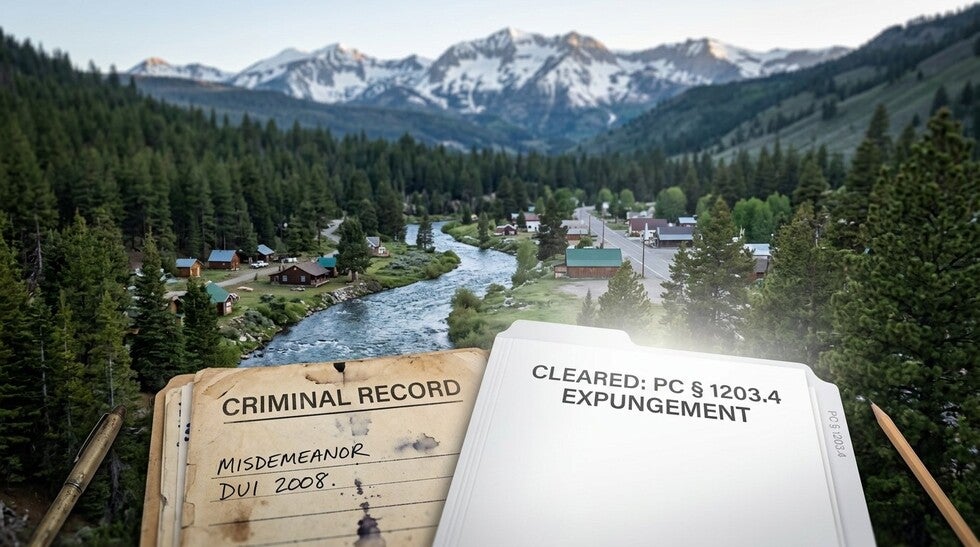
Expungement in Alpine County can help eligible people move forward after a misdemeanor or felony conviction, but California “expungement” is not a complete erasure of the past. Under Penal Code § 1203.4, the court may allow an eligible person to withdraw a guilty or no contest plea, or set aside a guilty verdict, enter a not guilty plea, and dismiss the case. The record still exists, but the case is updated to show a statutory dismissal.
In a small county like Alpine County, that formal dismissal can matter in both legal and practical ways. A conviction may affect seasonal resort work, county employment, small business opportunities, housing, professional licensing, and community reputation. The goal is to use every available record-clearing tool correctly, including PC § 1203.4 dismissal, PC § 17(b) felony reduction, Proposition 47 reclassification, diversion sealing, and privacy protections when old records are requested.
What Expungement in Alpine County means under PC § 1203.4
PC § 1203.4 relief is often called expungement, but the more precise term is a dismissal after conviction. If the petition is granted, the conviction is not treated the same way in many private employment contexts, and the court record reflects that the case was dismissed under the statute. This can be valuable for employment, housing, reputation, and moving forward after successful completion of probation.
PC § 1203.4 generally applies when a person successfully completed probation, received early termination of probation, or otherwise qualifies for relief in the interests of justice. The petitioner generally cannot be currently serving a sentence, on probation, or charged with a new offense at the time of the petition.
People considering expungement under PC § 1203.4 in a small-county court should understand that eligibility depends on the sentence, the conviction, probation performance, current record status, and whether a different record-clearing statute applies.
What PC § 1203.4 changes and what it does not change
A granted PC § 1203.4 petition can update the court record and help with many private employment and housing situations. It can also give a person a clearer way to explain the case: the conviction was dismissed after successful completion of the required terms.
But PC § 1203.4 does not do everything. It generally does not:
- Erase the case from every government database.
- Seal the court file by itself.
- Restore firearm rights.
- End sex offender registration if registration is still required.
- Remove all immigration consequences for noncitizens.
- Eliminate all disclosure duties for public employment, licensing, or government applications.
- Prevent the conviction from being used as a prior in some future criminal cases.
For these reasons, the petition should be prepared with the person's actual goals in mind. A seasonal worker, teacher, contractor, county employee, licensed professional, noncitizen, or person with a firearm concern may need different advice even if the same statute is involved.
Expungement in Alpine County and small-community consequences
Alpine County is California's least populous county, and its smaller community structure can make a criminal record feel more visible. A person may be applying for work with someone who knows them personally, returning to seasonal employment, seeking housing through local contacts, or trying to rebuild trust in a community where people recognize each other.
PC § 1203.4 does not erase memories or rumors, but it creates an official legal result. The court record can show that probation was completed and the case was dismissed. In a small community, that formal closure can help a person explain the case accurately and move forward with a stronger record.
For people comparing local approaches, Sutter County expungement under PC § 1203.4 and Stanislaus County expungement petitions under PC § 1203.4 show how the same statewide law can matter differently depending on local employment patterns, court practice, and community setting.
Who may qualify for expungement in Alpine County
Eligibility depends on the conviction and sentence. Many misdemeanor convictions and probationary felony convictions may qualify after probation is completed, or after early termination of probation is granted. Some cases that did not involve probation may require different statutes. State prison sentences, certain serious offenses, sex registration issues, and newer charges can complicate eligibility.
A record-clearing review should answer:
- Was the case a misdemeanor, felony, or wobbler?
- Was probation granted?
- Was probation completed successfully?
- Were all fines, restitution, classes, and community service completed?
- Is the person currently on probation, serving a sentence, or facing a new case?
- Does the conviction require a PC § 17(b) reduction first?
- Does Proposition 47, diversion sealing, arrest sealing, or another statute apply?
There is generally no fixed deadline requiring a person to petition immediately after probation ends. Many people file years later when a job, license, background check, housing application, or family situation makes record clearing urgent.
PC § 17(b) felony reduction before expungement
Some felony convictions are wobblers, meaning they could have been punished as either felonies or misdemeanors. If a person successfully completed felony probation on a qualifying wobbler, a PC § 17(b) motion may ask the court to reduce the felony to a misdemeanor.
This can be important before or alongside PC § 1203.4 relief. A dismissed misdemeanor often looks different from a dismissed felony in employment, housing, licensing, and personal reputation contexts. The court's decision depends on the conviction, facts, probation performance, criminal history, rehabilitation, and interests of justice.
A strong request may include proof of completed probation, stable employment, education, treatment, restitution payment, community involvement, family responsibilities, and time without new criminal conduct.
Proposition 47 and other reclassification options
Some older felony drug or theft convictions may qualify for reclassification under Proposition 47 if the offense would now be treated as a misdemeanor and the person meets the statutory requirements. Reclassification is different from expungement. It changes the felony classification when available, while PC § 1203.4 dismisses the case after conviction.
In the right case, the sequence may matter. A person may seek felony reclassification first, then PC § 1203.4 dismissal. In other cases, PC § 17(b), PC § 1203.4, arrest sealing, or another remedy may be more appropriate.
The defense should review the entire record, not just the charge name. The dollar amount, statute, sentence, prior convictions, and case history can affect whether reclassification is available.
Diversion completion and record sealing
Not every record-clearing case involves a conviction. If a person completed diversion and the case was dismissed, sealing may be available under a different statute. Diversion sealing is not the same as PC § 1203.4 because there may be no conviction to dismiss.
A person who successfully completed diversion may benefit from record sealing after successful diversion completion under Penal Code § 1001.9. This can be especially important for people who want to reduce the visibility of an arrest that did not end in a conviction.
Record sealing can still have limits. Law enforcement, courts, and some agencies may retain access in certain circumstances. Before filing, the person should understand what sealing will change, what it will not change, and how it differs from dismissal after conviction.
Privacy, subpoenas, and old records
Record clearing helps, but old records may still appear in certain legal disputes, subpoenas, background investigations, or licensing reviews. A person who has cleared a record may still need to protect privacy when employers, civil litigants, agencies, or opposing parties request personal information.
Employment disputes can involve privacy protections for employment records subpoenas in California, especially when an old criminal case is not directly relevant to the dispute. Requests for medical, financial, educational, or other private information may require separate attention because California personal records subpoena privacy rights can affect what must be produced and what can be challenged.
When old allegations surface in civil litigation, testimony matters. Proper deposition objections on the record in California can help protect against overbroad, misleading, or improper questioning about dismissed or unrelated matters.
Illegal recordings and record-sensitive allegations
Some convictions are especially record-sensitive because they suggest dishonesty, privacy violations, workplace misconduct, or trust issues. Illegal recording allegations can affect employment, licensing, and reputation even when the case is old or low-level.
A conviction involving illegal recording charges under Penal Code § 632 should be reviewed carefully for expungement eligibility, employment impact, and whether privacy-related collateral consequences remain after dismissal.
PC § 1203.4 can help with the formal record, but it may not erase professional concerns. A person should be ready to explain rehabilitation, compliance, changed circumstances, and why the dismissed case should not define current trustworthiness.
Where Expungement in Alpine County petitions are filed
Expungement petitions in Alpine County are generally filed with the Superior Court of California, County of Alpine, located at 14777 State Route 89, Markleeville, CA 96120. Petitioners should rely on court notices, attorney instructions, and official court communications for filing requirements, hearing dates, and appearance obligations.
An expungement process may involve obtaining the docket, reviewing sentencing records, confirming probation completion, checking restitution and fines, preparing declarations, filing the petition, serving the prosecuting agency when required, responding to objections, and appearing at a hearing if the court sets one.
Because Alpine County has a small court system, preparation should be clear and complete. The petition should show eligibility, rehabilitation, completion of obligations, and why relief is in the interests of justice.
Documents to gather before filing
A successful petition starts with records. Petitioners should collect proof that the sentence was completed and that the person has moved forward since the conviction.
Helpful documents include:
- Case number, docket, plea form, and sentencing order.
- Proof of probation completion or early termination.
- Receipts for fines, fees, and restitution.
- Proof of completed classes, treatment, or community service.
- Employment records or job-offer information.
- School, training, or licensing documents.
- Letters of support from appropriate sources.
- Evidence of volunteer work, family responsibilities, or community involvement.
- Explanation of why relief is needed now.
The more complete the petition, the easier it is for the court to understand why the record should be updated.
What to avoid before seeking expungement
People sometimes hurt their own record-clearing chances by filing too quickly, filing the wrong petition, ignoring unpaid restitution, or assuming dismissal means complete erasure. A careful review can prevent mistakes.
Avoid these problems:
- Filing before probation is complete unless early termination is also requested.
- Ignoring outstanding restitution or court obligations.
- Assuming a felony is automatically reduced.
- Confusing expungement with sealing.
- Failing to disclose the case when legally required.
- Assuming firearm rights or immigration consequences are fixed.
- Using the wrong courthouse or old address.
- Submitting a petition without supporting evidence of rehabilitation.
Record clearing is most effective when it is matched to the person's specific goal, whether that goal is work, licensing, housing, education, immigration planning, or personal closure.
Expungement in Alpine County lawyers in California
Expungement in Alpine County can help eligible people update their criminal record, reduce employment barriers, support seasonal work opportunities, pursue licensing goals, and create formal court-recognized closure after probation. PC § 1203.4 is powerful, but it must be used correctly and with a clear understanding of its limits.
Bulldog Law helps clients evaluate PC § 1203.4 petitions, PC § 17(b) reductions, Proposition 47 reclassification, diversion sealing, arrest sealing, privacy concerns, and record-sensitive employment issues. If you have an old Alpine County conviction or dismissed diversion case, legal strategy should begin with the complete court record and the specific outcome you need.