
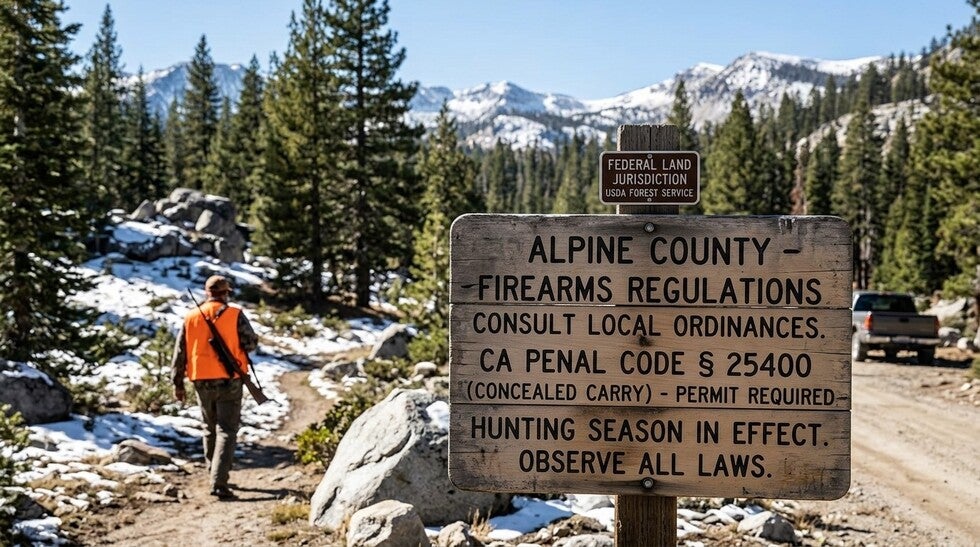
Weapons Charges in Alpine County often begin with a traffic stop on Highway 89, a hunting-season contact near Highway 4, a search near a campground, a vehicle stop after leaving a trailhead, or a firearm discovered during a law enforcement encounter on public land. Under Penal Code § 25400, California generally prohibits carrying a concealed firearm capable of being concealed on the person, including a concealed handgun in a vehicle, unless a lawful exception applies.
Alpine County cases require careful analysis because the county is rural, mountainous, and heavily shaped by hunting, recreation, national forest access, and small-community realities. A firearm that may be lawful in one setting can create criminal exposure in another. The defense must examine the firearm type, whether it was loaded, where it was stored, whether it was concealed, the reason for the stop, whether the contact occurred on a public road or public land, and whether the accused has any prior conviction that affects firearm rights.
What Weapons Charges in Alpine County mean under PC § 25400
Penal Code § 25400 is mainly a concealed firearm statute. In vehicle cases, it often involves a handgun found under a seat, in a center console, in a glove box, inside a backpack, in a door pocket, or otherwise concealed in a place connected to the driver or passenger.
For many ordinary firearm owners transporting a handgun in California, the safest legal approach is to keep the firearm unloaded and locked in the trunk or in a locked container other than the glove compartment or utility compartment. Long guns, hunting firearms, assault weapons, and other items can involve different rules, so the defense should not assume every weapons case is governed by the same statute.
A defense to PC § 25400 may involve lawful transport, lack of concealment, lack of knowledge, lack of control, an invalid stop, an unlawful search, or an exception that applies to the specific facts. A person facing criminal charges in Alpine County should have the case reviewed before making statements about ownership, storage, or purpose.
Weapons Charges in Alpine County during hunting season
Hunting season can create weapons cases on Highway 89, Highway 4, mountain roads, camp areas, trailheads, and routes connected to public land. A valid hunting license and lawful hunting purpose are important, but they do not excuse every transport, loaded-firearm, concealment, or prohibited-person issue.
PC § 25400 may not be the correct statute for every hunting firearm case because rifles and shotguns are not usually treated the same as concealable handguns. A hunting-related case may instead involve loaded firearm allegations, Fish and Game Code issues, unsafe discharge, possession in a restricted area, transportation rules, or a location-specific violation.
Helpful hunting-season evidence may include:
- Current hunting license and tags.
- Maps showing the hunting area and route.
- Proof of camp, trailhead, or lawful destination.
- Photos showing how the firearm was stored.
- Evidence that the firearm was unloaded before travel.
- Witnesses who saw the firearm's condition and location.
- Bodycam, dashcam, or citation details showing where the contact occurred.
Good-faith hunting context may support reduction, dismissal, or a more favorable resolution, but the defense still needs a statute-specific legal challenge.
Highway 89, Highway 4, and stop challenges
Many Alpine County weapons cases begin as traffic stops. On mountain roads, officers may cite speeding, unsafe lane movement, equipment violations, registration issues, suspected DUI, or driving behavior near trailheads and campgrounds. The prosecution must still rely on a lawful stop and lawful search.
The defense should ask:
- What Vehicle Code violation justified the stop?
- Did dashcam or bodycam footage match the report?
- Was the detention extended without lawful justification?
- Did the driver or passenger consent to a search?
- Was consent voluntary or the product of pressure?
- Was the firearm in plain view or found during a deeper search?
- Who had access to the place where the firearm was found?
If officers unlawfully stopped the vehicle, prolonged the detention, or searched without a valid legal basis, the defense may seek suppression of the firearm and any statements connected to it.
Federal land jurisdiction and national forest firearm rules
Alpine County includes large areas of public land, including national forest territory and recreation areas. Federal land can add another layer of analysis, but it does not mean state law disappears. Firearm possession on national forest land can be affected by federal regulations, state firearms law, state hunting law, posted closures, campsite rules, fire restrictions, discharge restrictions, and the specific purpose of possession.
A lawful hunting or recreational purpose can matter, but the exact location matters more. A person walking in a lawful hunting area may face a different analysis than a person driving on a California public road, entering a restricted facility, carrying a concealed handgun in a vehicle, or possessing a firearm while legally prohibited.
The defense should determine:
- The exact GPS location of the contact.
- Whether the location was federal, state, county, private, or mixed-use land.
- Which agency made the stop or search.
- Whether the case was cited into state court or federal court.
- Whether any posted restriction, closure, or special regulation applied.
- Whether the alleged violation involved possession, concealment, loaded status, discharge, or prohibited-person status.
Federal land issues should be analyzed early because they can affect the court, prosecutor, procedure, plea options, and sentencing exposure.
Lautenberg risk and prior domestic violence convictions
Federal firearms law can prohibit possession of firearms or ammunition by a person convicted of a qualifying misdemeanor crime of domestic violence. This is often called a Lautenberg issue. It can arise even when the current state charge is only a California weapons case.
Not every old domestic violence-related conviction automatically qualifies. The defense must review the exact statute, relationship element, plea record, factual basis, use or attempted use of force, counsel history, and whether any later legal action changed the conviction's effect. A person should not assume either that they are prohibited or that they are safe without reviewing the record.
In a small county, prior history may be known socially, but federal firearm status is a legal question. A person with any prior domestic violence case should not make statements about firearm possession, ammunition, ownership, hunting use, or past convictions without legal advice.
Other weapons, impact tools, and school grounds
Not every weapons case involves a firearm. California law also regulates certain knives, batons, impact weapons, tools, devices, and items carried in sensitive places. Some items that appear ordinary in an outdoor or work setting can become legally sensitive depending on location, intent, and statutory definition.
Some impact-weapon allegations require analysis of lawful-use exceptions. The Penal Code § 22215 exemption for impact weapons may matter when the item was connected to an authorized athletic, training, or lawful activity rather than criminal use.
School-related cases are different. A student, parent, employee, or visitor accused of bringing a prohibited item onto campus may face weapons on school grounds under PC § 626.10, even when the item was not used or displayed. School cases can also trigger discipline, employment consequences, protective orders, and probation conditions.
Correctional facilities and restricted locations
Weapons charges can become more serious when the location is sensitive. A firearm, knife, tool, ammunition, or other regulated item near a courthouse, jail, school, correctional facility, or government location may involve separate statutes and security rules.
California law treats weapons and contraband in correctional facilities under PC § 4574 differently from ordinary vehicle possession. The same object that creates a lower-level issue in one place can create major exposure if brought into or near a restricted correctional setting.
Location-based cases should be reviewed for notice, signage, intent, possession, whether the item was actually prohibited, whether the accused knowingly entered the restricted area, and whether law enforcement followed search and seizure rules.
Weapons law continuity and recodification
California weapons statutes have been reorganized over time. Older police reports, plea forms, probation documents, and criminal history records may refer to former code sections or older language. That can create confusion when deciding whether a prior conviction counts, whether a statute changed substance, or whether only the numbering changed.
The rules involving weapons-law continuity under Penal Code § 16010 can help clarify how older and newer weapons statutes relate to each other. This matters when prosecutors rely on prior convictions, old dispositions, or outdated statutory labels to increase current exposure.
Defense counsel should compare the old statute, the current statute, the plea record, and the charged conduct before accepting the prosecution's characterization of a prior weapons case.
How Alpine County compares with other weapons courts
California weapons law is statewide, but county context matters. Alpine County cases may involve hunting routes, public land, mountain-road stops, seasonal visitors, small-community knowledge, and a very small court system. Those facts can affect investigation, negotiation, and mitigation.
Other California counties may present different weapons patterns. Placer County weapons cases under PC § 25400 may involve Tahoe travel, suburban stops, and larger court calendars. Madera County weapons charges under PC § 25400 may involve Central Valley and Sierra access issues. San Luis Obispo County weapons cases under PC § 25400 may involve coastal, university, and rural property contexts.
An Alpine County defense should be built around the actual road, land status, firearm type, storage method, stop evidence, hunting context, and court location.
Where Weapons Charges in Alpine County are handled
State weapons cases in Alpine County are handled at the Superior Court of California, County of Alpine, located at 14777 State Route 89, Markleeville, CA 96120. Defendants should rely on court notices, attorney instructions, and official court communications for exact hearing dates, courtroom assignments, and appearance requirements.
A weapons case may involve arraignment, release conditions, firearm surrender issues, discovery, bodycam review, motions to suppress, negotiations, preliminary hearing in felony cases, and trial. If federal land or federal prohibited-person issues arise, a separate federal analysis may be necessary.
In a small county, detailed factual preparation can matter. The defense should be ready to explain the route, land status, firearm storage, lawful purpose, prior conviction history, and why the prosecution's theory does or does not fit the statute charged.
Defenses to Weapons Charges in Alpine County
Weapons defense depends on the statute, location, firearm type, and accused person's status. A strong defense may challenge the stop, the search, the possession theory, the firearm classification, or whether an exception applies.
Potential defenses include:
- Illegal stop, detention, or search.
- No knowledge that the firearm or weapon was present.
- No control over the vehicle, bag, container, or campsite area.
- The firearm was not concealed within the meaning of PC § 25400.
- The firearm was lawfully transported.
- The item was not legally a prohibited weapon.
- A hunting, employment, sport, transport, or location-specific exception applied.
- The prosecution charged the wrong statute for the item or conduct.
- The prior conviction does not create a firearm prohibition.
- Statements were obtained in violation of constitutional rights.
Depending on the facts, the defense may seek dismissal, suppression, reduction, diversion where legally available, misdemeanor treatment, or a negotiated outcome that protects employment and firearm eligibility as much as possible.
What to do after a weapons arrest in Alpine County
After a weapons arrest, do not explain ownership, purpose, storage, hunting plans, prior convictions, or firearm status without legal advice. Statements that sound harmless can decide whether prosecutors can prove knowledge, control, concealment, loaded status, or prohibited possession.
Important steps include:
- Write down the exact location of the stop or contact.
- Identify whether the contact occurred on a public road, private land, state land, or federal land.
- Preserve hunting licenses, tags, maps, range receipts, purchase records, and training documents.
- Save photos or evidence showing how the firearm was stored, if available.
- Do not move, sell, hide, or transfer firearms after a court order or police instruction.
- For prior domestic violence cases, obtain the old court records immediately.
- Do not contact witnesses to coordinate stories.
- Appear at all court dates unless counsel confirms otherwise.
Early action can protect the criminal case, employment, hunting privileges, licensing issues, and future firearm rights.
Weapons Charges in Alpine County lawyers in California
Weapons Charges in Alpine County require careful review of PC § 25400, hunting-season facts, Highway 89 and Highway 4 stop evidence, federal land jurisdiction, lawful transport, loaded-firearm allegations, school or correctional facility rules, prior conviction prohibitions, and Lautenberg risk.
Bulldog Law defends California weapons cases involving concealed firearms, hunting-related transport, public-land encounters, search challenges, restricted locations, impact weapons, prior conviction issues, and employment-sensitive outcomes. If you or a loved one is facing a weapons charge in Alpine County, legal strategy should begin before statements are made, the location is misunderstood, or the prosecution applies the wrong framework to the facts.