
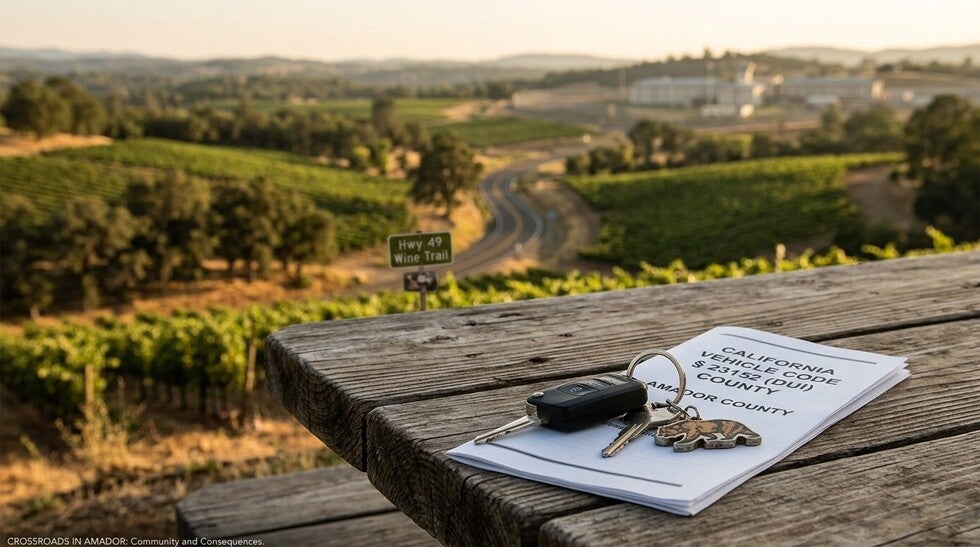
DUI in Amador County often begins with a local pattern: wine tasting along Highway 49, a Sierra recreation drive on Highway 88, an off-duty arrest involving the Mule Creek correctional officer community, or a summer boating stop on Amador County waterways. The charge may look routine at first, but a California DUI can affect driving privileges, employment, licensing, immigration status, insurance, and professional reputation.
California Vehicle Code section 23152 generally covers two common misdemeanor DUI theories. Subdivision (a) prohibits driving under the influence of alcohol, drugs, or both. Subdivision (b) prohibits driving with a blood alcohol concentration of 0.08 percent or more. Prosecutors often file both counts from the same arrest, and the defense may challenge the stop, driving evidence, field sobriety tests, chemical testing, rising BAC, and officer observations.
DUI in Amador County and the 10-day DMV deadline
A DUI arrest creates two separate tracks. The criminal case proceeds through court, while the DMV administrative per se process can affect the driver's license before the court case is finished. After a California DUI arrest, a driver generally has 10 days to request a DMV hearing to challenge the administrative suspension.
That deadline matters in every Amador County DUI case, whether the arrest happened near Plymouth wineries, on Highway 88 after a ski trip, in Jackson, near Ione, or after a boating stop. Missing the DMV deadline can limit the ability to contest the administrative suspension, even if the criminal case is still pending.
Drivers should also review how California's 2025 DUI law updates may affect license consequences, ignition interlock issues, and defense planning.
Highway 49 wine country DUI cases in Shenandoah Valley
Highway 49 runs through Jackson, Sutter Creek, Amador City, Drytown, Plymouth, and the Shenandoah Valley wine region. A common Amador County DUI fact pattern starts as a winery day with friends and ends with a CHP stop on the return drive.
Wine tasting cases often require careful BAC timing analysis. A driver may visit several wineries over four to six hours, consume tasting pours at multiple stops, eat inconsistently, and begin driving soon after the last tasting. If alcohol was still absorbing during the drive, the chemical test result may be higher than the driver's BAC at the actual time of driving.
This is often called a rising BAC defense. It does not apply in every case, and it depends on reliable facts. The defense may need to reconstruct:
- The wineries or tasting rooms visited
- The time spent at each location
- The number and size of pours consumed
- Food and water intake
- The time of the last drink
- The time of driving
- The time of the breath or blood test
- Body weight, drinking pattern, and absorption factors
Highway 49 cases also require a stop analysis. CHP or another officer must have a lawful basis for the traffic stop, such as reasonable suspicion of a specific traffic violation or impaired driving. General suspicion that a driver came from wine country is not enough by itself. If the report says there was weaving, speeding, lane drift, or another violation, the defense should compare that claim against dashcam, bodycam, dispatch records, and roadway conditions.
Mule Creek correctional officers and off-duty DUI consequences
Mule Creek State Prison is located in Ione and is a major employer in Amador County. For correctional officers and other CDCR employees, an off-duty DUI arrest can create employment concerns separate from the criminal case.
A DUI conviction does not automatically produce the same consequence in every CDCR employment matter. The result may depend on the facts, prior record, job duties, reporting obligations, whether there was an accident or injury, whether dishonesty is alleged, and whether the conduct has a sufficient connection to employment. Still, correctional officers should treat the case as both a criminal defense matter and a potential administrative matter.
For a Mule Creek correctional officer, early mistakes can make the situation worse. Statements to supervisors, investigators, co-workers, or law enforcement may affect both tracks. A defense strategy should consider the DMV hearing, the court case, potential workplace reporting rules, and any future background or peace officer eligibility issues.
When the evidence supports it, a negotiated reduction to reckless driving involving alcohol, often called a wet reckless, may carry different consequences than a DUI conviction. It is not guaranteed, and prosecutors and courts evaluate the facts before any reduction is available.
Is a DUI a criminal offense in Amador County?
Yes. A California DUI is not just a traffic ticket. Most first-time VC § 23152 cases are misdemeanors, but they are still criminal cases. A conviction can involve probation, fines and assessments, DUI education, license consequences, ignition interlock requirements or restrictions, insurance consequences, and possible jail exposure depending on the facts.
Because the case is criminal, the prosecution must prove the charge beyond a reasonable doubt. The defense may challenge the driving, the stop, the arrest, the field sobriety testing, the chemical test, the officer's training, the maintenance of testing equipment, the blood draw procedure, the timeline, and the interpretation of impairment signs.
The answer to whether a DUI is a criminal offense matters for anyone worried about employment, licensing, background checks, professional discipline, or immigration consequences.
DUI diversion and wet reckless issues in California
Many people charged with misdemeanors ask whether diversion can keep the case from becoming a conviction. DUI cases are different. California Vehicle Code section 23640 generally bars diversion for DUI offenses, and appellate courts have held that ordinary misdemeanor judicial diversion does not override that DUI-specific restriction.
That does not mean every DUI case has only one possible outcome. Depending on the facts, the defense may pursue dismissal, suppression of evidence, reduction to a non-DUI offense, wet reckless, dry reckless, or another negotiated result. But clients should be cautious about assuming that ordinary misdemeanor diversion is available simply because the case is a first offense.
For context, California DUI diversion programs and legal rights remain a frequent source of confusion because general misdemeanor diversion rules do not always apply to DUI charges. The practical effect of California DUI diversion rulings should be reviewed before making assumptions about eligibility.
Highway 88 Sierra recreation corridor DUI cases
Highway 88 carries traffic between Jackson, Pine Grove, Pioneer, Kirkwood, and the Sierra recreation corridor. Weekend visitors may drive through Amador County after skiing, snowboarding, dining, or drinking at mountain or roadside establishments.
These cases can involve facts that overlap with impairment signs. Cold weather, fatigue, dehydration, altitude exposure, ski exertion, and long driving distances may affect balance, coordination, speech, appearance, and performance on field sobriety tests. Those facts do not excuse impaired driving, but they may provide context for officer observations.
Field sobriety tests also depend on where and how they were administered. A shoulder on Highway 88, winter conditions, uneven pavement, poor lighting, boots, fatigue, traffic noise, and weather can all affect performance. The defense should compare the officer's written observations against video, location conditions, and the actual instructions given.
Cosumnes River and boating under the influence cases
Some Amador County alcohol-related arrests involve boating or water recreation rather than ordinary roadway driving. California Harbors and Navigation Code section 655 prohibits operating certain vessels while under the influence or with a prohibited BAC.
A boating under the influence case is a criminal matter, but it should not be described as identical to a roadway DUI in every respect. The penalties, licensing effects, priorability, and procedures may differ depending on the specific charge, the facts, whether anyone was injured, and the defendant's prior history.
Summer boating cases often involve physical conditions that should be documented early, including sun exposure, dehydration, swimming, fatigue, heat, motion on the water, and the timing of alcohol consumption. Those facts may affect how impairment observations are interpreted.
DUI injury and prior conviction exposure
A simple DUI becomes more serious if another person is injured. Vehicle Code section 23153 covers DUI causing injury, and those cases may be charged as misdemeanors or felonies depending on the facts, injuries, prior history, and alleged driving conduct.
Prior convictions can also increase punishment and license consequences. A prior DUI, wet reckless, DUI injury case, or qualifying boating under the influence conviction within the lookback period may affect sentencing and DMV consequences.
When a case involves injury plus prior DUI history, Vehicle Code 23560 and DUI injury with prior convictions can become important to understanding the possible sentencing range and defense priorities.
How DUI cases are handled at Amador County Superior Court
Amador County DUI cases are handled at the Superior Court of California, County of Amador, located at 500 Argonaut Lane, Jackson, CA 95642. This is a neutral public courthouse. Bulldog Law is not affiliated with, endorsed by, partnered with, or specially connected to the court, CHP, CDCR, the DMV, the district attorney, law enforcement, or any government agency.
A misdemeanor DUI case typically begins with an arraignment. At arraignment, the court advises the defendant of the charge, addresses counsel, receives a plea, and sets future dates. Later proceedings may include discovery, DMV coordination, motion practice, negotiation, readiness conferences, trial, and sentencing if there is a conviction or plea.
In felony DUI or DUI injury cases, the process may include a preliminary hearing where the prosecution must present enough evidence for the case to proceed. The defense may use that hearing to test driving evidence, injury causation, officer observations, chemical testing, and witness credibility.
Clients should expect the court case and DMV case to move on different tracks. Winning one does not automatically win the other, but evidence developed in one forum may affect strategy in the other.
What to do after a DUI arrest in Amador County
Early action can preserve defenses. A driver should avoid discussing the facts with officers, employers, supervisors, insurance representatives, or witnesses without legal advice.
- Request the DMV hearing within the 10-day deadline.
- Save the pink temporary license and all arrest paperwork.
- Write down the exact stop location on Highway 49, Highway 88, or another roadway.
- Document the time of driving, time of last drink, and time of chemical testing.
- For wine country cases, list every winery, tasting pour, meal, and time period.
- For Highway 88 cases, document altitude, fatigue, weather, road conditions, footwear, and field sobriety test location.
- For Mule Creek correctional officers, get legal advice before making workplace statements about the arrest.
- For boating cases, document sun exposure, water activity, fatigue, and all alcohol timing.
The strongest DUI defense often starts with details that seem ordinary at first: a tasting receipt, a dinner bill, a ride timeline, a dashcam angle, an uneven shoulder, or a breath-test maintenance issue.
DUI in Amador County lawyers in California
Bulldog Law defends clients facing DUI charges in Amador County and throughout California. The firm handles Highway 49 wine country DUI cases, Highway 88 recreation corridor arrests, Mule Creek correctional officer cases, DMV hearings, rising BAC defenses, chemical test challenges, wet reckless negotiations, and DUI injury exposure.
A DUI arrest in Amador County can affect your license, job, record, and future. The most important step is to protect the DMV deadline, preserve evidence, and build a defense around the specific facts of the stop, arrest, testing, and local court process. Call Bulldog Law at (888) 928-1609 to discuss the next steps after an Amador County DUI arrest.