
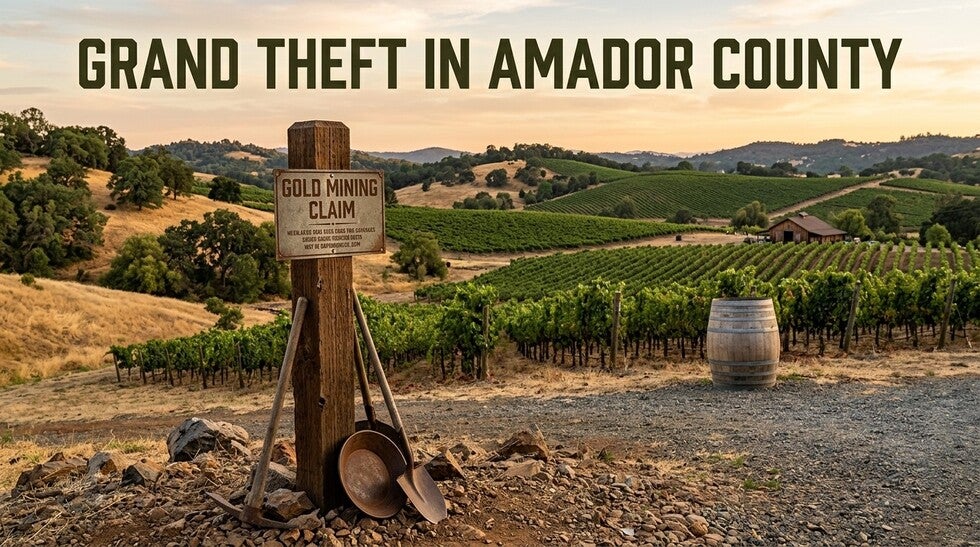
Grand Theft in Amador County can arise from allegations involving wine grapes in Plymouth's Shenandoah Valley, ranch equipment, cattle, vehicles, catalytic converters, employer property, wage disputes, identity documents, or mining activity along the historic Mother Lode. Under Penal Code § 487, the difference between felony exposure and a lower-level theft case often turns on value, intent, property type, prior record, and whether the accused had a good-faith belief in a right to the property.
Amador County theft cases are highly fact-specific. A grower may estimate loss based on finished wine revenue, while California theft law focuses on the value of the property taken. A rancher may describe cattle loss using retail beef value, while the defense may need livestock market evidence. A mining dispute may look like theft in a police report but actually turn on a disputed claim boundary, old permission, or a good-faith ownership belief. The defense should begin with valuation, intent, and authorization.
What Grand Theft in Amador County means under PC § 487
Grand theft generally applies when the value of money, labor, real property, or personal property taken exceeds $950. But California law includes special rules. Theft of certain farm crops, including fruits and other agricultural products, can be grand theft when the value exceeds $250. Theft of a firearm or automobile can also be grand theft regardless of whether the ordinary $950 threshold is met.
Prosecutors may charge grand theft based on:
- Property valued at more than $950.
- Qualifying farm crops valued at more than $250.
- Theft of a vehicle or firearm.
- Employee theft from an employer aggregating $950 or more in a 12-month period.
- Theft from the person of another.
- Special statutes involving repeat theft, vehicle theft, wage theft, or identity theft.
County-specific theft defense matters because the evidence depends on the local economy. Tehama County grand theft cases may involve ranching, equipment, and rural property disputes, while Sacramento County grand theft cases may involve urban retail, government, employment, or financial allegations. Amador County requires a defense built around vineyards, mining, ranching, small businesses, and local property relationships.
Grand Theft in Amador County and fair market value
Value is often the first battleground. California theft valuation generally focuses on fair market value at the time and place of the taking. That is not always replacement cost, sentimental value, retail markup, future revenue, or what the owner paid years earlier.
Defense valuation may challenge:
- Inflated owner estimates.
- Replacement cost instead of used market value.
- Retail wine pricing instead of grape commodity pricing.
- Retail beef pricing instead of livestock auction value.
- New equipment pricing instead of depreciated used value.
- Speculative future profits.
- Aggregated values that do not legally belong together.
A reduction in value can change the charge, negotiation posture, immigration analysis, restitution demand, and whether the case remains a felony. In some cases, value evidence can be the difference between grand theft and petty theft.
CDFA wine grape pricing and Shenandoah Valley theft allegations
Plymouth's Shenandoah Valley wine region can produce theft allegations involving grapes, vineyard equipment, barrels, tools, irrigation equipment, vehicles, or winery records. When the allegation involves wine grapes, the valuation should focus on the grapes as agricultural property, not the retail price of bottled wine that might have been produced later.
Published wine grape pricing data, varietal, crop year, region, quality, harvest status, and contract terms may all matter. Zinfandel, Barbera, Sangiovese, and other Amador County varietals may have different values. A grower's projected finished-wine revenue may substantially overstate the fair market value of grapes at the time they were allegedly taken.
Defense evidence may include:
- Current grape pricing reports.
- Varietal and tonnage evidence.
- Harvest records.
- Buyer contracts and invoices.
- Quality, disease, smoke, or weather issues.
- Labor and transportation costs.
- Whether the crop was actually taken, damaged, or miscounted.
The agricultural threshold also matters. Because certain farm crops can qualify as grand theft above $250, the defense should not assume the ordinary $950 threshold controls every vineyard case.
Gold mining claim defense and claim of right
Amador County's Mother Lode history still produces disputes involving placer claims, hard-rock mining sites, recreational prospecting, equipment, gold recovery, access roads, tailings, water use, and boundary lines. These cases can be complicated because criminal theft requires more than a disagreement over who had the better property right.
A good-faith claim of right can negate theft intent when the accused genuinely believed they had a lawful right to the property or activity. The belief does not have to be legally correct in every detail, but it must be sincere and factually supported. A person cannot simply invent a claim after being arrested.
In mining-related cases, defense evidence may include:
- BLM mining claim records.
- County property and assessor records.
- Maps, GPS data, and claim boundaries.
- Historical access agreements.
- Partnership or permission records.
- Prior mining practices.
- Communications about who could enter or mine the area.
- Equipment ownership documents.
If the dispute is really about claim boundaries, partnership rights, or permission, the case may belong in civil litigation rather than criminal court. The defense should develop the property history before the prosecution's theft theory becomes fixed.
Cattle, ranch equipment, and rural property valuation
Ranching cases can involve cattle, trailers, tools, irrigation materials, fencing, hay, feed, ATVs, generators, fuel, and equipment. Valuation must be tied to the actual property taken. A used trailer is not valued as a new trailer. Cattle should be evaluated by age, weight, condition, market category, and livestock market evidence, not retail beef prices.
Rural ownership disputes may also involve shared equipment, informal family arrangements, grazing agreements, fence-line confusion, inherited property, or borrowed tools. Those facts can affect both value and intent.
Defense questions include:
- Who owned the property?
- Who had permission to use it?
- Was there a business, family, or ranching arrangement?
- Was the value independently verified?
- Was the property recovered?
- Was the alleged taking permanent or temporary?
- Was the accusation based on a civil dispute?
Vehicle theft, enhanced theft, and prior convictions
Vehicle-related theft can carry consequences beyond ordinary grand theft. California has enhanced punishment rules for certain repeat vehicle-theft cases. A person with a prior felony vehicle theft-related conviction may face enhanced exposure if later convicted of a qualifying vehicle theft offense.
Defense involving enhanced vehicle theft charges should examine whether the prior conviction legally qualifies, whether the current offense is one of the covered offenses, whether the prosecution can prove the prior record, and whether the facts support unlawful taking, joyriding, receipt of stolen property, or a lesser theory.
Vehicle cases may also involve catalytic converters, trailers, ranch trucks, construction equipment, winery vehicles, ATVs, or borrowed vehicles. The defense should evaluate consent, ownership, title, possession, intent to permanently deprive, and whether the alleged victim authorized use.
Petty theft with priors and repeat theft allegations
Not every theft case overcharged as serious begins with high value. California law now includes enhanced treatment for some repeat petty theft or shoplifting cases when the person has qualifying prior theft-related convictions. That means a lower-value theft allegation can become much more serious if the prosecution alleges prior convictions.
A defense involving enhanced petty theft charges should begin by challenging both the current theft allegation and the prior conviction proof. The defense should verify certified records, identity, dates, qualifying offenses, and whether the alleged current conduct was actually theft or shoplifting.
Repeat theft allegations can also be reduced through restitution, treatment, mitigation, mental health evidence, substance use treatment, civil compromise where legally available, or negotiated outcomes that avoid felony treatment when the facts support it.
Identity theft and federal exposure
Some Amador County theft cases involve checks, credit cards, payroll records, account access, forged documents, online orders, tax information, government benefits, or employer data. These facts may create identity theft exposure under state law, and some cases can trigger federal attention if federal documents, banks, mail, wire communications, or government programs are involved.
When identity documents are involved, federal identity theft charges can carry severe consequences, including mandatory consecutive sentencing in aggravated identity theft cases. The defense should evaluate whether the accused knowingly used another person's identifying information, whether the identity evidence was accurate, and whether federal jurisdiction is realistic or only a threat used in negotiation.
Digital and document evidence should be preserved. Phones, computers, login records, payroll systems, bank records, and IP data can help show whether the accused actually committed the conduct or whether someone else had access.
Wage theft and employer defense
California can treat intentional wage theft as grand theft when statutory thresholds are met. Penal Code § 487m focuses on intentional deprivation of wages, gratuities, benefits, or other compensation by unlawful means, with knowledge that the compensation was due. It can apply when more than $950 is taken from one employee, or more than $2,350 in the aggregate from two or more employees, during a consecutive 12-month period.
Employer defense involving criminal wage theft charges should separate intentional theft from payroll error, classification disputes, overtime misunderstandings, cash-flow problems, recordkeeping failures, or civil employment disputes. Not every wage dispute is a crime.
Important evidence may include:
- Payroll records.
- Timecards and schedules.
- Pay stubs and bank records.
- Employee classification documents.
- Written wage agreements.
- Communications about disputed hours.
- Corrective payments or restitution efforts.
Because wage theft cases can involve employees, civil agencies, prosecutors, and public reputation, the defense should be coordinated before the employer makes statements or produces records without legal review.
Where Grand Theft in Amador County cases are handled
Grand theft cases in Amador County are generally handled at the Superior Court of California, County of Amador, located at 500 Argonaut Lane, Jackson, CA 95642. Defendants should follow court notices, attorney instructions, and official court communications for hearing dates, courtroom assignments, and appearance requirements.
A PC § 487 case may involve arraignment, release conditions, discovery, valuation records, search warrant review, witness statements, business records, restitution documentation, motions, preliminary hearing in felony cases, negotiations, trial readiness, and trial.
The early stages matter. If prosecutors accept an inflated value estimate, a civil dispute may begin looking like a felony theft case. The defense should challenge value, intent, ownership, and authorization before those assumptions control the case.
Defenses to Grand Theft in Amador County charges
Grand theft defense depends on the property, value, intent, and relationship between the parties. The best defense may be a valuation challenge, a claim of right, mistaken ownership, lack of intent, consent, identity dispute, or proof that the case is civil rather than criminal.
Potential defenses include:
- The property was worth less than the felony threshold.
- The prosecution used the wrong valuation method.
- The accused had a good-faith claim of right.
- The accused had permission or believed permission existed.
- The accused did not intend to permanently deprive the owner.
- The property was borrowed, shared, or disputed.
- The accused was misidentified.
- Business records do not prove theft.
- The search or seizure was unlawful.
- The matter is a civil dispute, not a crime.
In wobbler cases, the defense may also seek misdemeanor treatment under PC § 17(b), restitution-based resolution, diversion where legally available, reduction to petty theft, or dismissal when proof is weak.
What to do after a grand theft arrest in Amador County
After a grand theft arrest or investigation, do not explain the property, value, permission, or business relationship without legal advice. Statements about “borrowing,” “paying it back,” or “thinking it was mine” can help or hurt depending on the context, and they should not be made casually.
Important steps include:
- Preserve receipts, invoices, contracts, texts, emails, and business records.
- Do not delete financial records, payroll records, messages, or location data.
- Identify who had access to the property or account.
- Document permission, ownership history, or claim-of-right evidence.
- For vineyard cases, preserve grape-pricing, harvest, and contract records.
- For mining cases, preserve claim filings, maps, and access records.
- For employment cases, preserve payroll and timekeeping records.
- For noncitizens, get immigration-aware criminal defense before any plea.
Early defense work can protect valuation arguments, prevent damaging statements, support restitution discussions, and reduce the risk that a disputed property issue becomes a felony conviction.
Grand Theft in Amador County lawyers in California
Grand Theft in Amador County requires careful review of PC § 487, agricultural valuation, CDFA wine grape pricing, livestock market evidence, Mother Lode mining claim disputes, vehicle theft enhancements, wage theft allegations, identity theft exposure, restitution, and felony reduction strategy.
Bulldog Law defends California theft cases involving vineyards, ranching property, mining claims, vehicles, employer property, wage disputes, identity allegations, search issues, valuation disputes, claim-of-right defenses, and trial strategy. If you or your business is facing a grand theft investigation in Amador County, legal defense should begin before value is inflated, intent is misunderstood, or a civil dispute is treated as a felony theft case.