
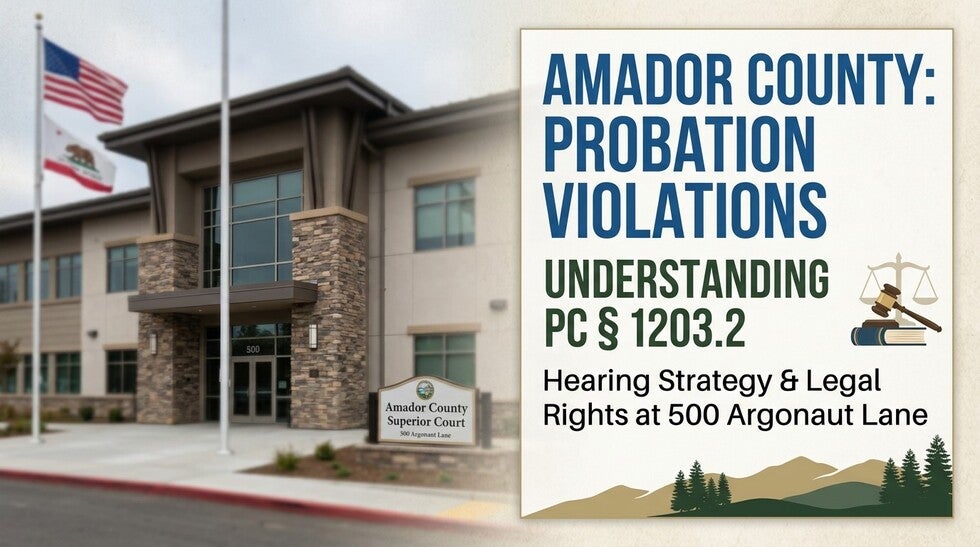
Probation Violations in Amador County can put a person's freedom, job, family stability, immigration status, and future record at risk. Under California Penal Code § 1203.2, the court may revoke, modify, or reinstate probation when it finds that a person violated probation terms. The outcome depends on the alleged violation, the evidence, the person's overall probation performance, and the defense strategy presented at the hearing.
A probation violation is not handled like a new criminal trial. The burden of proof is lower, the court may consider evidence differently, and the judge has broad options. That makes preparation critical. The defense should not focus only on whether a violation technically occurred. It should also focus on why it happened, whether probation can still succeed, and why reinstatement or modified terms serve justice better than custody.
What Probation Violations in Amador County require under PC § 1203.2
Penal Code § 1203.2 allows the court to act when there is reason to believe a person violated probation, committed a new offense, abandoned court-ordered supervision, or failed to comply with required terms. The court may summarily revoke probation pending a hearing, issue a warrant, remand the person, or set further proceedings.
At the violation hearing, the prosecution does not need to prove the violation beyond a reasonable doubt. Probation violations are generally decided under a preponderance of the evidence standard, meaning the court asks whether the violation more likely than not occurred. That lower standard is one reason a violation hearing can be dangerous even when the evidence would be weak in a new criminal trial.
Common allegations include:
- Missing a probation appointment
- Failing a drug or alcohol test
- Not completing community service
- Not enrolling in or completing treatment
- Failing to pay restitution, fines, or fees when able
- Leaving the county or state without permission
- Contacting a protected person
- Possessing weapons, drugs, or alcohol when prohibited
- Being arrested for a new criminal offense
Bulldog Law's discussion of probation violations and Penal Code § 1203.3 explains why probation modification, revocation, and early termination issues often overlap.
Probation Violations in Amador County and technical violations
A technical violation is a violation of a probation condition without a new criminal offense. Examples include a missed appointment, late paperwork, unpaid restitution, missed treatment, or a failed test. These cases are not minor automatically, but they can often be defended through context and mitigation.
The defense should ask why the violation happened. A missed appointment may involve transportation problems, work conflict, medical issues, family emergency, homelessness, language barriers, or confusion about reporting instructions. A failed test may require review of lab reliability, medication, timing, and whether treatment modification is more appropriate than punishment.
Useful mitigation evidence can include:
- Proof of employment
- Pay stubs and work schedules
- Treatment records
- Medical records
- Drug testing history
- Community service records
- Restitution payment receipts
- Family support letters
- Transportation or housing documentation
The goal may be dismissal of the violation, reinstatement on the same terms, or reinstatement with modified conditions that the person can actually complete.
New offense violations and the risk of full revocation
A new offense violation is more serious because it alleges that the person committed new criminal conduct while on probation. The court can find a probation violation even before the new case is resolved, depending on the evidence presented at the violation hearing. That creates strategic pressure because the defense may need to protect both the probation case and the new criminal case at the same time.
A rushed admission can damage the new case. A statement made to a probation officer, investigator, or judge can become evidence elsewhere. Defense counsel should coordinate the strategy before the client gives explanations about the new allegation.
The defense may need to:
- Challenge the evidence supporting the new allegation.
- Protect the client's right against self-incrimination.
- Seek to trail the violation hearing behind the new case when appropriate.
- Preserve objections to police reports, hearsay, and unreliable evidence.
- Build a disposition argument for reinstatement even if the court finds a violation.
When the person has otherwise done well on probation, the defense should present the full record of compliance, not just the new arrest report.
Where probation violation hearings happen in Amador County
Amador County criminal matters are handled at the Superior Court of California, County of Amador, located at 500 Argonaut Lane, Jackson, CA 95642. Defendants should rely on the court notice, attorney instructions, and official court calendar for exact hearing dates and appearance requirements.
A probation violation case may involve arraignment on the violation, custody or release arguments, discovery, probation reports, evidentiary hearing, disposition hearing, and possible modification of terms. If the person is in custody, the defense should address release, treatment placement, work impact, family obligations, and whether a less restrictive response can protect the court's interests.
The judge may dismiss the violation, reinstate probation, modify probation, impose a short custody sanction, order treatment, extend or adjust supervision where legally allowed, or revoke probation and impose a suspended sentence. The exact options depend on the original sentence, offense, statutory limits, probation terms, and record.
Disposition advocacy at 500 Argonaut Lane
In many probation violation cases, the most important work is disposition advocacy. Even when the court finds a violation, the defense can argue that continued probation is the right outcome. The court may be more willing to reinstate probation when the defense shows accountability, progress, and a concrete plan to prevent future problems.
A strong disposition plan may include:
- Immediate reengagement with probation
- Treatment enrollment or increased treatment
- Testing schedule changes
- Restitution payment plan
- Employment verification
- Transportation plan
- Housing stability
- Family supervision or support
- Community service completion timeline
The defense should give the court a practical alternative to revocation. Judges need confidence that probation will work if reinstated. A vague promise to “do better” is weaker than a documented plan with dates, providers, and accountability.
Mule Creek correctional officers and employment consequences
Amador County probation violations can carry special consequences for correctional officers, peace officers, and employees connected to Mule Creek State Prison or other public safety work. A violation that results in custody, new criminal conduct, dishonesty findings, or additional restrictions can affect employment, administrative review, peace officer credibility, and future licensing or certification.
A correctional officer should not discuss the facts of the alleged violation with supervisors, investigators, coworkers, or internal affairs without legal advice. The criminal case and employment process can affect each other. A statement meant to protect a job can harm the violation hearing or a new criminal case.
The defense strategy should account for both tracks. The best outcome may be reinstatement with realistic modified terms that preserve employment while satisfying the court's concerns.
Plymouth H-2A workers, noncitizens, and immigration risk
For H-2A workers, DACA recipients, lawful permanent residents, and other noncitizens in Amador County, probation violations can create immigration concerns. A technical violation may extend supervision or complicate applications. A new offense violation can create immigration consequences based on the new charge, plea, sentence, and record of conviction.
No noncitizen should admit a violation, accept modified terms, or plead to a new offense without immigration-aware criminal defense advice. Even a misdemeanor or probation admission can create problems depending on the underlying offense, immigration status, and future applications.
For noncitizens, the defense should focus on avoiding unnecessary admissions, limiting harmful record language, preserving eligibility for relief where possible, and coordinating with immigration counsel when needed.
DUI probation violations and 0.01 percent allegations
DUI probation carries special conditions. A person on DUI probation may be prohibited from driving with any measurable alcohol in their system, refusing chemical testing, driving without valid licensing, or committing new alcohol-related driving violations. These conditions can trigger both DMV and criminal court consequences.
A driver accused of violating DUI probation should understand DUI probation and the 0.01 percent rule under Vehicle Code § 23154. If the original case involved DUI sentencing terms, DUI sentencing and probation under Vehicle Code § 23600 can help explain why alcohol education, testing, license compliance, and probation conditions must be reviewed carefully.
The defense may challenge the stop, test result, timing of alcohol absorption, probation notice, chemical testing procedure, or whether the alleged conduct actually violated a valid term.
Domestic violence probation terms and no-contact allegations
Domestic violence probation can include mandatory terms, counseling, protective orders, firearm restrictions, restitution, stay-away orders, and reporting requirements. A violation may be alleged if the person misses a program session, contacts a protected person, violates a restraining order, fails to surrender firearms, or commits a new offense.
Protective order violations are especially risky. A defendant can violate an order even if the protected person initiates contact, unless the court modifies the order. The safest response is to follow the written order until a judge changes it.
California domestic violence probation terms require careful analysis, and People v. Forester and Penal Code § 1203.097 domestic violence probation issues show why probation conditions must be reviewed for statutory authority, clarity, and enforceability.
Probation bars, firearm enhancements, and great bodily injury cases
Not every defendant is eligible for probation in the same way. Some offenses and enhancements can limit or bar probation unless specific legal findings are made. This matters both at sentencing and during a violation, because a person who received probation despite serious allegations may face harsher consequences if the court later finds noncompliance.
Great bodily injury allegations can affect probation eligibility, and Penal Code § 1203.075 great bodily injury probation bars should be reviewed when injury enhancements were part of the original case. Firearm use or firearm enhancement allegations can also restrict probation options, making Penal Code § 1203.06 firearm enhancement probation bars important in cases involving weapons.
If the original case involved a probation limitation, the violation defense must be realistic. The court may have fewer options, and the defense should focus on preserving any lawful path to reinstatement or avoiding the most severe consequence.
Juvenile DEJ probation and young clients
Young clients may face probation-like conditions through juvenile court, deferred entry of judgment, or informal supervision. These cases are different from adult probation, but the same practical lesson applies: missed terms can affect the outcome and future record.
Families should understand Welfare and Institutions Code § 794 DEJ probation conditions before a young person admits a violation or gives statements to probation, school officials, or law enforcement.
For juveniles, the defense should emphasize rehabilitation, school progress, treatment, family structure, and record protection. A violation should not be allowed to define a young person's future without careful review.
Probation, parole, and why the difference matters
Probation and parole are not the same. Probation is typically ordered by the court as part of sentencing and is supervised under court authority. Parole generally follows release from prison and is supervised through a different system. The violation procedures, decision makers, custody exposure, and defense strategy can differ.
People often use the words interchangeably, but that can create confusion when trying to understand rights and consequences. Bulldog Law's explanation of how parole and probation differ helps clarify why a probation violation at 500 Argonaut Lane is not handled the same way as a parole violation.
Early termination and modification of probation
Not every probation issue begins with a violation. Some clients may qualify to ask for early termination or modification under Penal Code § 1203.3 after sustained compliance. Early termination may help with employment, licensing, travel, immigration planning, and later record relief, depending on the case.
A person with a strong compliance record should consider whether a proactive motion is available before a small problem becomes a violation. The court may consider good conduct, reform, completion of programs, restitution, time served on probation, and the interests of justice.
Modification may also be appropriate when a condition is unrealistic or interfering with work, medical care, family obligations, transportation, or treatment. The correct approach is to ask the court to change the condition, not to violate it and explain later.
What to do after Probation Violations in Amador County
After receiving a violation notice, do not make statements about the alleged violation to probation, police, prosecutors, employers, or investigators without legal advice. A person may think they are explaining a mistake, but those statements can become admissions.
Practical steps include:
- Save all probation paperwork, court notices, and violation reports.
- Preserve records of reporting, treatment, testing, community service, and restitution.
- Write down dates, times, and reasons for any alleged noncompliance.
- Identify witnesses who can verify work, transportation, medical, or family issues.
- Do not contact protected persons if any order restricts contact.
- Do not miss the violation hearing.
- For noncitizens, get immigration-aware advice before any admission.
- For correctional officers or licensed workers, get advice before workplace statements.
The defense should begin before the hearing, not at the podium. The court needs evidence, not excuses.
Probation Violations in Amador County lawyers in California
Probation Violations in Amador County require a strategy built for the lower burden of proof, the judge's broad discretion, and the real consequences of revocation. PC § 1203.2 hearings can affect custody, employment, immigration, treatment, family stability, and future record relief.
Bulldog Law defends California probation violation cases with attention to factual challenges, technical violations, new offense allegations, DUI probation, domestic violence terms, probation bars, early termination, and disposition advocacy. If you or a loved one faces a probation violation at 500 Argonaut Lane in Jackson, defense work should begin before statements are made, records disappear, or the court sees only the probation report.