
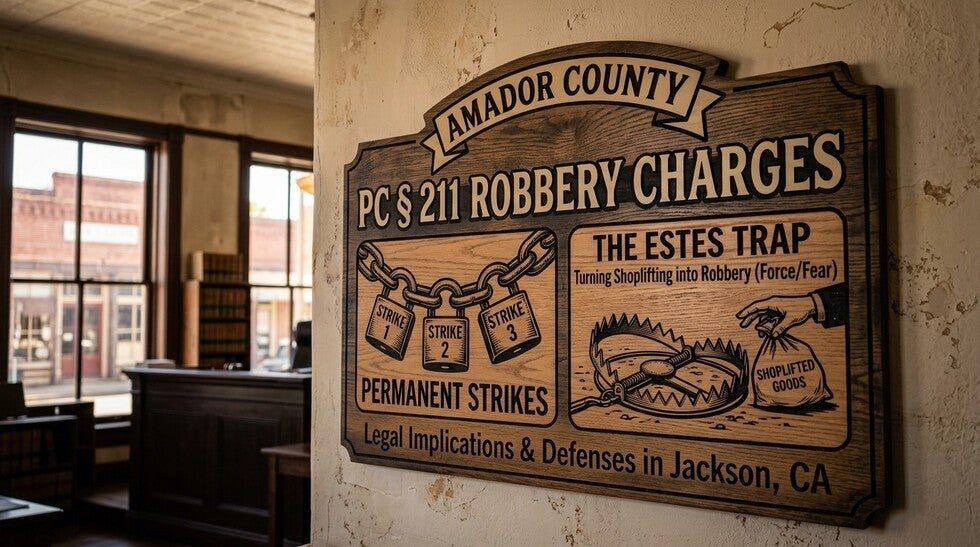
Robbery Charges in Amador County are felony cases with consequences that can reach far beyond jail or prison exposure. A PC § 211 conviction can create a California strike, limit custody credits, affect immigration status, threaten peace officer employment, and turn a low-value retail theft allegation into a life-changing prosecution if force or fear is alleged.
California robbery is defined as the felonious taking of personal property from another person or that person's immediate presence, against the person's will, accomplished by force or fear. That force-or-fear element is often the center of the defense, especially in Jackson retail cases where a shoplifting accusation escalates after contact with a store employee or loss prevention worker.
Robbery Charges in Amador County under Penal Code 211
Robbery is not a Proposition 47 petty theft reduction offense. It is also not a wobbler that can simply be charged as either a felony or misdemeanor at the outset. A robbery charge under PC § 211 is a felony, and the defense usually focuses on whether the prosecution can actually prove every robbery element rather than only prove a theft.
That distinction matters. A theft case may involve property value, intent to steal, store policies, or mistaken possession. Robbery adds the requirement that the taking was accomplished by force or fear. In many cases, that is the difference between a misdemeanor shoplifting outcome and a strike felony. Bulldog Law's comparison of burglary and robbery charges helps explain why the presence of a person, immediate presence, and force-or-fear allegations change the legal analysis.
Potential robbery penalties depend on degree and facts. First degree robbery can apply to robberies involving an inhabited dwelling, certain public transportation settings, or ATM-related circumstances. If a first degree residential robbery is committed while voluntarily acting in concert with two or more other people, the triad is three, six, or nine years in state prison. Other first degree robbery cases generally carry three, four, or six years. Second degree robbery generally carries two, three, or five years.
Robbery is also listed as both a serious felony and a violent felony under California law. That means a conviction can count as a strike under the Three Strikes law. It also generally limits conduct credits to no more than 15 percent, which often means a person sentenced to custody serves far more time than in a nonviolent felony case. Sentencing should still be fact-specific, and courts may consider mitigation, record, injury, weapon allegations, restitution, and proportionality arguments. Bulldog Law's analysis of California robbery sentencing proportionality addresses why the punishment should be tied to the actual conduct, not just the label attached to the charge.
The Estes trap in Jackson retail robbery cases
An “Estes robbery” is not a separate statute. It is a term used for a shoplifting or theft allegation that becomes a robbery allegation because the prosecution claims force or fear was used to retain property or escape before the theft was complete. These cases can arise in grocery stores, pharmacies, hotels, restaurants, and other businesses serving Jackson, Sutter Creek, Ione, Plymouth, and nearby Gold Country communities.
The legal trap is that the property value may be low, but the alleged confrontation can raise the case from shoplifting to PC § 211 robbery. A shoulder turn, a step around an employee, a disputed push, a tug over a bag, or words exchanged during flight may be described in a report as force or fear. Surveillance footage may show something more ambiguous.
In an Estes case, the defense should move quickly to preserve evidence. Many retail video systems overwrite footage after a short period, sometimes within weeks. The defense should seek every available camera angle, not only the clip selected by store personnel or law enforcement. A partial view may make movement look intentional, while a wider angle may show confusion, crowding, an employee initiating contact, or no meaningful force at all.
Important defense questions include:
- Was the accused still in possession of the property when the alleged force occurred?
- Did the alleged force occur before the accused reached a place of temporary safety?
- Was there actual force or fear, or only incidental contact during movement?
- Did the employee's report match the complete surveillance record?
- Were there injuries, threats, weapons, or only a disputed physical encounter?
- Did store personnel preserve all video angles, audio, receipts, dispatch notes, and incident reports?
Robbery law is statewide, but local facts matter. A Jackson retail case may involve different evidence and witness issues than a San Jose PC 211 robbery prosecution, a San Joaquin County robbery case, a Kern County PC 211 case, or a Shasta County robbery defense. The statute is the same, but the courthouse, surveillance sources, local witnesses, and negotiation posture can be very different.
Defense issues beyond the charging document
A robbery complaint is only an accusation. The defense must test identification, intent, force, fear, property possession, and the reliability of every witness statement. In Amador County cases, identification can be especially important when the accused is a visitor, an agricultural worker, or someone unfamiliar to the reporting witness.
Eyewitness identification should be examined carefully. Stress, lighting, distance, obstructed views, brief observation time, cross-racial identification issues, suggestive show-ups, and exposure to social media or store-circulated images can all affect reliability. When surveillance is involved, authentication and clarity matter. A grainy still image is not the same as proof beyond a reasonable doubt.
Weapon allegations also change the case. A firearm, knife, replica weapon, or alleged implied weapon can influence bail, plea negotiations, sentencing exposure, and how a jury views fear. California robbery and federal robbery law do not always use the same categories, and Bulldog Law's discussion of armed and unarmed robbery distinctions explains why the weapon issue can affect punishment in different ways depending on the legal system.
Some defendants have military status, reserve obligations, or prior service. A civilian Amador County robbery case is handled in California Superior Court, but military consequences may still be relevant for a servicemember. Bulldog Law's guide to robbery accusations under military law addresses how robbery allegations can be treated in a military justice context.
Mule Creek correctional officers and peace officer career risks
Mule Creek State Prison is a major employer in Ione, and robbery allegations involving correctional officers require careful attention to both the criminal case and employment consequences. A PC § 211 conviction can be devastating for a CDCR career because a felony conviction can disqualify a person from being employed as a peace officer under Government Code section 1029.
It is important to be precise. CDCR correctional officers are treated differently from many POST-certified peace officers under California's SB 2 decertification process, and public agencies make their own employment decisions under applicable rules, contracts, and procedures. Still, a felony robbery conviction can create disqualification, internal reporting, firearm eligibility, and background consequences that may threaten continued correctional peace officer employment.
For a Mule Creek correctional officer, the defense should be coordinated from the beginning. Statements to law enforcement, store personnel, supervisors, internal investigators, or co-workers can create criminal and employment problems. The priority is often to prevent the case from becoming a robbery conviction at all by challenging force, fear, identification, intent, and the accuracy of the report.
Noncitizens, H-2A workers, and immigration consequences
Noncitizens charged with robbery need immigration-focused criminal defense before any plea is entered. This includes H-2A workers in agricultural and wine country employment, lawful permanent residents, visa holders, DACA recipients, asylum applicants, and undocumented residents with U.S. family ties.
Robbery can create serious immigration exposure. California PC § 211 robbery has been treated as a crime involving moral turpitude. It also may be treated as an aggravated felony theft offense if the sentence imposed is at least one year, even though current Ninth Circuit law has held that California robbery does not categorically qualify as a crime of violence aggravated felony under 8 U.S.C. § 1101(a)(43)(F). The exact immigration consequence depends on the record of conviction, sentence, immigration history, and current federal law.
For noncitizens, the defense goal is not only to reduce custody exposure. It is also to avoid plea language, sentence structure, and offense labels that may trigger removal, inadmissibility, or bars to relief. In a retail Estes case, defeating the force-or-fear allegation may preserve the possibility of a non-robbery resolution, depending on the facts and the prosecutor's position.
Wine country visitor defendants in Plymouth and Shenandoah Valley cases
Amador County also sees visitor cases involving people from Sacramento, the Bay Area, the Central Valley, and out of state. Wine tasting trips, hotel stays, restaurant disputes, casino visits, and retail stops can lead to allegations that a disagreement became theft, threats, or robbery.
Visitor defendants face practical problems. They may live far from Jackson, miss court notices, misunderstand local procedures, or assume the case will be handled like a traffic ticket. Robbery is different. Missing court can lead to a bench warrant, and delay can cause surveillance footage or witness details to disappear.
Early defense work should focus on gathering receipts, ride-share records, hotel records, location data, photographs, text messages, witness names, and video sources. The goal is to reconstruct what happened before memories fade and before the prosecution's version becomes the only organized narrative.
How PC 211 cases are handled at Amador County Superior Court
Felony robbery cases in Amador County are handled at the Superior Court of California, County of Amador, located at 500 Argonaut Lane, Jackson, CA 95642. Mentioning the courthouse is only for practical orientation. Bulldog Law is not affiliated with the court, the prosecutor's office, law enforcement, CDCR, or any government agency.
A robbery case may begin with arrest, booking, bail or release conditions, and arraignment. The arraignment is where the court advises the defendant of the charge, considers counsel, addresses release conditions, and sets future dates. In a felony case, later proceedings may include discovery, investigation, bail review, preliminary hearing, trial readiness conferences, motions, plea negotiations, jury trial, and sentencing if there is a conviction.
At the preliminary hearing, the prosecution must present enough evidence for a judge to determine whether there is probable cause to hold the defendant to answer. This is often an important point in robbery defense because witnesses may testify about force, fear, identification, possession of property, injuries, statements, and surveillance. Even when the defense does not win dismissal at the preliminary hearing, testimony can expose weaknesses that matter later.
Clients should expect strict court dates, formal courtroom procedures, and conditions of release that may include stay-away orders, no-contact orders, search conditions, travel limits, or firearm restrictions. Any violation can make the case harder to resolve.
What to do after a robbery arrest in Amador County
After a PC § 211 arrest, early decisions matter. A person accused of robbery should avoid trying to explain the case to officers, store employees, alleged victims, supervisors, immigration officials, or co-defendants without legal advice.
- Invoke the right to remain silent and do not answer case questions without counsel.
- Preserve surveillance footage immediately in Jackson retail or hotel cases.
- Save receipts, phone location data, text messages, photos, and witness contact information.
- Do not contact the alleged victim or store personnel if a no-contact or stay-away issue may exist.
- Assume jail calls and recorded messages may be reviewed, except protected attorney communications.
- Noncitizens should obtain immigration-aware criminal advice before considering any plea.
- CDCR and law enforcement employees should coordinate criminal defense before making workplace statements.
Robbery cases are often won or improved through details. The report may call an action force, but the video may show movement. A witness may claim fear, but the timeline may show no threat. A store may preserve one angle, but another camera may show the full encounter.
Robbery Charges in Amador County lawyers in California
Bulldog Law defends people accused of PC § 211 robbery in Amador County and across California. The firm focuses on the evidence that actually decides robbery cases: force, fear, identification, surveillance, possession of property, intent, injury claims, strike exposure, immigration consequences, and career risk.
For clients facing an Estes allegation in Jackson, a wine country visitor case, a Mule Creek employment-sensitive case, or a noncitizen robbery charge, the priority is to act quickly and build a defense before video is overwritten, witnesses disappear, or damaging statements are made. Call Bulldog Law at (888) 928-1609 to discuss a robbery defense strategy tailored to the facts.