
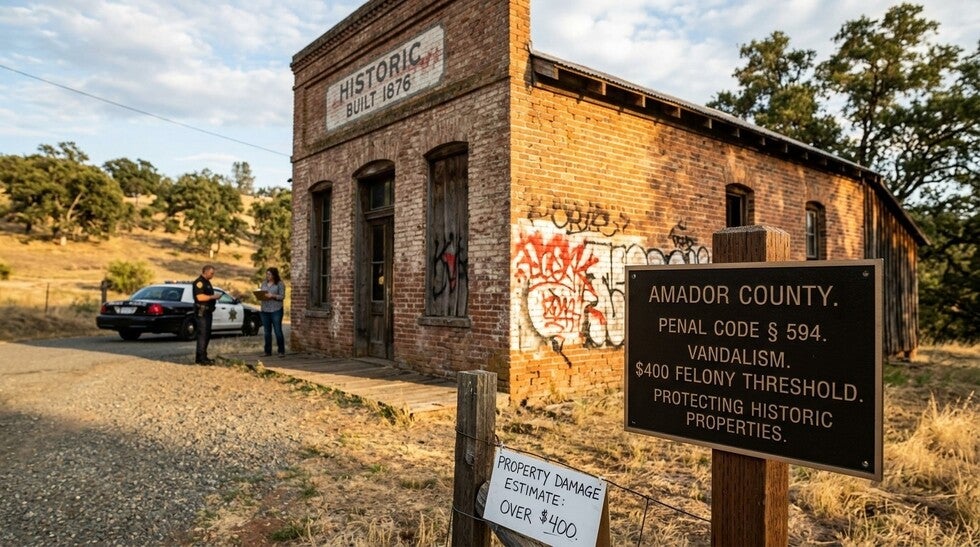
Vandalism in Amador County is often decided by two practical questions: what was damaged and how much the damage is worth. Under California Penal Code § 594, vandalism generally means maliciously defacing, damaging, or destroying property that does not belong to the accused. Damage under $400 is usually charged as a misdemeanor. Damage of $400 or more can be charged as a wobbler, meaning the prosecutor may pursue it as either a misdemeanor or felony depending on the facts.
In Amador County, those valuation questions can become complicated quickly. A graffiti allegation on a Sutter Creek historic facade, damage to a Jackson business, broken winery equipment in Plymouth, or damage to public property may involve repair estimates that are higher than the visible damage suggests. The defense should not accept the first estimate without reviewing repair method, replacement cost, depreciation, labor, materials, and whether the claimed restoration is legally and factually justified.
What Vandalism in Amador County requires under PC § 594
To prove vandalism, the prosecution generally must show that the accused maliciously defaced property with graffiti or other inscribed material, damaged property, or destroyed property, and that the property was not the accused person's own property. “Maliciously” does not always mean hatred. It can mean an intentional wrongful act or an act done with the intent to annoy or injure another person.
Common Amador County vandalism allegations may involve:
- Graffiti on buildings, signs, fences, vehicles, or public property.
- Broken windows, doors, gates, equipment, or fixtures.
- Damage to winery property, tasting rooms, vineyard equipment, or storage areas.
- Scratched cars, keyed paint, or damaged tires.
- Damage connected to domestic disputes, neighbor conflicts, or bar incidents.
- Damage to historic, religious, cemetery, or government property.
California vandalism law is broader than many people expect. Bulldog Law's overview of California vandalism laws under Penal Code § 594 explains why intent, ownership, damage amount, and restitution can all affect the defense.
Vandalism in Amador County and the $400 felony threshold
The $400 threshold is often the central issue. If the amount of defacement, damage, or destruction is less than $400, the case is generally a misdemeanor. If the amount is $400 or more, the case can be charged as a misdemeanor or felony. A felony vandalism conviction can carry much more serious consequences, including custody exposure, probation terms, restitution, fines, employment consequences, and immigration concerns for noncitizens.
The prosecution's damage number is not automatically correct. Repair estimates can include unnecessary upgrades, full replacement when repair is possible, inflated labor rates, or restoration work that goes beyond the actual damage. In cases involving older buildings, wineries, vehicles, or specialty equipment, valuation can require independent review.
Defense valuation challenges may focus on:
- Whether repair, rather than replacement, is the correct measure.
- Whether the estimate includes preexisting damage.
- Whether depreciation should reduce equipment value.
- Whether the estimate includes cosmetic upgrades unrelated to the alleged act.
- Whether multiple incidents were improperly combined.
- Whether the accused caused all of the alleged damage.
- Whether the amount can be reduced below $400.
If the defense can keep the valuation below $400, the case may remain in misdemeanor territory. If the amount is $400 or more, the defense may still pursue misdemeanor treatment, reduction under Penal Code § 17(b), civil compromise where available, or a disposition that avoids a felony record.
Historic property in Sutter Creek, Jackson, and Amador County
Amador County includes historic areas tied to California's Gold Rush history, including Sutter Creek, Jackson, Amador City, and other preserved structures. Damage to historic property can create difficult valuation issues because restoration may require specialized materials, preservation methods, or contractors familiar with older architecture.
That does not mean every historic-property estimate is accurate. The defense should ask whether the property is actually protected or historically designated, whether the claimed repair is required by law or merely preferred by the owner, whether less expensive methods would restore the property, and whether the alleged act caused all the claimed restoration needs.
Historic-property vandalism cases require balance. The community has a genuine interest in preserving historic buildings. But the accused has the right to challenge inflated repair costs, unsupported felony filings, and restitution demands that exceed the damage actually caused.
Plymouth winery and vineyard damage valuation
Vandalism allegations involving Plymouth and Shenandoah Valley wineries can involve property that is harder to value than ordinary household items. Damage may involve vineyard rows, irrigation systems, fences, barrels, cellar equipment, tasting room fixtures, refrigeration systems, or specialized production tools.
Winery cases may require expert review because replacement cost is not always the same as legal damage value. A used piece of equipment may have depreciated. A damaged vine may require analysis of replacement cost, lost production, age, and whether the plant could recover. A cellar or tasting room repair estimate may include business upgrades that should not be charged to the accused as vandalism loss.
The defense should request invoices, photographs, maintenance records, equipment age, repair alternatives, and any insurance documentation. If the prosecution relies on a broad owner estimate, an independent appraisal may be necessary.
Religious property, cemeteries, and protected places
Certain property types can create additional exposure or more serious charging decisions. Allegations involving places of worship, cemeteries, or religiously motivated vandalism may be prosecuted under statutes beyond ordinary PC § 594. These cases can also attract public attention, victim impact evidence, and restitution claims.
When the allegation involves a church, synagogue, mosque, temple, religious school, cemetery, or other protected religious property, the defense must analyze intent, knowledge, damage amount, motive, and whether hate-crime-related allegations are supported by evidence. Bulldog Law's article on defending religious property vandalism charges under PC § 594.3 explains why these cases require careful review of both the property type and the alleged reason for the act.
Cemetery and funeral-related allegations raise separate concerns. Damage to graves, markers, memorial property, or disruption of funeral-related activities can carry emotional and legal consequences beyond ordinary property damage. Bulldog Law discusses cemetery vandalism and funeral interference charges under Penal Code § 594.35, including why intent, identity, and the exact conduct alleged matter.
Chemical vandalism and contamination allegations
Some vandalism cases involve alleged contamination, chemical substances, or damage that affects soil, water, equipment, buildings, or public spaces. These cases may be more serious because cleanup costs can be high, and prosecutors may argue that the damage created health, safety, or environmental risks.
A chemical vandalism case should be reviewed with attention to testing, causation, cleanup scope, chain of custody, expert opinions, and whether the accused actually caused the contamination. Bulldog Law's discussion of chemical vandalism and contamination defense under PC § 594.4 explains why scientific evidence and cleanup estimates should be challenged carefully.
In Amador County, alleged contamination may arise around businesses, wineries, equipment yards, rural property, vehicles, or public facilities. The defense should not assume that every cleanup bill equals criminal restitution.
Civil compromise in Amador County vandalism cases
For some misdemeanor vandalism cases involving private property, civil compromise may be available under Penal Code §§ 1377 and 1378. This can allow dismissal when the injured party has been compensated and the court approves the compromise. It is not available in every case, and it is usually unavailable for certain public offenses or cases involving protected interests beyond private property loss.
Amador County's smaller community setting can make civil compromise especially important. The accused and property owner may be neighbors, relatives, customers, coworkers, or business contacts. A restitution-based resolution may repair the harm while avoiding a conviction that damages the accused person's future.
Civil compromise strategy usually requires:
- Confirming the case is legally eligible.
- Determining the accurate amount of loss.
- Paying or arranging restitution.
- Obtaining the property owner's acknowledgment of satisfaction.
- Presenting the compromise properly to the court.
Even when civil compromise is unavailable, restitution, apology letters, repair work, counseling, or community service may support a better negotiated outcome.
Community service, graffiti cleanup, and sentencing
Vandalism sentences can include jail, probation, fines, restitution, cleanup, counseling, stay-away orders, and community service. In graffiti cases, the court may order the defendant to clean, repair, or replace the damaged property when appropriate and feasible. Minors may face additional issues involving parents or guardians.
Bulldog Law's guide to community service requirements for vandalism convictions in California explains why cleanup and service terms should be realistic, specific, and connected to the case.
For defendants who work, attend school, care for family, or live outside Amador County, the defense should ask for terms that can actually be completed. Unworkable probation terms can create future violations even when the person intends to comply.
How Amador County vandalism compares with other California counties
Vandalism law is statewide, but local facts matter. The same PC § 594 statute applies in Amador County, Tulare County, Santa Clara County, and Kern County, but property types, prosecution policies, local courts, and restitution issues can differ.
For comparison, Tulare County vandalism cases under PC § 594 may involve agricultural property, rural businesses, and local restitution concerns. Santa Clara County vandalism defense under PC § 594 may involve tech campuses, urban property, and higher repair estimates. Kern County vandalism cases under PC § 594 may involve oilfield, agricultural, residential, or commercial property damage.
In Amador County, the defense should focus on the local record: the actual property, actual damage, actual repair cost, and actual conduct alleged. A statewide statute does not eliminate the need for county-specific defense.
Where Vandalism in Amador County cases are handled
Vandalism cases in Amador County are generally handled at the Superior Court of California, County of Amador, located at 500 Argonaut Lane, Jackson, CA 95642. Defendants should follow the court notice, attorney instructions, and official court calendar for exact hearing dates and appearance requirements.
A vandalism case may involve arraignment, discovery, restitution documentation, negotiations, motions, readiness conferences, trial, sentencing, or diversion-related discussions where available. If the case is filed as a felony, the defense may also address reduction to a misdemeanor, preliminary hearing strategy, and whether the damage amount supports felony treatment.
Early defense work should focus on photographs, repair estimates, ownership records, witness statements, surveillance video, messages, and any evidence of accident, consent, mistaken identity, or overvaluation.
Defenses to Vandalism in Amador County charges
Vandalism charges can often be defended through facts, valuation, intent, identity, and resolution strategy. The strongest defense depends on what the prosecution can actually prove.
Possible defenses include:
- No malicious intent.
- Accidental damage.
- Consent or reasonable belief of permission.
- Mistaken identity.
- Insufficient proof that the accused caused the damage.
- Damage amount below $400.
- Inflated repair or replacement estimate.
- Preexisting damage.
- Shared or disputed ownership.
- Restitution and civil compromise in eligible misdemeanor cases.
- Reduction from felony to misdemeanor under PC § 17(b).
The defense should not wait until sentencing to challenge value. The damage amount affects charging, leverage, restitution, probation, and record consequences from the beginning.
What to do after a vandalism arrest in Amador County
After a vandalism arrest or citation, do not explain intent, damage, alcohol use, argument history, or presence at the scene without legal advice. Statements meant to apologize or calm the situation may become admissions.
Practical steps include:
- Take or preserve photographs of the alleged damage if lawful and safe.
- Save texts, calls, receipts, location records, and witness names.
- Do not contact the alleged victim if there is a protective order or stay-away term.
- Do not repair or alter property without permission and legal advice.
- Request copies of repair estimates and invoices.
- Document insurance involvement or prior damage.
- Ask whether civil compromise, diversion, or reduction is available.
- Appear at all court dates at 500 Argonaut Lane unless counsel confirms otherwise.
Fast action matters because surveillance footage, photographs, and repair evidence can disappear quickly.
Vandalism in Amador County lawyers in California
Vandalism in Amador County cases require careful review of PC § 594, the $400 threshold, historic property valuation, winery damage, protected property statutes, restitution, civil compromise, and felony reduction strategy. A repair estimate should not decide the case without challenge.
Bulldog Law defends California vandalism cases with attention to valuation, intent, identity, restitution, civil compromise, community service, probation consequences, and courtroom strategy at 500 Argonaut Lane in Jackson. If you or a loved one is facing a vandalism charge in Amador County, the defense should begin before the prosecution's damage number becomes the story of the case.