
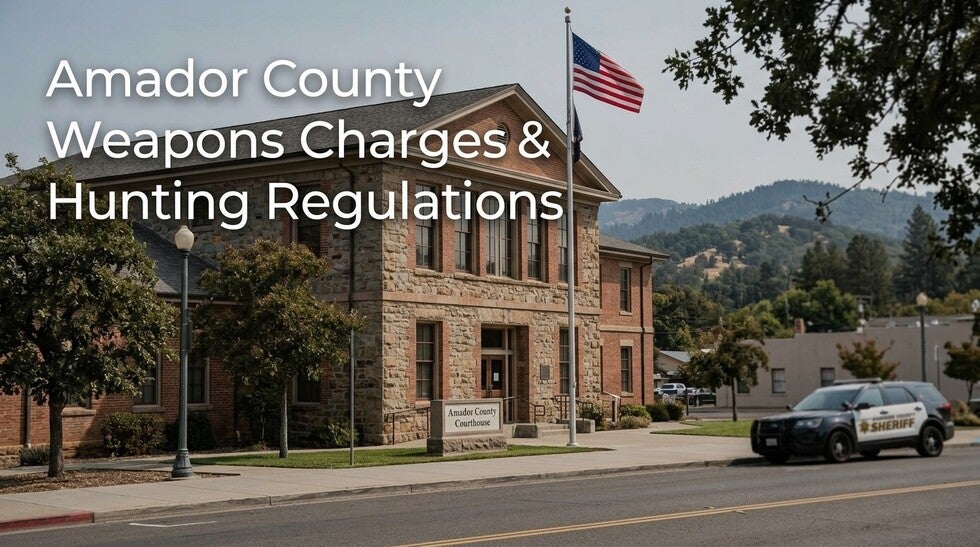
Weapons Charges in Amador County often begin with a traffic stop on Highway 49 or Highway 88, a hunting-season encounter near Eldorado National Forest, a vehicle search after a DUI arrest, a probation search, or a firearm discovered during a domestic violence investigation. Under Penal Code § 25400, California generally prohibits carrying a concealed handgun or other firearm capable of being concealed on the person, including inside a vehicle, unless a lawful exception applies.
Amador County cases require more than a generic firearms-law analysis. A Mule Creek correctional officer may face employment and federal firearms consequences. A hunter may have a lawful hunting purpose but still face transport problems. A rancher may have used firearms for decades but still be subject to California public-road rules. An out-of-state traveler may have a CCW permit that does not authorize concealed carry in California. The defense must focus on the firearm, the location, the transport method, the stop, the person's status, and any prior conviction history.
What Weapons Charges in Amador County mean under PC § 25400
Penal Code § 25400 applies to concealed carry of certain firearms, including concealed firearms in a vehicle under the person's control or direction. Many cases involve a handgun found under a seat, in a center console, in a backpack, under clothing, or inside a vehicle compartment.
California has lawful transport rules, but they are technical. For many ordinary firearm owners transporting a handgun, the safest legal framework is that the firearm is unloaded and locked in the trunk or in a locked container other than a glove box or utility compartment. Ammunition should not be in the firearm, and keeping ammunition separate can reduce disputes, although California's rules focus heavily on whether the firearm is loaded and whether the handgun is properly secured.
A defense to concealed firearm charges under Penal Code § 25400 may involve lawful transport, lack of knowledge, lack of control, illegal search, invalid stop, mistaken ownership, or an applicable exception.
Weapons Charges in Amador County and Highway 49 or Highway 88 stops
Many Amador County weapons cases begin in vehicles. Highway 49 runs through historic Gold Country communities, and Highway 88 connects Jackson, Pine Grove, Pioneer, Kirkwood routes, and access points toward forest and mountain recreation. A firearm discovered during a stop is only admissible if the stop, detention, search, and seizure were lawful.
Defense questions include:
- What was the stated reason for the stop?
- Did dashcam or bodycam footage support that reason?
- Was the detention prolonged beyond the traffic purpose?
- Did the driver consent to a search, and was that consent voluntary?
- Was the firearm visible, concealed, loaded, or locked?
- Who owned the firearm?
- Did multiple passengers have access to the same area?
- Was the accused prohibited from possessing firearms or ammunition?
If officers unlawfully extended the stop or searched without a valid basis, the defense may seek suppression of the firearm and related statements.
Mule Creek correctional officers and Lautenberg risk
Mule Creek correctional officers and other public safety employees can face consequences that go far beyond the criminal case. A weapons arrest may trigger employment review, internal affairs issues, peace officer credibility concerns, firearms authorization problems, and administrative consequences. If there is a prior domestic violence conviction, federal Lautenberg issues may also arise.
Under federal law, a person convicted of a qualifying misdemeanor crime of domestic violence may be prohibited from possessing firearms or ammunition. Not every old domestic violence conviction automatically qualifies. The analysis can depend on the statute, relationship element, use or attempted use of physical force, court records, plea documents, counsel rights, and whether civil rights were restored in a legally meaningful way.
A correctional officer should not make statements about firearm possession, employment authorization, prior convictions, or domestic violence history without legal advice. A statement in the criminal case can affect employment, federal exposure, and future firearms eligibility.
Eldorado National Forest hunting and firearm transport
Hunting, camping, and forest access create common firearms issues in Amador County. A person may lawfully possess a hunting rifle or shotgun in one setting but violate California law when driving on a public road with the firearm loaded, improperly stored, or accessible in a way that triggers a different statute.
PC § 25400 focuses on concealed firearms capable of being concealed on the person, usually handguns. Long guns may raise different issues, including loaded firearm allegations under Penal Code § 25850, Fish and Game rules, forest rules, vehicle transport requirements, or location-specific restrictions. A valid hunting license and tag can provide important context, but they do not excuse every transport violation.
Helpful hunting-related evidence can include:
- Current hunting license and tags.
- Maps showing lawful hunting location.
- Camp location and route.
- Whether the firearm was unloaded before entering a public road.
- Where the firearm and ammunition were stored.
- Whether the encounter occurred on public road, private land, or federal land.
- Whether any statements were made before Miranda warnings were required.
The defense should separate a lawful hunting purpose from the technical question of whether California transport and loaded-firearm rules were followed.
Ranching culture, public roads, and firearm possession
Amador County's ranching community may involve firearms used for livestock protection, wildlife management, remote property work, and family traditions. But California public-road rules still matter. A firearm that may be lawfully possessed on private property can create exposure if it is carried loaded or concealed in a vehicle on a public road without meeting legal requirements.
Ranch cases require a practical defense. The context may help explain purpose, lack of criminal intent, and why a noncustodial or reduced outcome is appropriate. But community custom is not automatically a legal defense. The defense must still analyze firearm type, loaded status, storage, public-road location, prior convictions, and whether the officer had a lawful basis for the stop or search.
Out-of-state CCW permits and California travelers
California generally does not recognize concealed carry permits issued by other states. A traveler with a Nevada, Arizona, Oregon, Idaho, or other out-of-state CCW permit should not assume that permit authorizes concealed carry in California. Recent litigation may affect how some nonresidents apply for California permits, but it does not create general reciprocity for out-of-state licenses.
Good-faith confusion may matter in negotiations, especially for a visitor who lawfully carried elsewhere and had no criminal purpose. But it may not defeat a PC § 25400 charge by itself. The defense should focus on lawful transport, lack of concealment, lack of knowledge, search issues, and whether the person had any California-recognized authorization.
Comparable corridor cases, including Bakersfield weapons charges under PC § 25400, Fresno County weapons charges under PC § 25400, and San Diego concealed weapon charges under PC § 25400, show how California's statewide concealed-carry rules can affect both residents and travelers in very different local settings.
Correctional facilities, airports, and school grounds
Weapons charges can become more serious when the location is sensitive. Amador County residents, correctional employees, travelers, and parents should be especially careful around correctional facilities, airports, schools, and government buildings.
A person entering or approaching a correctional setting must consider weapons and contraband rules for correctional facilities under PC § 4574. Airport or terminal cases may implicate airport terminal weapons charges under Penal Code § 171.5. School-related incidents require separate analysis because weapons on school grounds under PC § 626.10 can involve knives, tasers, BB devices, and other items beyond ordinary firearm carry.
Location-specific statutes often have their own exceptions, definitions, and penalties. A defense that works in a vehicle-stop case may not apply in a school, airport, or correctional-facility case.
Other weapons, impact tools, and recodification issues
Not every weapons case involves a handgun. California law includes many statutes covering batons, impact weapons, knives, ammunition, imitation firearms, less-lethal devices, and other items. Some statutes were reorganized through the Deadly Weapons Recodification Act, which means older references may appear in records, plea forms, or police reports.
Continuity provisions matter when older law and current code sections must be compared. Weapons-law continuity under Penal Code § 16010 and the Deadly Weapons Recodification Act under Penal Code § 16005 can help clarify whether a statutory change altered substance or merely renumbered prior law.
Some tools and sports-related items may have specific exemptions. For example, the Penal Code § 22215 exemption for certain impact weapons can be relevant when the item was possessed for a lawful athletic, training, or authorized purpose rather than criminal use.
Where Weapons Charges in Amador County are handled
State weapons cases in Amador County are generally handled at the Superior Court of California, County of Amador, located at 500 Argonaut Lane, Jackson, CA 95642. Defendants should rely on the court notice, attorney instructions, and official court calendar for exact hearing dates and appearance requirements.
A weapons case may involve arraignment, bail or release conditions, firearm surrender issues, criminal protective orders, discovery, bodycam review, motions to suppress, negotiations, preliminary hearing in felony cases, and trial. If federal firearms issues arise, especially involving prohibited possession, domestic violence convictions, or firearms near federal property, the defense must evaluate whether federal authorities could become involved.
The first court appearances matter because the court may impose no-weapons conditions, search terms, surrender requirements, or protective orders that affect work, hunting, ranch operations, and home life.
Defenses to Weapons Charges in Amador County
Weapons defense depends on the statute, firearm type, storage method, location, and accused person's status. The strongest defense may be constitutional, factual, statutory, or mitigation-based.
Potential defenses include:
- Illegal stop, detention, or search.
- No knowledge that the firearm was present.
- No control over the vehicle or container.
- Firearm was lawfully transported unloaded in a locked container or trunk.
- Firearm was not concealed within the meaning of the statute.
- Item was not a firearm or prohibited weapon under the charged statute.
- Applicable lawful-use, employment, hunting, or transport exception.
- Prior conviction does not qualify as a firearm prohibition.
- Statements were obtained in violation of constitutional rights.
- Out-of-state traveler confusion supports reduction or noncustodial resolution.
The defense should also evaluate whether a charge can be reduced, dismissed after suppression, resolved through diversion where legally available, or negotiated to protect employment and firearms eligibility where possible.
What to do after a weapons arrest in Amador County
After a weapons arrest, do not explain why the firearm was present, who owned it, whether it was loaded, or whether you knew about it without legal advice. Those statements can decide the case. In Lautenberg situations, statements about possession and prior domestic violence history can create federal consequences.
Practical steps include:
- Write down the reason given for the stop or search.
- Preserve photos or records showing how the firearm was stored, if available.
- Save hunting licenses, tags, range receipts, purchase records, or training documents.
- Do not contact witnesses to coordinate stories.
- Do not move, sell, or hide firearms after a court order or police contact.
- For correctional officers or licensed workers, get legal advice before employer statements.
- For anyone with a prior domestic violence case, obtain the old court records immediately.
- Appear at all court dates unless counsel confirms otherwise.
Fast, careful action can protect the criminal case, employment, licensing, and future firearm rights.
Weapons Charges in Amador County lawyers in California
Weapons Charges in Amador County require careful review of PC § 25400, lawful transport, loaded-firearm allegations, Highway 49 and Highway 88 stop evidence, hunting context, ranching realities, out-of-state CCW issues, correctional employment, and federal Lautenberg risk. A firearm discovery should never be treated as the end of the defense.
Bulldog Law defends California weapons cases involving concealed firearms, transport, loaded firearm allegations, correctional facility concerns, school and airport weapons rules, prior conviction prohibitions, suppression motions, and employment-sensitive outcomes. If you or a loved one is facing a weapons charge in Amador County, legal strategy should begin before statements are made, old convictions are mischaracterized, or the prosecution controls the facts.