
By the The Bulldog Law Criminal Defense Team • Reviewed by a licensed California criminal defense attorney
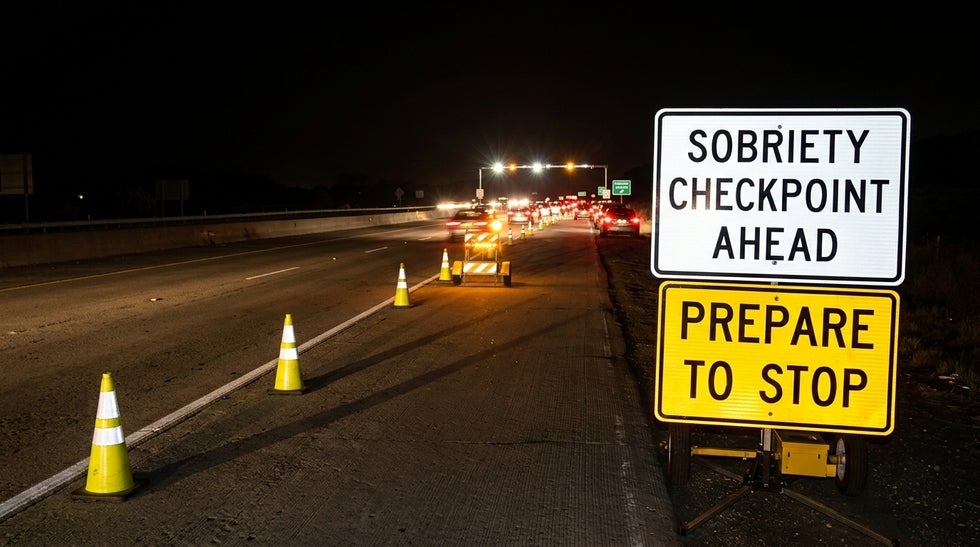
YES sobriety checkpoints are legal in California: the U.S. and California Supreme Courts have upheld them as administrative stops, exempt from the usual requirement of individualized suspicion - BUT only when they comply with the INGERSOLL FACTORS, the checklist California law imposes:
(1) supervisory-level decision-making (command staff, not field officers, choose the operation);
(2) a NEUTRAL formula for which cars are stopped (every car, every fifth car no officer discretion, no profiling);
(3) site selection based on DUI data;
(4) safety precautions (lighting, signage, safe flow);
(5) reasonable time and duration;
(6) visible indicia of officialness (marked units, uniforms the checkpoint must look like one);
(7) MINIMAL detention length for screening; and
(8) ADVANCE PUBLICITY of the program.
Every factor is also a defense: a checkpoint that field officers improvised, that stopped cars by hunch, that hid around a blind curve, or that held drivers for extended fishing violates the framework and the remedy is SUPPRESSION of everything the stop produced. Your rights at one are equally concrete: you may lawfully AVOID a checkpoint by turning away (avoidance alone is not reasonable suspicion though any traffic violation during the turn creates its own stop, and the maneuver must never look like flight from a pursuit); you MUST present your license on demand; you do NOT have to answer questions “where are you coming from, have you been drinking” can be met with polite silence (the rights framework applies before arrest too); FIELD SOBRIETY TESTS ARE VOLUNTARY, always; and the roadside breath test (PAS) is voluntary for drivers 21+ not on DUI probation while POST-ARREST chemical testing carries the implied-consent refusal consequences the DMV track enforces.
This guide from The Bulldog Law's DUI defense practice covers the rules, the rights, the script for the window and how checkpoint arrests get taken apart.
At the Window: The Script, and What's Actually Voluntary
- The lawful minimum stop when directed, window down enough to communicate, license (and on request registration/insurance) handed over: the documentary compliance the law requires.
- The words “Good evening, officer. Here's my license. I'm not answering questions.” Polite, complete, final because ‘just came from dinner, had one beer two hours ago' is the admission that anchors everything after, and silence cannot be.
- Voluntary means NO, said politely field sobriety tests (the walk, the eyes, the balance theater) are voluntary and are graded to be failed decline them; the handheld roadside breath test (PAS) is voluntary for 21+ non-probation drivers decline it; neither refusal is admissible as guilt, and neither carries a penalty at the screening stage.
- Where the line moves if officers develop probable cause and ARREST you, the implied-consent regime activates: refusing the post-arrest chemical test (station breath or blood) triggers license-suspension consequences and enhancement allegations a different calculus entirely, decided with the 10-day DMV clock already running.
- Special situations unlicensed drivers: checkpoints carry special limits on license-only impounds (drivers must generally be given opportunity for a licensed driver to retrieve the car) a rights area officers get wrong; passengers: not required to identify or answer; recording: you may record the encounter (the 148(g) rule protects it) calmly, without interfering.
Taking a Checkpoint Arrest Apart
Checkpoint DUI cases carry a defense layer ordinary stops don't: the CHECKPOINT ITSELF is on trial.Discovery demands go to the operation's paperwork the supervisory authorization, the site-selection memo, the neutral-formula instructions and deviation logs, the publicity records, staffing and timing documents and Ingersoll noncompliance (field-level improvisation, discretionary stops, formula abandoned when traffic backed up, screening detentions stretched into interrogations) supports suppression of the stop and everything downstream: the observations, the tests, the arrest.
On top of that layer, every standard DUI defense still runs - the screening officer's ‘objective symptoms' boilerplate versus the video, FST conditions and instructions, PAS device calibration, rising-BAC timelines, and the weak-case audit which is why checkpoint files, built on seconds-long screenings and assembly-line paperwork, reduce and dismiss at healthy rates with counsel who demands the operational file. If you were arrested at one: calendar the DMV 10-day deadline first, write down everything about the checkpoint's layout and your detention's length while it's fresh, and get the operational-plan discovery moving the checkpoint's own file is, in a real fraction of cases, the defense.
Frequently Asked Questions
Can you legally turn around to avoid a DUI checkpoint?
Yes California law does not require you to drive into a checkpoint, and avoiding one is not, by itself, reasonable suspicion for a stop: checkpoints must be visible precisely so drivers can see them, and a legal U-turn or side-street exit is lawful travel. The two ways it goes wrong: committing a traffic violation in the maneuver (illegal U-turn, crossing a double yellow which creates its own valid stop), and driving that looks like flight (speeding away, extended weaving) officers watch the approach zone for exactly both. So: turn early, turn legally, drive normally. And if you were stopped after a lawful avoidance with no violation, the stop's justification is the first thing counsel attacks.
Do I have to answer questions or do the tests at a checkpoint?
You must stop and show your license that's the checkpoint's lawful scope. Beyond it: questions (‘been drinking? coming from where?') may be met with polite refusal your answers are the evidence, your silence is not; FIELD SOBRIETY TESTS are voluntary and safely declined; the roadside PAS breath device is voluntary for drivers 21+ not on DUI probation.
The line that changes everything is ARREST: post-arrest chemical testing falls under implied consent, and refusal there carries license and enhancement consequences. The window script that protects sober and imperfect drivers alike: license handed over, ‘I'm not answering questions,' declines delivered politely, and nothing volunteered the seconds of small talk are where checkpoint cases are actually built.
What makes a DUI checkpoint illegal?
Failure of the Ingersoll framework: no supervisory authorization (field-improvised operations), no neutral stop formula (officers choosing cars by discretion or appearance), hidden or unsafe siting, missing advance publicity, screening detentions stretched beyond the minimal intrusion the doctrine permits, or an operation that doesn't visibly read as official. Each defect is litigated through the checkpoint's own records the authorization memo, formula logs, publicity proofs your lawyer demands in discovery and established noncompliance suppresses the stop and everything it produced: observations, tests, arrest. This is the defense layer unique to checkpoint cases and the reason none of them should be pled before the operational file has been obtained and audited.
I was arrested at a checkpoint is my case hopeless?
The opposite of hopeless checkpoint cases carry MORE defense angles than ordinary stops: the operation's legality (Ingersoll compliance, proven from records you're entitled to demand), the seconds-long screening's reliability (boilerplate ‘objective symptoms' versus what video shows), voluntary tests you may have declined or done under bad conditions, device calibration, and rising-BAC timelines stacked on top of every standard DUI defense and the reduction ladder (wet reckless and below) that borderline facts support. Two urgent moves: request the DMV hearing within 10 DAYS of arrest (the license clock runs regardless of the criminal case), and preserve your memory of the checkpoint's layout, signage, and how long you were held. Then let counsel pull the operational file assembly-line arrests meet assembly-line paperwork, and paperwork has holes.
Checkpoints are legal because courts trust the rules that constrain them which makes the rules your shield twice: at the window, where your rights are concrete and your silence is safe, and in court, where the operation's own file gets audited. Know the script before the cones appear.
The Bulldog Law's DUI defense team handles checkpoint arrests operational discovery first across California. Contact the firm online or call (888) 928-1609 and remember the 10-day DMV clock.