
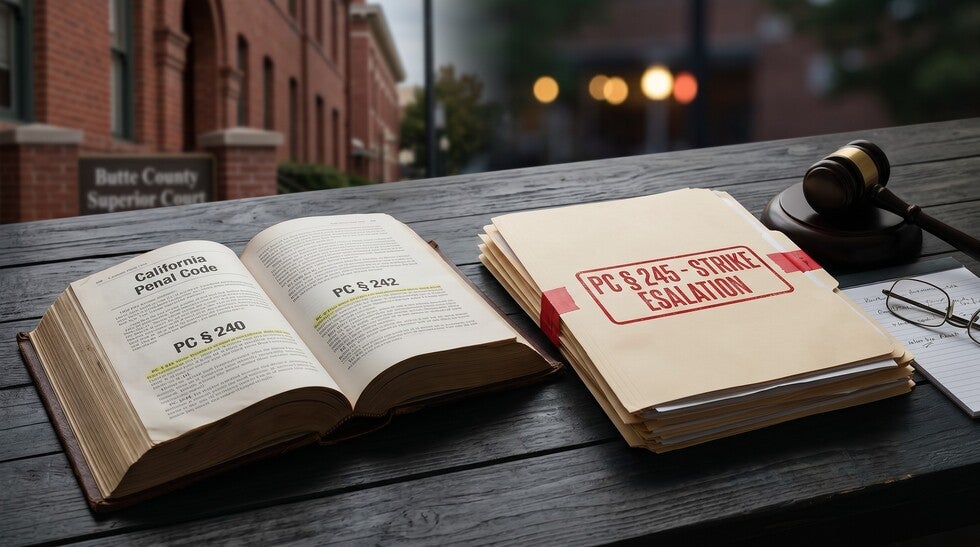
Assault and Battery in Butte County cases often begin with fast-moving facts: a bar fight near CSU Chico, a parking lot confrontation in Oroville, a family dispute in Gridley, a Paradise rebuild community conflict, or a student housing incident that turns into a police report. California law separates assault from battery, and that distinction can affect charges, defenses, plea options, licensing consequences, immigration issues, and whether prosecutors try to escalate the case into a felony strike under Penal Code § 245.
Simple assault under PC § 240 and simple battery under PC § 242 are usually misdemeanor offenses. But the case can change quickly if prosecutors allege serious injury, a deadly weapon, force likely to produce great bodily injury, domestic violence, sexual touching, a protected victim, or a prior record. The defense must control the facts early before a chaotic incident becomes a felony narrative.
Assault and Battery in Butte County under PC § 240 and PC § 242
Assault and battery are not the same offense. Assault is an unlawful attempt, with present ability, to commit a violent injury on another person. It does not require actual contact. Battery is the willful and unlawful use of force or violence on another person. Battery requires some touching, but the touching can be slight if it is harmful or offensive and not legally justified.
The difference matters in real cases:
- A raised fist that never lands may be charged as assault.
- A shove, slap, thrown drink, or grabbed shirt may be charged as battery.
- A missed punch can still support assault if the person had present ability.
- Incidental contact during mutual movement may not prove unlawful battery.
- Self-defense or defense of others can defeat either charge when supported by facts.
A broader explanation of whether assault and battery are the same helps show why prosecutors cannot simply use the terms interchangeably. The exact movement, timing, contact, intent, and threat level matter.
Simple assault and simple battery penalties
Simple assault under PC § 240 is generally a misdemeanor punishable by up to six months in county jail, a fine of up to $1,000, or both. Simple battery under PC § 242, punished through PC § 243(a), is generally a misdemeanor punishable by up to six months in county jail, a fine of up to $2,000, or both.
Those are maximum penalties, not automatic outcomes. In many cases, the defense may seek dismissal, reduction, diversion where legally available, civil compromise in limited eligible situations, informal resolution, anger management, restitution, or a non-jail outcome. But the strategy depends on the facts and on whether the case involves injury, weapons, domestic relationships, alcohol, prior history, or protected victims.
California's general assault and battery defense framework focuses on whether the prosecution can prove willful conduct, unlawful force, present ability, identity, lack of self-defense, and every required element beyond a reasonable doubt.
Assault and Battery in Butte County and the PC § 245 strike escalation
The most serious local risk is escalation from PC § 240 or PC § 242 into Penal Code § 245. PC § 245 can apply when prosecutors allege assault with a deadly weapon, assault with a firearm, or assault by means likely to produce great bodily injury. A felony PC § 245 charge can carry prison exposure, and some felony assault convictions can qualify as serious felony strikes depending on the exact subsection, weapon, victim, personal use, injury allegations, and record of conviction.
Not every fight is a strike. Not every object is a deadly weapon. Not every injury proves force likely to produce great bodily injury. A bottle, chair, shoe, phone, vehicle, or pavement-impact theory must be tested against the actual evidence.
The defense should examine:
- Whether the object was used as a weapon or merely present.
- Whether the contact was intentional or accidental.
- Whether the alleged injury matches the accusation.
- Whether medical records support great bodily injury claims.
- Whether video shows mutual combat or self-defense.
- Whether witnesses exaggerated because of alcohol, stress, or loyalty.
- Whether a misdemeanor battery theory fits better than felony assault.
The goal is often to stop a misdemeanor-level confrontation from becoming a strike felony through overcharging.
The CSU Chico bar district and alcohol-related allegations
Chico bar district cases often involve alcohol, crowded sidewalks, door staff, rideshare pickups, cell phone video, and conflicting witness accounts. A minor bump can be described as a shove. A defensive reaction can be described as aggression. A fall caused by intoxication can be blamed on a punch. A friend group can produce coordinated statements that leave out the first act of aggression.
Evidence in CSU Chico-area cases may include:
- Bar security video.
- Sidewalk or parking lot surveillance.
- Cell phone videos.
- Door staff reports.
- Police bodycam footage.
- Medical records from urgent care or emergency treatment.
- Student conduct records.
- Text messages before and after the incident.
Students should be especially careful. A criminal case can affect school discipline, housing, internships, graduate programs, teaching credentials, nursing applications, law enforcement goals, professional licensing, and immigration status for noncitizens.
Domestic battery, dating relationships, and protective orders
If the alleged victim is a spouse, dating partner, cohabitant, former partner, fiancé, co-parent, or person in another qualifying relationship, prosecutors may treat the case as domestic violence. That can change the case even if the alleged touching was minor.
Domestic battery under PC § 243(e)(1) does not require visible injury. PC § 273.5, by contrast, requires corporal injury resulting in a traumatic condition. A domestic violence case can also involve emergency protective orders, criminal protective orders, firearm restrictions, counseling requirements, immigration consequences, custody concerns, and professional licensing issues.
The defense of domestic battery charges often turns on relationship status, credibility, self-defense, injury evidence, prior incident evidence, 911 calls, bodycam footage, and whether the alleged contact was willful or accidental.
Sexual battery allegations and unwanted touching
Some Butte County battery cases involve allegations of touching an intimate part for sexual arousal, sexual gratification, or sexual abuse. Those allegations can lead to PC § 243.4 sexual battery charges, which carry much more serious consequences than ordinary battery. Depending on the facts and charge level, consequences may include jail, felony exposure, registration issues, employment consequences, school discipline, and severe reputational harm.
The defense of California sexual battery charges must examine consent, intent, touching, witness reliability, intoxication, surveillance, text messages, delay in reporting, and whether the accusation grew out of a misunderstanding, regret, relationship conflict, or mistaken identification.
No person accused of sexual battery should try to explain the incident to the alleged victim, school, employer, or police without legal advice. Even an apology can be misinterpreted as an admission.
Self-defense, mutual combat, and defense of others
Self-defense is one of the most important defenses in assault and battery cases. A person may use reasonable force to defend against imminent unlawful force. The force must be proportional to the threat as the person reasonably perceived it. Defense of others can also apply when a person reasonably acts to protect someone else.
Self-defense evidence may include:
- Photos of the defendant's injuries.
- Witnesses who saw the alleged victim start the fight.
- Video showing the first aggressive act.
- Messages threatening violence before the incident.
- Evidence the alleged victim was intoxicated or aggressive.
- Medical records showing defensive injuries.
- Prior history between the parties.
Mutual combat does not automatically eliminate self-defense, but it can complicate the case. The defense must carefully show who escalated, who tried to leave, who used disproportionate force, and whether any later force was legally justified.
How Butte County compares with other California assault cases
California assault and battery law is statewide, but local facts shape defense strategy. Chico cases may involve CSU Chico, the downtown bar district, student discipline, and nightlife surveillance. Oroville cases may involve parking lots, family disputes, local business conflicts, and jail-related consequences. Paradise cases may involve small-community visibility after years of rebuilding. Gridley and Biggs cases may involve agricultural families, workers, and community reputation.
Other counties show different patterns. Los Angeles assault and battery cases often involve dense surveillance, entertainment venues, and overlapping city agencies. Sacramento County assault and battery cases may involve Capitol-area nightlife, schools, workplaces, and regional law enforcement patterns.
A Butte County defense should focus on local evidence, not assumptions from the police report.
Where Assault and Battery in Butte County cases are handled
Assault and Battery in Butte County cases are generally handled through the Criminal Division of the Butte County Superior Court at the Butte County Courthouse, located at One Court Street, Oroville, CA 95965. Butte County also operates the North Butte County Courthouse at 1775 Concord Avenue, Chico, CA 95928. Defendants should rely on court notices, attorney instructions, and official court communications for the correct location, department, date, and appearance requirements.
A case may involve arraignment, protective orders, stay-away terms, alcohol restrictions, discovery, bodycam footage, surveillance video, medical records, witness statements, negotiations, diversion analysis where legally available, suppression motions, trial readiness, and trial.
The early phase matters. Video can be overwritten, bruises can fade, witnesses can leave town, and school or employment consequences can begin before the criminal case is resolved.
Defenses to assault and battery charges
The best defense depends on the charge and facts. The prosecution may have a complaining witness, but that does not prove the case beyond a reasonable doubt.
Potential defenses include:
- Self-defense.
- Defense of another person.
- Accidental contact.
- No present ability to apply force.
- No willful use of force.
- False accusation or exaggeration.
- Mutual combat with unreliable witness accounts.
- Identity mistake.
- Video contradicts the police report.
- The case is overcharged as PC § 245.
- The object was not used as a deadly weapon.
- The injury evidence does not support felony treatment.
Defense strategy should also consider immigration, professional licensing, student discipline, firearm consequences, protective orders, and whether a civil compromise or reduction is legally realistic.
What to do after an assault or battery arrest in Butte County
After an arrest, do not explain the fight to police, campus officials, bar staff, employers, friends, or the alleged victim without legal advice. Statements made to “clear things up” can be used to prove intent, contact, force, fear, intoxication, or lack of self-defense.
Important steps include:
- Invoke the right to remain silent.
- Photograph injuries immediately.
- Preserve clothing, damaged property, and medical records.
- Identify witnesses before memories fade.
- Request preservation of surveillance video quickly.
- Do not contact the alleged victim if any order exists.
- Do not discuss the case on recorded jail calls.
- For students, coordinate criminal defense with campus discipline strategy.
Fast defense work can prevent a simple battery case from becoming a felony assault case, protect school and licensing goals, and preserve the evidence that shows what really happened.
Assault and Battery in Butte County lawyers in California
Assault and Battery in Butte County cases require careful review of PC § 240, PC § 242, PC § 243, PC § 245, self-defense, bar district evidence, CSU Chico consequences, domestic battery issues, sexual battery allegations, strike exposure, surveillance, and courtroom strategy.
Bulldog Law defends California assault and battery cases involving Chico nightlife, Oroville arrests, student discipline, self-defense, mutual combat, domestic battery, sexual battery, deadly weapon allegations, great bodily injury claims, professional licensing, immigration consequences, and trial defense. If you or a loved one is facing assault or battery charges in Butte County, legal strategy should begin before video is erased, statements are made, or a misdemeanor fight is escalated into a felony strike.