
Burglary in Butte County often turns on one question before any other: was the structure inhabited at the time of entry? Under California Penal Code section 459, burglary is not limited to breaking a lock or stealing property. A person can be charged if prosecutors claim the person entered a covered structure with the intent to commit theft or another felony inside.
The difference between first degree and second degree burglary is enormous. First degree burglary involves an inhabited dwelling and is always a felony. Second degree burglary covers other burglaries and can often be charged as either a felony or misdemeanor. In Butte County, this distinction can arise in Paradise rebuild properties, CSU Chico student rentals during academic breaks, Oroville-area homes affected by evacuation history, and retail entries where Prop 47 shoplifting rules may apply.
Burglary in Butte County under PC § 459
California burglary does not require the prosecutor to prove that property was actually stolen. The alleged crime is complete if the prosecution proves the defendant entered the structure with the required intent at the time of entry. Intent formed after entry may support another charge, but it is not the same as burglary intent.
That makes timing critical. The defense should ask what the person intended when they crossed the threshold, whether there was permission to enter, whether the entry was into a covered structure, and whether the prosecution can prove theft or felony intent beyond a reasonable doubt.
A general overview of California burglary laws involving entry with intent can help explain why a PC § 459 case is often more about intent and authorization than about forced entry.
First degree burglary and the inhabited element
First degree burglary generally means burglary of an inhabited dwelling house, vessel, floating home, trailer coach, or inhabited portion of another building. “Inhabited” means the place is currently being used for dwelling purposes, whether or not someone is physically present when the entry occurs.
This is why a home can still be inhabited when the resident is at work, away for the weekend, on vacation, or temporarily displaced. But a structure may present a more contestable issue if former residents have moved out, removed belongings, turned off utilities, or do not intend to return.
First degree residential burglary carries two, four, or six years in state prison and is treated as a serious felony strike in California. Second degree burglary is generally a wobbler, meaning it may be filed or resolved as a misdemeanor or felony depending on the facts, record, and prosecutor's decision.
Burglary in Butte County and Paradise rebuild authorization defenses
Paradise's ongoing recovery after the 2018 Camp Fire has created recurring access issues. Contractors, subcontractors, inspectors, insurance adjusters, utility workers, family members, cleanup crews, and community helpers may have entered properties during different stages of rebuilding. Many arrangements were informal, verbal, temporary, or based on prior relationships.
In a Paradise rebuild burglary case, the defense may focus on authorization. If the accused reasonably believed they had permission to enter based on a prior arrangement, ongoing work, contractor role, inspection schedule, key access, owner communication, or failure to revoke permission clearly, the prosecution may have difficulty proving unlawful entry and criminal intent.
Useful evidence may include:
- Text messages, emails, invoices, work orders, and contractor agreements.
- Prior keys, gate codes, lockbox instructions, or site access instructions.
- Insurance, FEMA, inspection, or rebuild-related communications.
- Witnesses who knew the access arrangement.
- Photos showing posted signs, open work sites, or ongoing construction.
- Proof that the accused previously entered with permission.
A Paradise case is different from an urban residential burglary case where there was no prior relationship to the property. Local context does not create automatic immunity, but it can be central to whether the prosecution can prove burglary intent.
CSU Chico student rentals during academic breaks
CSU Chico student housing creates another recurring inhabited-element issue. Many students leave Chico during winter break, spring break, summer break, internships, holidays, or family emergencies. Their bedrooms or rentals may be temporarily empty, but that does not automatically make the property uninhabited.
A student rental is likely to remain inhabited if students ordinarily use it as a dwelling, keep personal property there, maintain utilities, pay rent, and intend to return. The analysis becomes more complicated when the lease ended, the student removed belongings, utilities were disconnected, a new tenant had not moved in, or the property was between academic-year occupants.
The defense should examine:
- Lease dates and move-out records.
- Whether personal property remained inside.
- Whether utilities, internet, and mail service continued.
- Whether the resident intended to return after break.
- Whether the property was vacant, abandoned, or being prepared for a new tenant.
- Whether common areas, garages, storage units, or bedrooms were separately controlled.
The same statewide burglary statute applies in other counties, but local student-housing patterns can change the factual analysis. A case involving Sacramento County burglary under PC § 459 may involve apartment complexes, government buildings, or urban retail patterns that differ from a CSU Chico rental during academic break.
Oroville Dam evacuation zone and occupancy questions
Oroville-area properties may raise unusual occupancy facts because of evacuation history, dam-safety concerns, seasonal use, rebuild decisions, family relocation, and changing housing patterns. The 2017 Oroville Dam spillway crisis caused major evacuations and left some residents with lasting changes in where and how they live.
For burglary purposes, the question is still fact-specific. Was the property ordinarily used as a dwelling? Did the resident intend to return? Were personal belongings present? Were utilities active? Was the property maintained as a residence, or had it become vacant, abandoned, or used only for storage?
Emergency history alone does not decide the inhabited element. But it may explain why a home was temporarily empty, why belongings remained, why utilities stayed on, or why the owner's intent to return was delayed rather than abandoned.
Prop 47 shoplifting and Butte County retail entries
Retail entries in Chico, Oroville, Gridley, Paradise, Biggs, and other Butte County communities may be charged as burglary if prosecutors allege the person entered with intent to steal. But Penal Code section 459.5 created the separate offense of shoplifting for entering an open commercial establishment during regular business hours with intent to commit larceny where the value of property taken or intended to be taken does not exceed $950.
When PC § 459.5 applies, the charge should generally be shoplifting rather than commercial burglary, unless a statutory exception applies. That can make a major difference because shoplifting is typically a misdemeanor, while second degree commercial burglary may be filed as a felony.
Retail defense issues include:
- Whether the business was open during regular business hours.
- Whether the alleged intent was to steal merchandise valued at $950 or less.
- Whether the prosecution is improperly charging burglary instead of shoplifting.
- Whether the value includes improper add-ons, taxes, security costs, or speculation.
- Whether the case involves return fraud, employee access, or a misunderstanding instead of theft intent.
County practice matters here too. The defense approach in Santa Clara County burglary cases may differ from a Chico or Oroville retail case where local video, store policy, and Prop 47 classification are central.
Burglary is different from robbery
Burglary and robbery are often confused, but they are different crimes. Burglary focuses on entry with intent. Robbery involves taking property from another person or their immediate presence by force or fear. A person can commit burglary without ever confronting anyone, and a person can commit robbery without entering a structure.
This distinction matters because prosecutors sometimes describe a property crime in emotionally loaded terms. If no force or fear was used against a person, robbery may not fit. Bulldog Law's explanation of the difference between burglary and robbery is useful when the accusation involves both property and alleged confrontation.
Robbery sentencing also raises separate proportionality concerns. A burglary defense should not import robbery penalties or assumptions unless the actual charge supports them. The discussion of robbery sentencing proportionality in California highlights why the exact charge and conduct matter.
Federal robbery issues are separate from Butte County burglary
Most Butte County burglary cases are prosecuted in California state court. Federal robbery or theft-related cases involve different statutes, agencies, courts, and elements. A state burglary case should not be treated as a federal robbery case unless the facts involve federal property, interstate commerce, federally insured institutions, federal officers, or another basis for federal jurisdiction.
For example, intimidation in federal robbery cases involves standards that are different from proving entry with theft or felony intent under California burglary law.
Butte County courthouse process for burglary cases
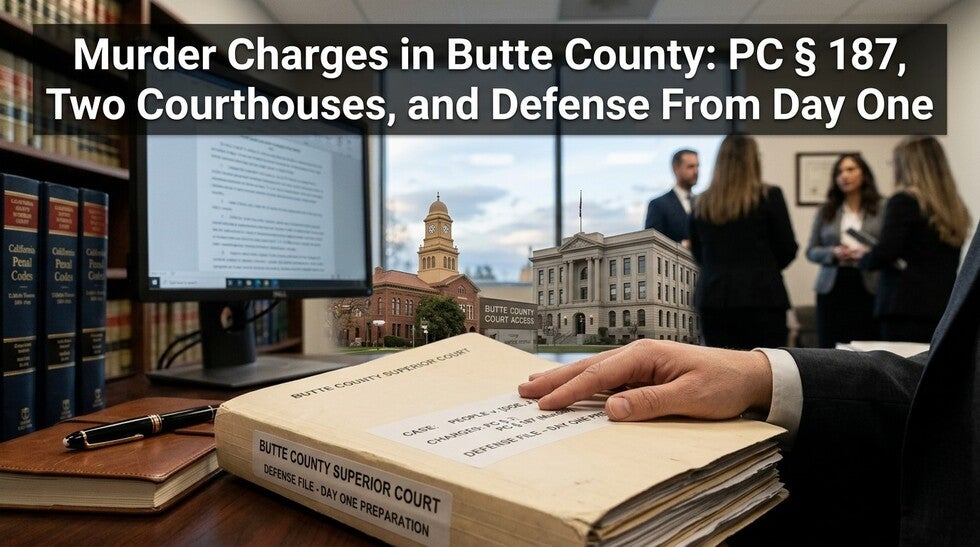
Burglary cases in Butte County are handled in the Superior Court of California, County of Butte. The Butte County Courthouse is located at One Court Street, Oroville, CA 95965-3303. The North Butte County Courthouse is located at 1775 Concord Avenue, Chico, CA 95928. These are public court facilities, and Bulldog Law has no affiliation, endorsement, partnership, or special access with the court.
A first degree burglary case is a felony and may involve arraignment, bail or release conditions, discovery, preliminary hearing, motion practice, negotiations, and trial setting. A second degree burglary case may proceed as either a felony or misdemeanor depending on charging and resolution. Retail cases may require early arguments that PC § 459.5 shoplifting, not commercial burglary, is the correct charge.
The defense should obtain police reports, surveillance video, body-camera footage, dispatch records, witness statements, property records, access communications, lease documents, utility records, receipts, and any evidence showing permission or lack of theft intent.
Immigration, student, employment, and housing consequences
Burglary convictions can carry serious consequences beyond jail or prison. First degree residential burglary can create immigration danger, housing barriers, employment problems, licensing issues, school discipline, and strike consequences. Non-citizens should get immigration-informed criminal defense advice before any plea.
For H-2A workers, agricultural employees, students, contractors, and rebuild workers, the wording of the charge and plea can matter. A reduction from first degree burglary to a lesser offense, a shoplifting classification, a misdemeanor resolution, or a non-theft alternative may be important where supported by the evidence and accepted by the court and prosecution.
In agricultural regions, burglary defenses may overlap with farm property, equipment access, barns, sheds, shops, or storage buildings. The local analysis in Tulare County burglary defense may share some rural-property issues with Butte County, though each case depends on its own facts.
Defenses to Burglary in Butte County
Burglary defenses should be built around the prosecution's specific theory. A Paradise rebuild case may focus on authorization. A CSU Chico student rental case may focus on whether the unit was inhabited. An Oroville-area property case may focus on temporary displacement or abandonment. A Chico retail case may focus on shoplifting classification and value.
Common defenses include:
- No intent to commit theft or a felony at the time of entry.
- Permission, consent, or good-faith belief in authorization.
- The structure was not inhabited for first degree burglary purposes.
- The case should be charged as PC § 459.5 shoplifting.
- Mistaken identity or unreliable video evidence.
- Owner, tenant, contractor, or employee misunderstanding.
- Insufficient evidence of value or intended theft.
- Illegal search, detention, or interrogation.
Other California counties can offer useful comparisons. A case involving Madera County burglary allegations may share rural property or agricultural access issues, while Butte County adds Paradise rebuild facts, CSU Chico housing patterns, and Oroville evacuation-zone history.
What to do after a burglary arrest in Butte County
Do not explain the entry, authorization, ownership, intent, or relationship to the property without legal advice. Innocent-sounding explanations can be misquoted or used to prove intent. It is safer to preserve evidence and let counsel communicate strategically.
After a burglary arrest, consider these steps:
- Save all citation, booking, release, bail, and court paperwork.
- Preserve texts, emails, contracts, leases, invoices, keys, codes, and access records.
- Identify witnesses who knew about permission or occupancy.
- Do not contact alleged victims in a way that could violate release terms.
- For student rentals, gather lease, utility, move-out, and property records.
- For Paradise rebuild cases, collect contractor and rebuild access documents.
- For retail cases, ask counsel to request preservation of surveillance video quickly.
- For non-citizens, get immigration advice before any plea.
Burglary in Butte County lawyers in California
Bulldog Law helps clients facing Burglary in Butte County, including PC § 459 first degree and second degree burglary, Paradise rebuild authorization defenses, CSU Chico student rental cases, Oroville-area occupancy disputes, retail shoplifting classification, immigration consequences, and proceedings in Chico and Oroville.
No lawyer can promise a dismissal, reduction, or specific outcome. What Bulldog Law can do is review the evidence, test the inhabited element, investigate authorization, challenge intent, identify overcharging, and build a defense focused on what prosecutors must prove beyond a reasonable doubt.