
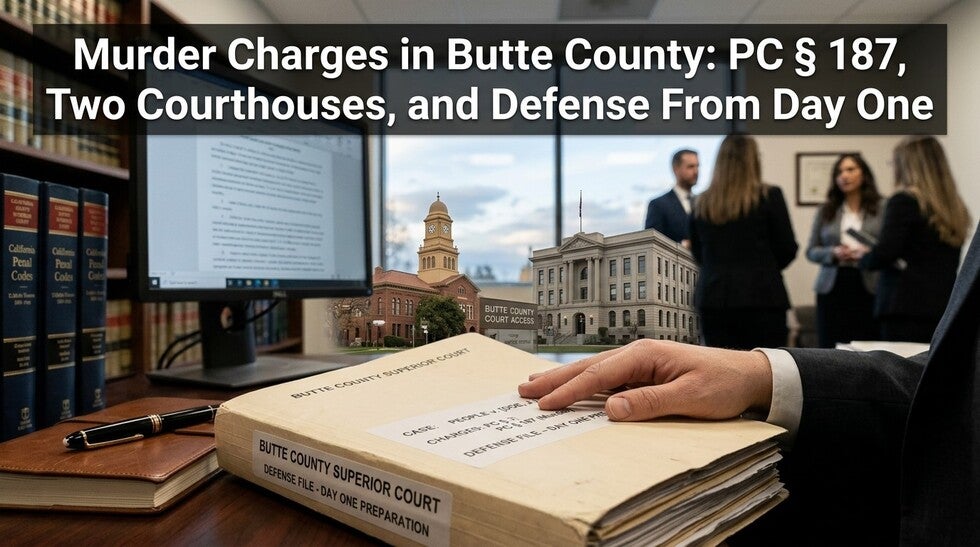
Murder charges in Butte County are among the most serious allegations a person can face in California. A Penal Code § 187 case can expose the accused to life imprisonment, intense law enforcement investigation, forensic evidence, witness statements, and early court proceedings that shape the entire defense. The first days matter because the prosecution's version of events can harden quickly if the defense is not investigating at the same time.
Butte County cases can involve incidents in Chico, Oroville, Paradise, Gridley, Biggs, and surrounding North Valley communities. The facts may involve a domestic conflict, a street confrontation, a suspected gang allegation, an alleged killing during another felony, or a long history between the accused and the deceased. No two murder cases are the same, and the defense strategy must be built around the evidence, the law, and the local court process.
What murder charges in Butte County require under PC § 187
California Penal Code § 187 defines murder as the unlawful killing of a human being, or a fetus, with malice aforethought. In practical terms, the prosecution must prove more than a death and more than the defendant's involvement. It must prove the mental state required for murder.
Malice can be express or implied. Express malice generally means an intent to kill. Implied malice can apply when the prosecution claims the defendant intentionally committed an act dangerous to human life, knew the danger, and acted with conscious disregard for life. The exact theory matters because it affects defenses, jury instructions, degree of murder, and plea negotiations.
California murder law is separate from federal murder law, but the concepts sometimes overlap in language. Clients with cases involving federal investigation, interstate conduct, or related federal allegations should understand that malice aforethought in federal murder cases may be analyzed under a different statutory framework than a Butte County PC § 187 prosecution.
First-degree and second-degree murder charges in Butte County
California murder is generally charged as first degree or second degree. First-degree murder can include willful, deliberate, and premeditated killings, certain listed methods such as lying in wait or poison, and killings committed during certain listed felonies. Second-degree murder covers other murders that do not meet the requirements for first degree.
The sentencing exposure is severe. First-degree murder can carry 25 years to life, life without the possibility of parole, or in legally eligible special circumstance cases, death, although California's death penalty system involves additional law and procedure. Second-degree murder generally carries 15 years to life, with higher terms in certain situations, such as specified peace officer victim cases or certain drive-by shooting allegations.
The difference between first and second degree can turn on careful factual questions:
- Was there evidence of planning, or did the incident unfold suddenly?
- Did the accused have time to deliberate, or was the confrontation impulsive?
- What did witnesses actually see and hear?
- Do phone records, surveillance footage, or location data support or undermine premeditation?
- Was the prosecution's theory based on intent to kill, implied malice, or felony murder?
A California PC § 187 case should not be analyzed as if it were a federal prosecution. For comparison, first-degree and second-degree murder under federal law involves different statutes, definitions, and sentencing rules.
How murder charges in Butte County move through the two courthouses
Butte County Superior Court lists two courthouse locations: the Butte County Courthouse at One Court Street, Oroville, CA 95965-3303, and the North Butte County Courthouse at 1775 Concord Avenue, Chico, CA 95928. The court's Criminal Division is listed at the Butte County Courthouse in Oroville and handles felony criminal matters for the county.
Because court assignments, calendars, remote appearance rules, and hearing locations can change, defendants and families should rely on the court notice, minute order, attorney instructions, or official calendar for the exact location of any appearance. Murder cases often involve arraignment, bail or detention issues, discovery litigation, preliminary hearing settings, readiness conferences, motion practice, and trial preparation. Missing a court date or misunderstanding the location can create serious problems.
The preliminary hearing is one of the first major contested proceedings in a California felony case. The prosecution must present enough evidence for the court to hold the defendant to answer. Although the standard is lower than proof beyond a reasonable doubt, the hearing can be critical because defense counsel may cross-examine witnesses, expose inconsistencies, test forensic assumptions, and preserve testimony for later impeachment.
Why defense from day one matters in a PC § 187 case
In a murder case, the government investigation begins immediately. Detectives may interview witnesses, collect digital evidence, obtain search warrants, review surveillance footage, process firearms or biological evidence, and work with prosecutors before the defense has access to the full discovery file.
Defense from day one means the defense team does not simply wait for police reports. It means identifying and preserving evidence before it disappears. That may include:
- Surveillance footage from homes, businesses, roads, gas stations, or apartment complexes
- Text messages, call logs, social media messages, and location data
- Prior threats, restraining order history, or documented conflict between the parties
- Witnesses who saw the events before, during, or after the incident
- Medical, mental health, trauma, intoxication, or sleep deprivation evidence when relevant
- Forensic issues involving firearms, DNA, blood evidence, cause of death, or time of death
Early defense work is especially important when law enforcement has already labeled the case as premeditated, gang-related, or connected to another felony. Those labels can influence charging decisions, bail arguments, media narratives, and plea discussions.
Special circumstances, gang allegations, and AB 333 issues
Some murder charges include special circumstance allegations under Penal Code § 190.2. If found true, special circumstances can expose a defendant to life without the possibility of parole or, in legally eligible cases, death. Examples can include murder during certain listed felonies, multiple murder allegations, witness-related allegations, and certain gang-related allegations.
Gang allegations require especially close review. California's STEP Act gang enhancement statute, Penal Code § 186.22, was changed by AB 333. The prosecution must prove specific statutory elements, including that the alleged criminal street gang meets the legal definition, that the predicate offenses satisfy timing and common-benefit requirements, and that the current charged offense is not used to establish the required pattern of criminal gang activity.
A gang label is not enough. The defense may challenge whether the alleged benefit was more than reputational, whether the incident was personal rather than gang-motivated, whether the predicate offenses qualify, and whether the prosecution's expert testimony is supported by admissible evidence. In some cases, federal violent crime allegations can create additional exposure, and federal violent-crime sentencing questions require a separate analysis from a Butte County gang allegation.
Felony murder and SB 1437 in Butte County murder cases
California narrowed felony murder liability through changes associated with SB 1437. Under current Penal Code § 189, a participant in certain listed felonies in which a death occurs is liable for murder only if the person was the actual killer, aided and abetted the actual killer with intent to kill, or was a major participant in the underlying felony and acted with reckless indifference to human life. There is also a statutory peace officer exception.
This issue is critical for non-killer defendants. A person accused of robbery, burglary, kidnapping, or another listed felony may face murder allegations even if the prosecution does not claim that person personally killed anyone. The defense must examine the person's actual role, knowledge, planning, proximity to the killing, ability to prevent the death, and conduct before and after the incident.
Felony murder issues can also arise in federal sentencing contexts. When a drug case involves an alleged death, a death alleged in a federal drug case can change the guideline analysis, but that is different from a California PC § 187 felony murder prosecution.
Voluntary manslaughter, heat of passion, and imperfect self-defense
Not every unlawful killing is murder. California voluntary manslaughter can apply when a killing occurs upon a sudden quarrel or heat of passion, or when imperfect self-defense reduces murder because the defendant actually believed deadly force was necessary but that belief was legally unreasonable.
These defenses are fact-intensive. The defense may need to develop the complete history between the accused and the deceased, not just the final moments. Prior threats, escalating disputes, trauma, intoxication, physical size differences, weapons evidence, and witness perceptions can all matter.
In Paradise and nearby communities affected by the Camp Fire, the history between people may include displacement, property disputes, rebuild stress, family trauma, or long-running neighborhood conflict. That background does not excuse homicide by itself. It may, however, become relevant if it helps explain the accused person's perception of threat, emotional state, or response to provocation under recognized California law.
Other defenses and strategy issues in a Butte County PC § 187 case
A murder defense can involve multiple overlapping strategies. Some focus on identity. Others focus on mental state, degree, justification, forensic reliability, witness credibility, or whether the prosecution can prove causation beyond a reasonable doubt.
Potential defense issues may include:
- Self-defense or defense of another
- Imperfect self-defense reducing murder to voluntary manslaughter
- Heat of passion or sudden quarrel
- Lack of premeditation and deliberation
- No malice, or insufficient evidence of implied malice
- Misidentification or unreliable eyewitness testimony
- False confession, coercive interrogation, or Miranda issues
- Illegal search, seizure, phone extraction, or warrant problem
- Unreliable forensic conclusions or incomplete forensic testing
- Failure to prove major participation or reckless indifference in a felony murder theory
The best defense path depends on the evidence. A case involving a single eyewitness is different from a case involving surveillance footage, cell-site data, DNA, multiple defendants, jail calls, or expert forensic testimony. Defense counsel must also consider immigration consequences for noncitizens, firearm enhancements, strike consequences, parole eligibility, and the effect of any special circumstance allegation.
What families should do after an arrest for murder in Butte County
Families often want to help immediately, but the wrong step can harm the defense. A person accused of murder should not discuss the facts with detectives, jail staff, other inmates, friends, relatives, or anyone on recorded jail calls. Loved ones should assume that jail phone calls, video visits, and messages may be monitored.
Practical steps may include:
- Help the accused invoke the right to remain silent and request a lawyer.
- Do not contact witnesses about what they should say.
- Preserve messages, photographs, videos, call logs, and social media records.
- Write down the names of potential witnesses and where they can be found.
- Save information about prior threats, conflicts, or self-defense evidence.
- Avoid posting about the case online.
- Get defense counsel involved before evidence disappears.
California murder law applies statewide, but local practice can vary by county, courthouse, prosecutor, and facts. A defense approach in murder defense in San Bernardino County may involve different logistics than a Butte County prosecution, while PC § 187 cases in Santa Clara County may move through a different court system and local process.
Murder charges in Butte County lawyers in California
Murder charges in Butte County require immediate, serious, and evidence-driven defense work. The prosecution may already be building a theory of premeditation, malice, gang benefit, felony murder, or special circumstances. The defense must begin its own investigation before memories fade, video is overwritten, digital records are lost, or early testimony becomes the foundation for the rest of the case.
Bulldog Law defends serious California criminal cases with a focus on early investigation, careful legal analysis, and strategic preparation from the start. If you or a loved one is facing a PC § 187 allegation in Butte County, speak with a defense lawyer before answering questions, discussing the facts, or making decisions that could affect the case.