
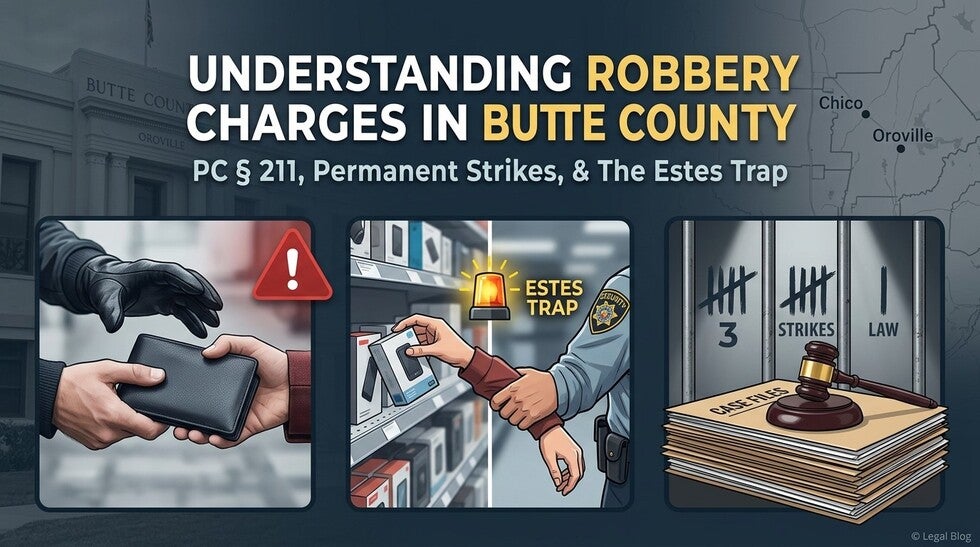
Robbery Charges in Butte County are prosecuted under Penal Code § 211 when the government claims that property was taken from another person, or from the person's immediate presence, against that person's will, by force or fear. Unlike shoplifting or many theft offenses affected by Proposition 47, robbery remains a felony. It can create strike exposure, violent felony consequences, prison time, immigration problems, professional licensing barriers, and long-term damage that reaches far beyond the criminal case.
Many Butte County robbery cases do not begin as armed robberies. They begin as retail theft allegations in Chico or Oroville, student incidents near CSU Chico, disputes in parking lots, convenience store confrontations, or alleged shoplifting that escalates when loss prevention gets involved. The key defense question is often whether the prosecution can prove force or fear, not simply whether property was taken.
What Robbery Charges in Butte County require under PC § 211
California robbery requires more than theft. The prosecution must prove a taking from the person or immediate presence of another, against that person's will, accomplished by force or fear. That force or fear element is what separates robbery from ordinary theft in many cases.
A robbery case may involve:
- Alleged force used to take property directly from someone.
- Fear created by words, conduct, gestures, or display of a weapon.
- Property taken from a person's immediate presence, such as a counter, register, vehicle, or bag.
- Retail theft that allegedly turns into robbery during escape.
- A dispute over whether contact was intentional, forceful, or merely incidental.
The difference between burglary versus robbery matters because burglary focuses on entry with intent, while robbery focuses on taking property from a person or immediate presence by force or fear.
Robbery Charges in Butte County and Prop 47 limits
Proposition 47 reduced many lower-level theft and drug offenses, but it did not turn robbery into a misdemeanor. PC § 211 is not a wobbler. It is a felony. A person accused of robbery should not assume that retail value under $950 automatically makes the case shoplifting or petty theft.
That said, the value and setting can still matter. If the facts show only entry into an open store during business hours with intent to steal merchandise worth $950 or less, the defense may argue the case belongs in shoplifting territory rather than robbery. But if prosecutors claim force or fear against loss prevention, a store employee, or another person, they may try to escalate the case into robbery.
The defense goal in many retail cases is to prevent a misdemeanor theft allegation from becoming a felony strike through an exaggerated force-or-fear theory.
The Estes trap in Chico retail cases
An “Estes robbery” refers to a retail theft case where prosecutors claim the accused used force or fear during the effort to retain property or escape after taking it. These cases can arise when a person accused of shoplifting pushes past loss prevention, pulls away from a guard, struggles over a bag, turns a shoulder while leaving, or makes a statement that employees interpret as threatening.
Chico retail locations, including stores near Highway 99, the Chico Mall area, and retail corridors serving CSU Chico students and local residents, often have multiple surveillance cameras. That footage can be more important than the loss prevention report. A report may describe “force,” while the video may show confusion, incidental contact, a stumble, or a person simply trying to leave.
Defense evidence may include:
- All camera angles, not just the store's selected clip.
- Bodycam footage from responding officers.
- Loss prevention policies and training.
- Witness statements from customers or employees.
- Whether any property was actually retained.
- Whether alleged force occurred before or after the property was abandoned.
- Whether any fear was reasonable under the circumstances.
Surveillance retention windows can be short. The defense should request preservation immediately.
Oroville, Paradise, Gridley, and retail enforcement
Oroville retail cases may involve stores along Oro Dam Boulevard, Olive Highway, and other commercial areas. Paradise rebuild community cases may involve local stores, contractors, community members, and disputes in a community where legal accusations can become widely known. Gridley and Biggs cases may involve smaller retail settings, agricultural workers, and cross-county travel.
The legal standard is the same across Butte County, but the facts are local. A small store with one camera, a crowded Chico retailer, an Oroville parking lot, or a Paradise post-fire community setting can all change how witnesses perceive force, fear, identity, and intent.
Robbery defense should focus on what happened second by second. The difference between theft, attempted theft, battery, assault, and robbery can turn on a few seconds of video or one disputed movement.
Armed robbery, unarmed robbery, and federal exposure
Robbery does not require a firearm. A person can be accused of robbery based on force or fear without a weapon. But if prosecutors allege a firearm, knife, dangerous object, or firearm enhancement, exposure can increase sharply.
The difference between armed and unarmed robbery can affect sentencing, bail, plea negotiations, and federal risk. In some cases involving banks, commerce, federal property, interstate activity, or Hobbs Act theories, federal robbery defense may become necessary.
The defense should evaluate whether the alleged weapon was real, displayed, used, known to the alleged victim, or merely assumed. A vague statement, concealed hand, or disputed object should not be treated as a firearm without proof.
Sentencing, strike consequences, and proportionality
Robbery is a serious felony strike in California. It is also listed as a violent felony, which can affect custody credits and sentencing consequences. First degree robbery sentencing depends on the specific type of first degree robbery. Some first degree robbery cases carry three, four, or six years, while certain in-concert residential robberies can carry three, six, or nine years. Second degree robbery generally carries two, three, or five years.
Those ranges can change if enhancements are alleged, including firearm use, great bodily injury, prior strikes, prior serious felonies, or other aggravating factors. Because robbery can be treated much more severely than the underlying property value might suggest, robbery sentencing proportionality can become a central defense theme.
The defense should challenge overcharging early. A low-value retail incident with ambiguous contact should not be treated the same way as a planned armed robbery.
Immigration consequences for noncitizens in Butte County
Noncitizens facing robbery charges need immediate immigration-aware criminal defense. Robbery can create serious immigration consequences, including crime involving moral turpitude issues and possible aggravated felony analysis if the record and sentence meet federal immigration definitions. The exact consequence depends on the statute, plea language, sentence, immigration status, prior record, and federal law at the time of analysis.
For H-2A workers, DACA recipients, green card holders, visa holders, and undocumented defendants in Gridley, Biggs, Chico, Oroville, and surrounding agricultural communities, a robbery conviction can threaten removal defense, future visa options, adjustment, naturalization, and employment stability.
No noncitizen should accept a robbery plea without reviewing immigration consequences first. A sentence that seems manageable in criminal court may create the most damaging consequence in immigration court.
CSU Chico students and licensing consequences
For CSU Chico students, a robbery charge can affect more than the semester. A strike felony can create future disclosure duties, school discipline, scholarship issues, internship barriers, graduate school problems, and professional licensing concerns.
Students pursuing nursing, education, accounting, law enforcement, healthcare, social work, real estate, or other licensed fields should treat the criminal case and licensing future as connected. Licensing boards may evaluate honesty, rehabilitation, public safety, violence, theft, and the final conviction record.
The defense should consider:
- Whether the case can be reduced to theft or another non-strike offense.
- Whether force or fear is actually supported by evidence.
- Whether school discipline is pending.
- Whether restitution or mitigation can help.
- Whether the record should avoid unnecessary admissions about violence.
- Whether diversion or dismissal alternatives exist for lesser charges.
A student should not explain the incident to police, campus officials, employers, or licensing programs without legal advice.
Identification and surveillance defenses
Some robbery cases depend on identification. Witnesses may be stressed, frightened, distracted, or influenced by later discussions. Surveillance may be blurry, angled, incomplete, or unable to show the person's face clearly. Clothing, body type, vehicle descriptions, and social media assumptions can be unreliable.
Defense issues include:
- Lighting and camera quality.
- Distance and observation time.
- Whether the witness saw the person before or after stress began.
- Cross-racial identification concerns.
- Suggestive photo lineups or showups.
- Whether police confirmed identity through independent evidence.
- Whether clothing or vehicle evidence was shared by others.
When identification is disputed, the defense should obtain original video files, not just compressed clips or screenshots. Metadata, time stamps, camera angles, and full-store footage may matter.
How Butte County robbery cases compare with other counties
California robbery law is statewide, but local patterns matter. San Joaquin County robbery cases may involve Central Valley commercial corridors, warehouses, and transit routes. San Jose robbery charges often involve dense retail, technology-related evidence, and urban surveillance. Tehama County robbery and Shasta County robbery cases may involve rural retail, highway corridors, and smaller-community visibility.
Butte County cases often involve Chico retail surveillance, Oroville courthouse practice, Paradise rebuild community dynamics, Gridley agricultural workers, CSU Chico student consequences, and Highway 99 or Highway 70 movement.
Where Robbery Charges in Butte County are handled
Robbery Charges in Butte County are generally handled through the Criminal Division of the Butte County Superior Court at the Butte County Courthouse, located at One Court Street, Oroville, CA 95965. Butte County also operates the North Butte County Courthouse at 1775 Concord Avenue, Chico, CA 95928, but criminal misdemeanor and felony matters are handled through the criminal division in Oroville. Defendants should rely on court notices, attorney instructions, and official court communications for the correct hearing location and appearance requirements.
A robbery case may involve arraignment, bail or release conditions, protective orders, discovery, surveillance video, bodycam footage, witness statements, store loss prevention records, suppression motions, preliminary hearing, negotiations, trial readiness, and trial.
The early stage matters. If the prosecution labels a retail incident as robbery, the defense should immediately preserve video, challenge force or fear, and prevent the case from being defined by a one-sided store report.
Defenses to Robbery Charges in Butte County
Robbery defense depends on the exact facts. The strongest defense may be that no force or fear occurred, the property was not taken from a person or immediate presence, the accused was misidentified, the incident was only theft or shoplifting, or the prosecution exaggerated a brief retail confrontation.
Potential defenses include:
- No force or fear was used.
- Any contact was accidental or incidental.
- The alleged victim was not actually afraid.
- The property was abandoned before any confrontation.
- The accused did not take property from a person or immediate presence.
- The case is shoplifting or theft, not robbery.
- The accused was misidentified.
- Surveillance contradicts the report.
- The stop, search, or confession was unlawful.
- The case is overcharged as a strike felony.
The defense should also evaluate restitution, mitigation, reduction to theft-related charges, suppression issues, immigration-sensitive resolutions, licensing-sensitive outcomes, and trial strategy when the evidence does not prove robbery beyond a reasonable doubt.
What to do after a robbery arrest in Butte County
After a robbery arrest, do not explain what happened, why you left, what you touched, whether you were scared, or whether you meant to push anyone without legal advice. Statements made early can be used to prove force, fear, intent, or identity.
Important steps include:
- Invoke the right to remain silent.
- Do not discuss the case on recorded jail calls.
- Preserve receipts, messages, location data, and witness information.
- Request preservation of retail surveillance immediately.
- Identify every camera angle near the incident.
- For noncitizens, get immigration-aware defense before any plea.
- For students, coordinate criminal defense with school and licensing concerns.
- Do not contact witnesses, loss prevention, or alleged victims.
Fast defense work can preserve video, challenge an Estes escalation, reduce strike exposure, and protect immigration, licensing, education, and employment goals.
Robbery Charges in Butte County lawyers in California
Robbery Charges in Butte County require careful review of PC § 211, force or fear, Estes retail allegations, Prop 47 limits, strike consequences, sentencing exposure, immigration risks, CSU Chico licensing concerns, Paradise community visibility, identification issues, and courtroom strategy in Butte County Superior Court.
Bulldog Law defends California robbery cases involving retail theft escalation, Chico and Oroville surveillance, armed and unarmed allegations, identification disputes, student consequences, noncitizen defense, professional licensing issues, strike reduction strategy, and trial defense. If you or a loved one is facing robbery charges in Butte County, legal strategy should begin before video is erased, statements are made, or a shoplifting allegation becomes a permanent strike felony.