
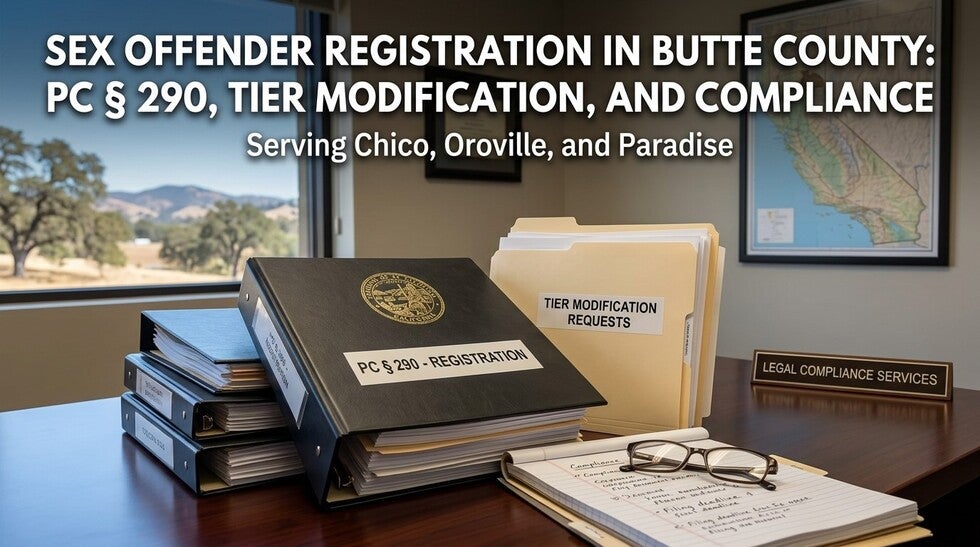
Sex Offender Registration in Butte County affects far more than a person's criminal record. Penal Code section 290 can affect housing, employment, travel, education, family life, community visibility, and the risk of a new criminal charge for an alleged registration mistake. For people living in Chico, Oroville, Paradise, Gridley, Biggs, and surrounding communities, compliance must be handled carefully and documented consistently.
California now uses a tiered registration system. Some registrants may be eligible to petition for termination after meeting the minimum registration period and compliance requirements. Others remain subject to lifetime registration. The correct strategy depends on the underlying conviction, tier designation, registration history, current residence, risk factors, rehabilitation evidence, and whether the person faces a failure-to-register allegation under PC § 290.018.
Sex Offender Registration in Butte County under PC § 290
PC § 290 requires registration for many California sex offense convictions and some out-of-state, federal, military, or juvenile adjudication situations. Registration is not one single act. It can include initial registration, annual updates, address changes, name changes, employment or school-related notices in some cases, transient registration, and other specific duties depending on the person's status.
A registrant should never rely on memory alone. Deadlines can be strict, and a misunderstanding can become a new criminal allegation. The safest approach is to keep copies of every registration form, receipt, appointment record, travel instruction, address update, and communication with the registering agency.
Many registration cases begin with the underlying sex offense. A person facing PC § 288 sex crime allegations should evaluate registration exposure before any plea, because some convictions can create lifetime consequences that are difficult or impossible to unwind later.
Sex Offender Registration in Butte County and California's tier system
California's tier system generally divides registrants into Tier 1, Tier 2, and Tier 3. Tier 1 generally involves a minimum registration period of 10 years. Tier 2 generally involves a minimum period of 20 years. Tier 3 generally involves lifetime registration. These timeframes are not automatic removal dates. Eligible registrants must usually petition for termination and obtain a court order.
Tier assignment depends on the offense, statute, age factors, risk-related rules, and other legal details. Some offenses that appear similar can produce very different registration outcomes. Certain sexual battery convictions, indecent exposure convictions, child-related convictions, and violent or aggravated sex offenses may fall into different tiers depending on the exact record.
When the underlying case involves alleged touching, sexual battery defense under PC § 243.4 can be important not only for jail or probation exposure, but also for future registration tier and termination issues.
Tier modification, tier review, and termination petitions
Many people use the phrase “tier modification” to describe two related issues: correcting or challenging a tier designation and petitioning to terminate registration after the minimum period. The precise remedy depends on the record. A person may need to review the conviction documents, sentencing orders, plea forms, prior registration notices, Department of Justice tier information, and any later changes in law.
A termination petition generally requires more than reaching the minimum number of years. The court may evaluate compliance history, new offenses, risk, rehabilitation, facts of the underlying offense, prosecutor objections, and public safety concerns. A strong petition should be built before filing.
Useful petition evidence may include:
- Proof of continuous registration compliance.
- No new qualifying offenses.
- Employment, education, and treatment history.
- Stable housing and community support.
- Letters from employers, counselors, mentors, or family members.
- Evidence of sobriety, therapy, parenting progress, or rehabilitation where relevant.
- Records correcting any mistaken allegation of noncompliance.
Compliance in Chico, Oroville, Paradise, and rural Butte County
Compliance can look different depending on where a person lives. Chico may involve apartment moves, student-area housing, shared residences, employment changes, campus-adjacent issues, and frequent address updates. Oroville may involve county-seat court proceedings, rural properties, temporary housing, and transportation barriers. Paradise and Magalia may involve rebuild-related address changes, temporary housing, RVs, family property, or moves between construction phases.
A registrant must treat every move as a legal event. Even a short-term stay, motel stay, temporary address, homelessness, or return to a rebuilt property can raise registration questions. A person who is transient may have separate reporting duties that are more frequent than ordinary annual registration.
Paradise rebuild issues can be especially complicated. A person displaced by the Camp Fire may have moved from temporary housing to family housing, then to a rental, then to a rebuilt residence. If the state alleges a missed address update, the defense should document the full timeline and whether any failure was willful rather than caused by confusion, displacement, illness, transportation, or unclear instructions.
PC § 290.018 failure to register allegations
Failure to register is a separate criminal charge. Under PC § 290.018, prosecutors generally must prove the failure was willful. That word matters. A missed deadline caused by mistake, misunderstanding, hospitalization, homelessness, jail transfer, agency confusion, or lack of clear notice may create a defense or mitigation argument.
The penalties depend on the underlying registration requirement and the alleged violation. A failure tied to a misdemeanor registerable conviction may be treated differently from a failure tied to a felony registerable conviction. A new conviction can also disrupt a person's registration history and damage a future termination petition.
Defense issues may include:
- The person did not know the specific duty.
- The person attempted to register but was turned away or misdirected.
- The agency records are incomplete or inaccurate.
- The address change was not legally reportable in the way alleged.
- Homelessness or transient status was misunderstood.
- The person was in custody, hospitalized, or otherwise unable to comply.
- The prosecution cannot prove willfulness beyond a reasonable doubt.
CSU Chico, schools, housing, and community visibility
Registration can affect CSU Chico enrollment, campus housing, student employment, campus access, and nearby housing. University policies are separate from PC § 290, but a person subject to registration should evaluate school rules before applying, moving near campus, attending events, or accepting employment connected to the university.
Registration also creates public visibility through California's public disclosure system for many registrants. In a county with smaller community networks, that visibility may affect work, dating, religious life, neighborhoods, contractors, landlords, and family relationships.
Some contact or harassment allegations can also overlap with registration status. Bulldog Law's guide to California stalking law under PC § 646.9 is relevant when a registrant is accused of repeated unwanted contact or conduct that could create new criminal exposure.
County comparisons can help show how local facts matter. Ventura County stalking allegations may involve different local housing, workplace, and court patterns than a Chico or Paradise case. Tulare County stalking defense may involve rural and agricultural community dynamics that differ from Butte County's CSU Chico and rebuild-community setting.
Electronic communications, harassment, and restraining orders
A registrant should be especially careful with texts, social media, dating apps, email, direct messages, group chats, and online comments. A message meant as an apology, explanation, or attempt to repair a relationship can become evidence in a harassment, stalking, restraining order, probation, parole, or registration-related case.
Electronic allegations may create separate exposure. Bulldog Law's article on electronic cyber harassment under PC § 653.2 explains why online conduct can become a criminal issue even when there is no physical contact.
Civil restraining orders can also affect daily life. A person facing civil harassment restraining order proceedings should understand that court orders, registration duties, probation terms, and school or employment restrictions can overlap but are not the same thing.
Sexual harassment communications, witnesses, and privilege
Some registration-related disputes involve workplace complaints, school complaints, protected communications, witnesses, or prior sexual misconduct allegations. The defense must evaluate who made each statement, who received it, whether the communication is privileged or confidential, and whether it can be used in court.
Bulldog Law's discussion of sexual harassment communication privilege is relevant when a registration issue overlaps with HR complaints, campus complaints, or civil proceedings.
Witness status can also matter. California law gives certain protections to sexual assault victims and witnesses in specified situations. Automatic immunity for sexual assault victims and witnesses may affect how statements, incentives, and credibility issues are analyzed.
Polygraph issues require caution too. Protections against polygraph requirements for sexual assault victims show why credibility disputes must be handled through lawful evidence, not assumptions or improper pressure.
Federal sex crime issues and registration consequences
Federal sex crime cases can create registration consequences in California and other jurisdictions. Online enticement, child exploitation, interstate communications, travel, coercion, image-based offenses, and federal sentencing can create consequences that differ from a state-only case.
Bulldog Law's guide to federal enticement and child exploitation defense is relevant when a person faces federal investigation and future registration exposure at the same time.
Federal law may also connect child exploitation, trafficking, and sexual offense theories in ways that affect charging, sentencing, and collateral consequences. Bulldog Law's article on child molestation and sex trafficking under federal law addresses that federal framework.
Victim-support statutes may appear in the broader system as well. Federal victim support for child sexual exploitation survivors reflects a separate legal framework from the defense issues in a registration or failure-to-register case.
Butte County court process for PC § 290 matters
Butte County criminal and post-conviction matters are handled in the Superior Court of California, County of Butte. The Butte County Courthouse is located at One Court Street, Oroville, CA 95965-3303. The North Butte County Courthouse is located at 1775 Concord Avenue, Chico, CA 95928. These are public court facilities, and Bulldog Law has no affiliation, endorsement, partnership, special access, or special relationship with the court.
A termination petition, tier-related dispute, or PC § 290.018 failure-to-register case may involve court records, registration proof, prosecutor review, law enforcement records, notices, hearings, and evidence of rehabilitation or compliance. The correct filing location and procedure should be confirmed from the person's current residence, prior case history, and current court rules.
For a failure-to-register case, the defense should immediately request and preserve registration records, appointment records, prior forms, address documents, custody records, medical records, travel documents, and any proof that the failure was not willful.
What to do if you are subject to registration in Butte County
Compliance should be documented like a legal file, not handled casually. A person who is eligible for relief should also prepare early, because a termination petition is stronger when years of records are organized before the filing date.
Practical steps include:
- Keep copies of every registration receipt and form.
- Calendar annual registration and address-change deadlines.
- Document every move, temporary stay, hotel stay, or transient period.
- Ask for written clarification if an instruction is unclear.
- Do not assume a verbal answer protects you without documentation.
- Preserve treatment, employment, housing, and rehabilitation records.
- Get legal advice before applying to CSU Chico, changing residences, or petitioning for termination.
- Contact counsel immediately if accused of failure to register.
Sex Offender Registration in Butte County lawyers in California
Bulldog Law helps clients address Sex Offender Registration in Butte County, including PC § 290 compliance, tier review, termination petitions, PC § 290.018 failure-to-register defense, Chico and Oroville court proceedings, Paradise rebuild address issues, CSU Chico policy concerns, electronic communication risks, and related sex offense consequences.
No lawyer can promise tier reduction, termination, dismissal, or a specific court outcome. What Bulldog Law can do is review the record, identify eligibility, document compliance, challenge willfulness, prepare rehabilitation evidence, and build a strategy focused on the exact facts and legal requirements that apply.