
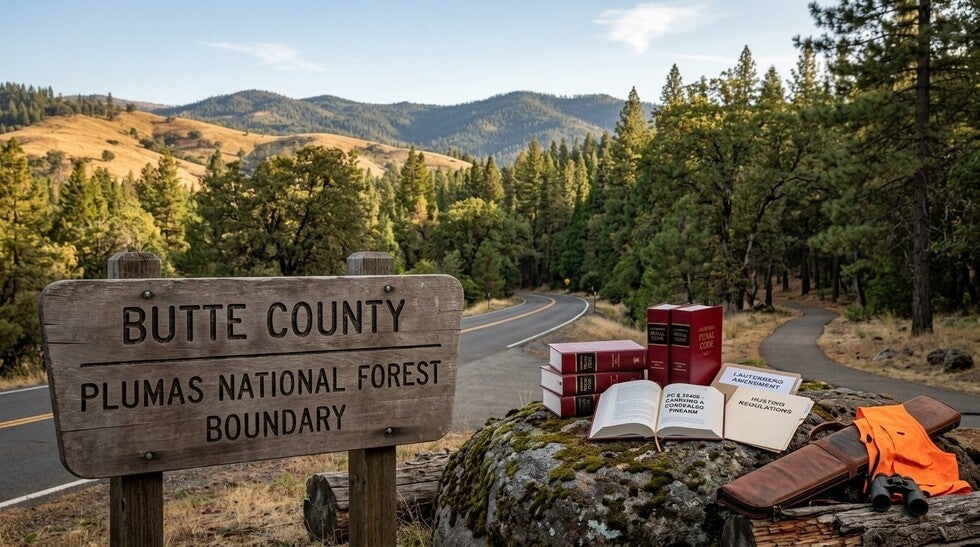
Weapons charges in Butte County often begin with a traffic stop, a hunting-season contact, a search during a domestic violence investigation, or a firearm found in a vehicle. Under California Penal Code § 25400, prosecutors may charge a person with carrying a concealed firearm when a pistol, revolver, or other firearm capable of being concealed on the person is carried concealed in a vehicle, carried concealed on the person, or caused to be carried concealed in a vehicle where the person is an occupant.
These cases can look very different in Chico, Oroville, Gridley, Paradise, Biggs, or on rural routes leading toward hunting areas. A Butte County firearm case may involve lawful ownership, unclear transportation rules, a valid hunting purpose, a prior conviction, an out-of-state visitor, or a search that should never have happened. The defense starts with the facts of possession, the lawfulness of the stop, and the exact way the firearm was stored or carried.
What weapons charges in Butte County can involve under PC § 25400
Penal Code § 25400 is focused on concealed firearms that are capable of being concealed on the person. It is not a general ban on every firearm in every vehicle. Still, a PC § 25400 arrest can become serious quickly if the prosecution alleges that the firearm was loaded, stolen, unregistered to the accused, connected to gang allegations, or possessed by someone legally prohibited from having firearms.
A basic misdemeanor PC § 25400 case can expose a defendant to jail, fines, probation, firearm restrictions, and a criminal record. Depending on the facts, the same charge can be filed as a felony or can carry felony exposure. Issues that may increase risk include:
- A prior felony conviction or other disqualifying conviction
- An allegation that the firearm was stolen
- A claim that the firearm and usable ammunition were readily accessible
- A claim that the accused was not the registered owner of the concealable firearm
- A prior domestic violence conviction or protective order issue
- A stop near a school, courthouse, jail, or other sensitive location
California weapons statutes were reorganized without always changing the underlying substance, so older case law can still matter in modern defense work. A lawyer evaluating preserved weapons-law precedent may find authority that affects search issues, statutory interpretation, or the prosecutor's theory of concealment.
Weapons charges in Butte County and firearm transport rules
The draft version of many firearm cases sounds simple: the gun was in the car, so the person must be guilty. California law is more specific than that. For handguns, lawful transport generally requires the firearm to be unloaded and locked in the trunk or in a locked container, not a glove box or utility compartment. For rifles and shotguns that are not concealable firearms, the transport rules are different, but they generally must still be unloaded while transported.
California law does not create one universal rule that all ammunition must always be stored separately from every firearm. However, whether ammunition was in the firearm, immediately accessible, or paired with a concealable firearm can affect charging, proof, and potential felony exposure. That is why photographs, bodycam footage, inventory sheets, and the officer's exact description of the firearm's location matter.
Defense questions in a transport case often include:
- Was the firearm actually concealed under PC § 25400?
- Was it a handgun, rifle, shotgun, registered assault weapon, or another regulated firearm?
- Was the firearm unloaded under the applicable definition?
- Was the container legally locked?
- Was the firearm in the trunk, passenger area, console, backpack, case, or under a seat?
- Was the accused the driver, passenger, owner, borrower, or someone with no knowledge of the gun?
- Did law enforcement have a lawful reason to stop, detain, search, or extend the encounter?
When a weapons statute has been renumbered or reorganized, California weapons-law continuity under Penal Code § 16010 can help frame why older statutory language and older judicial decisions may still matter in a current Butte County case.
Plumas National Forest hunting and Highway 70 transport issues
Butte County residents and visitors may travel east on Highway 70 toward Plumas National Forest and nearby hunting areas. Hunting may be lawful during the proper season with the proper license, tags, location, and compliance with California Department of Fish and Wildlife rules. That does not mean every firearm transportation method is lawful once the hunter is driving on a public road.
A licensed hunting purpose can be important context, but it is not a complete defense to every weapons charge. Penal Code § 25640 provides an important exemption for licensed hunters and fishermen carrying concealable firearms while engaged in hunting or fishing, or transporting those firearms unloaded when going to or returning from the expedition. The details matter. The firearm type, whether it was unloaded, whether the person was actually going to or returning from hunting, and where the contact occurred can all affect the defense.
For long guns, California Fish and Game rules and loaded-firearm laws may become more important than PC § 25400. A hunter with a rifle in a vehicle may face a different analysis than a person with a concealed handgun in the center console. A national forest route also does not erase state firearm law. In many situations, federal land rules and California law must be read together.
Gridley, Biggs, ranching culture, and public road firearm contacts
In rural Butte County communities, firearms may be part of ranching, agricultural work, predator control, livestock protection, and remote property life. That cultural context may help explain why a firearm was present, but it does not automatically answer the legal question.
A firearm that is lawful on private property may create legal risk when the person drives onto a public highway, county road, or other way open to the public. The defense may need to show the practical agricultural purpose, the location of the contact, the route taken, the storage method, the firearm type, and whether the person knowingly violated any law.
For a rancher, hunter, or agricultural worker, the defense should avoid treating the case as a generic “gun in car” case. The better approach is to document the work purpose, location history, property boundaries, firearm storage habits, and any facts showing that the accused was trying to comply with the law.
The Lautenberg issue in Butte County weapons cases
The Lautenberg Amendment is the common name for the federal firearm prohibition tied to certain misdemeanor crimes of domestic violence. Under federal law, a qualifying domestic violence misdemeanor conviction can prohibit possession of firearms and ammunition. A felony conviction may create separate federal and California firearm prohibitions.
This issue is technical and often misunderstood. A person may have resolved a domestic violence case years earlier as a misdemeanor without realizing it could affect firearm rights later. A California dismissal, expungement, reduction, or state-law restoration step does not always eliminate a federal firearm disability. The exact conviction, relationship element, advisements, plea documents, sentence, and any later relief must be reviewed carefully.
In a Butte County PC § 25400 case, a prior domestic violence conviction can change the risk analysis. A state concealed-firearm arrest may raise federal questions if the accused was legally prohibited from possessing the firearm or ammunition. The prosecution does not need to prove a “Lautenberg” issue for every PC § 25400 case, but defense counsel should identify that risk before the client makes statements about ownership, possession, storage, or the reason the firearm was in the vehicle.
Paradise rebuild storage and compliance situations
Paradise and surrounding communities affected by the Camp Fire have faced unusual firearm-storage realities. Families lost homes, moved into temporary housing, stored belongings with relatives, used job trailers, rebuilt properties, and moved firearms during long periods of displacement. Those facts do not create a blanket exemption from California firearm law, but they can be important in understanding intent, storage decisions, and the practical reason a firearm was being transported.
A Paradise rebuild case may turn on records showing where the firearm was stored before the contact, why it was moved, whether the person was going directly between lawful locations, and whether the firearm was unloaded and secured in a legally meaningful way. Receipts, insurance documents, rebuild records, temporary housing records, photographs, and messages can all become useful defense evidence.
Where weapons cases are handled in Butte County
The Superior Court of California, County of Butte has courthouse locations in Oroville and Chico. The Butte County Courthouse is located at One Court Street in Oroville. The North Butte County Courthouse is located at 1775 Concord Avenue in Chico. The court lists its Criminal Division at the Butte County Courthouse in Oroville, and that division handles criminal misdemeanor and felony matters for the county.
Defendants should follow the court notice, attorney instructions, minute order, or official calendar for the exact hearing location. A weapons case may involve arraignment, bail or release conditions, protective orders, firearm surrender issues, discovery, motion practice, plea negotiations, and trial settings. Some cases also involve DMV issues, probation holds, domestic violence protective order violations, or federal referral concerns.
Special locations can also change the analysis. A firearm or weapon allegation near a school may require separate review of school grounds weapons allegations under Penal Code § 626.10, while an allegation involving a jail, prison, or custodial setting can raise very different risks under correctional-facility weapons and contraband allegations under PC § 4574.
Defense strategies for weapons charges in Butte County
A strong defense starts with the stop. Many Butte County weapons cases begin as traffic stops on Highway 99, Highway 70, Highway 32, the Skyway, rural county roads, or city streets in Chico or Oroville. If the stop, detention, pat-down, vehicle search, inventory search, probation search, or warrant search was unlawful, the defense may seek to suppress the firearm and related statements.
Other defense issues may include lack of knowledge, lack of control, lawful transport, valid hunting or fishing exemption, no concealment, no loaded firearm, inaccurate police assumptions, unlawful questioning, Miranda violations, bodycam inconsistencies, and chain-of-custody problems. In some cases, the most important goal is avoiding a firearm-prohibiting conviction, protecting immigration status, preventing a felony record, or preventing the case from expanding into federal exposure.
Local facts matter, but California firearm law is statewide. Strategies used in San Bernardino County concealed firearm defense may overlap with Butte County cases, while Bakersfield PC § 25400 weapons charges and Sacramento County concealed firearm cases can involve different local practices, court calendars, and prosecutorial approaches.
What to do after a weapons arrest in Butte County
After a firearm arrest, the safest first step is to stop talking about the facts and ask for a lawyer. Statements that sound harmless, such as “it was mine,” “I forgot it was loaded,” “I keep it for protection,” or “I have a prior domestic violence case but it was expunged,” can create problems in state court, federal review, or future firearm-rights analysis.
Helpful steps include:
- Do not discuss firearm ownership, purpose, storage, or prior convictions with law enforcement without counsel.
- Preserve photographs, hunting licenses, tags, route information, and receipts for firearm cases or locks.
- Write down where the firearm was located, but do not post or text about the case.
- Save court paperwork from any prior domestic violence, felony, restraining order, or firearm-related case.
- Identify whether the contact happened on private property, a public road, national forest land, school property, or near a custodial facility.
- Preserve bodycam-related details, officer names, tow paperwork, inventory sheets, and citation documents.
- Assume jail calls, recorded messages, and social media posts may be used in court.
Weapons charges in Butte County lawyers in California
Weapons charges in Butte County require careful, early review of California firearm law, federal firearm restrictions, local court procedure, and the facts of the stop or search. A PC § 25400 case involving a hunter, rancher, Paradise rebuild resident, out-of-state visitor, or person with an old domestic violence conviction should not be treated as a routine misdemeanor without deeper analysis.
Bulldog Law defends serious California criminal cases with attention to search issues, firearm transport rules, prior-conviction consequences, and the client's long-term record. If you or a loved one is facing a Butte County weapons charge, legal strategy should begin before statements are made, evidence disappears, or a preventable firearm-rights issue becomes harder to fix.