
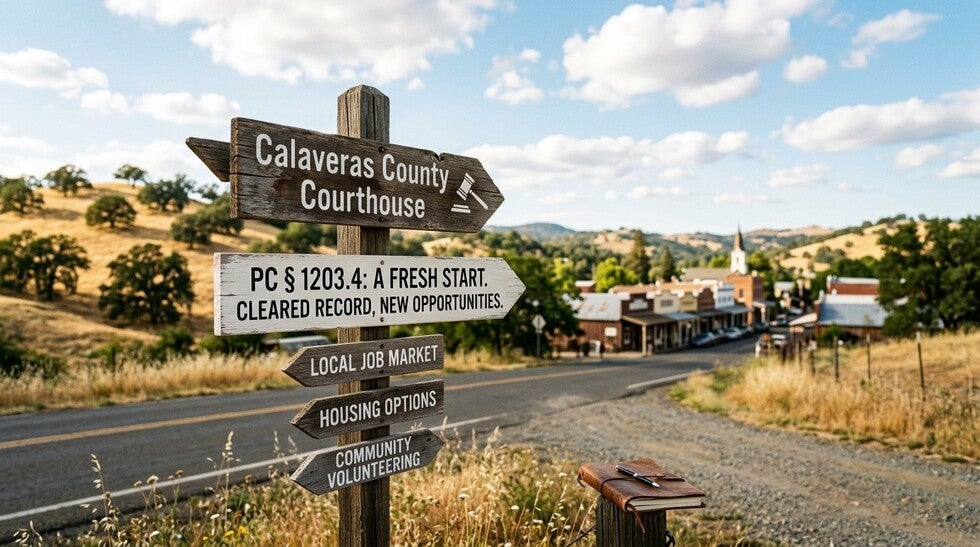
A conviction that is years behind you should not keep following you forward. But in a county of 45,000 people, where the same faces show up at the hardware store, the school parking lot, the local diner, an old record travels through the community in ways that a big city never experiences. I have seen a nurse in San Andreas stall on her BRN advancement for years because of a drug possession conviction she completed probation on three years ago. I have seen a contractor in Murphys lose business because of a felony theft charge from six years back that still circulates through word of mouth. PC § 1203.4 expungement gives these people a real, formal, court-recognized path forward. And in a small county, that formal closure matters more than most people realize.
What PC § 1203.4 Expungement Actually Does
PC § 1203.4 expungement is not just paperwork. It is a formal court action where the judge withdraws your guilty plea, enters a not guilty plea, and dismisses the case.
After that happens, most private employer background checks stop returning the conviction. The legal record shows a dismissal under the expungement statute, not a conviction. And in Calaveras County's small community, that formal court-recognized dismissal carries real weight with the social and employment networks that shape daily life here.
There is no deadline to petition after probation is completed. An old conviction from years ago is still eligible today.
Eligibility in Calaveras County
PC § 1203.4 is available when probation has been successfully completed, or when early discharge was granted by the Calaveras County Superior Court, and you are not currently serving a sentence or on probation for any other matter.
Probationary felonies, misdemeanor convictions, and conditional sentences all qualify. State prison sentences require a different relief pathway, and we identify the right one at the first consultation.
The key point most people miss: there is no time limit. You can petition years after probation ended. The pathway stays open whenever you are ready to use it.
The Three-Step Process
Prop 47 Reclassification if Applicable
If you have a pre-November 2014 felony drug conviction that would be a misdemeanor under Prop 47 today, the first step is a PC § 1170.18 petition. This permanently converts the felony to a misdemeanor before the expungement petition follows.
This step matters enormously for licensing boards that treat felony and misdemeanor convictions very differently.
PC § 17(b) Wobbler Reduction
If your felony conviction was a wobbler, meaning the judge had the option to charge it as either a misdemeanor or a felony, PC § 17(b) allows the Calaveras County Superior Court to permanently reduce it to a misdemeanor upon completing felony probation.
For a nurse whose BRN status is more seriously affected by a felony than a misdemeanor, for a teacher whose CCTC credentials respond differently to each designation, and for contractors and other licensed professionals, the felony-to-misdemeanor reclassification is often just as important as the expungement itself. Sometimes more.
The two-step process, PC § 17(b) reduction followed by PC § 1203.4 expungement, produces background check and licensing outcomes that expungement alone simply cannot achieve. We pursue both at the San Andreas courthouse wherever eligible.
PC § 1203.4 Expungement
The court withdraws the guilty plea, enters not guilty, and dismisses the case. Most private employer background checks stop returning the conviction. The record reflects a dismissal, not a conviction.
What Expungement Opens in Calaveras County
Professional licensing and community standing in a small county
Here is something that surprises most people. Expungement does not eliminate the disclosure obligation for most professional licensing boards. You may still need to disclose, but how that disclosure reads changes completely.
The PC § 1203.4 dismissal language shows that the Calaveras County Superior Court formally recognized your completed probation and dismissed the case. That is specific, documented evidence of rehabilitation. Licensing boards weigh it differently than an open conviction. Completely differently.
Think about the nurse in San Andreas. Her BRN advancement review kept stalling on a drug possession conviction she finished probation on three years ago. After expungement, the board sees a dismissed case with documented rehabilitation, not an active conviction. That changes the conversation.
In Calaveras County, the professional licensing dimension and the community standing dimension are deeply connected. The same community that includes your professional relationships also includes the social networks, the local employers, the neighbors who have heard things. The expungement dismissal addresses both at once, formal documentation of rehabilitation for the licensing board, and formal court-recognized closure for the community knowledge network.
We advise on the specific licensing board disclosure requirements and the community standing dimension at the very first consultation for every applicable Calaveras County licensee.
According to the California Department of Consumer Affairs, an expungement under PC § 1203.4 is a factor licensing boards must consider as evidence of rehabilitation when evaluating license applications and renewals.
Mother Lode Community Standing Restoration
For Calaveras County residents throughout the Mother Lode communities, Angels Camp, Murphys, San Andreas, Mokelumne Hill, Valley Springs, expungement provides something that matters beyond the background check.
In a small county, word travels. A conviction from years ago becomes part of what people know about you, at the school, at the hardware store, in the business community. The formal court-recognized dismissal changes what the community officially knows. It is not erasure. It is closure. And in a community this size, that formal closure carries real weight.
I have seen clients walk out of the San Andreas courthouse after an expungement hearing with something you cannot put a number on, the ability to say, and to show, that the court formally recognized their rehabilitation. In a small county, that matters in ways it simply does not in a big city.
We pursue expungement as part of the broader community-level standing restoration that Calaveras County residents rebuild alongside their professional and personal lives.
According to the California Courts self-help guide, PC § 1203.4 expungement allows courts to dismiss a conviction and is recognized as a formal legal record of rehabilitation.
What Expungement Does Not Change
Honesty matters here, and we are always upfront about the limits at the very first consultation.
Firearms rights are not restored by expungement. Lautenberg prohibitions are not removed. Government employment and most professional licensing boards still require disclosure of expunged convictions, the expungement changes how that disclosure is characterized and how much weight the board gives it, not whether the disclosure must be made.
The conviction also remains in law enforcement databases. Expungement is not invisibility, it is formal, documented rehabilitation that changes how the record reads in the places where it matters most.
We address every one of these limitations specifically at the first consultation so you know exactly what you are getting and what to expect.
The Courthouse and Timeline
Your Calaveras County expungement petition is filed at:
Calaveras County Superior Court 400 Government Center Drive, San Andreas, CA 95249
We prepare complete petitions and appear at every required hearing. There is no deadline to petition after probation completion, the pathway stays open whenever you are ready.
To get started, contact The Bulldog Law or call (888) 928-1609.
After a DUI Arrest in Calaveras County
These are the steps that matter most when you are thinking about pursuing expungement:
-
Check your probation status first. You must have successfully completed probation, or received early discharge, and must not currently be on probation or serving a sentence for any other matter.
-
Identify your conviction type. Probationary felony, misdemeanor, or conditional sentence, all qualify. State prison sentences need a different pathway. We identify the right one at the first consultation.
-
Ask about PC § 17(b) reduction if your conviction was a wobbler felony. Reducing it to a misdemeanor before the expungement petition can make a significant difference for professional licensing outcomes.
-
Ask about Prop 47 reclassification if you have a pre-2014 felony drug conviction. Reclassifying it to a misdemeanor first changes the entire expungement picture.
-
Document your rehabilitation. Employment history, community involvement, completed programs, all of this gives the court context that shapes the outcome.
-
Call (888) 928-1609 now. There is no deadline, but the sooner you start, the sooner your record reflects who you are today, not who you were then.
Final Thoughts on Expungement in Calaveras County
In a big city, an old conviction is one record in a sea of millions. In Calaveras County, it is something people know. It follows you to work, to community events, through professional licensing reviews that keep coming back to the same adverse factor year after year.
PC § 1203.4 expungement does not erase the past. But it gives the court, and the community, and the licensing boards, the formal, documented evidence that you completed what was required of you and that the case is closed.
For the nurse in San Andreas. The teacher in Angels Camp. The contractor in Murphys whose business keeps taking hits from something he paid his debt for six years ago. The pathway is real. The results are real. And there is no deadline, it is available right now.
I would love to hear from you about your specific situation. Every case has details that matter, and the right approach depends on what your conviction was, what boards you deal with, and what your community standing looks like today.
Call (888) 928-1609 or visit The Bulldog Law today. We are ready to help.
Expungement Questions for Calaveras County
How does expungement help professional licensees in Calaveras County's small community?
Calaveras County's professional community, nurses, teachers, healthcare workers, contractors, and licensed tradespeople, face licensing reviews through California licensing boards that look at criminal history carefully.
Expungement does not eliminate the disclosure obligation for most boards. But it completely changes how the conviction is characterized. The PC § 1203.4 dismissal shows the court formally recognized completed probation and dismissed the case, specific, documented rehabilitation evidence that boards weigh differently than an open conviction.
In a county this small, the professional licensing dimension and the community standing dimension are connected. The expungement dismissal addresses both at once. We advise on both at the very first consultation for every applicable Calaveras County licensee.
How does PC § 17(b) wobbler reduction work before expungement in Calaveras County?
PC § 17(b) allows the Calaveras County Superior Court to permanently reduce a wobbler felony to a misdemeanor upon completing felony probation. For a nurse whose BRN status is more seriously affected by a felony, for a teacher whose CCTC credentials respond differently to felony versus misdemeanor designation, and for contractors and licensed professionals, that reclassification can be just as significant as the expungement itself.
The two-step process, PC § 17(b) reduction followed by PC § 1203.4 expungement, produces background check and licensing outcomes that expungement alone cannot achieve. We pursue both at the San Andreas courthouse wherever eligible.
Is there a deadline to file for expungement in Calaveras County?
No. There is no deadline to petition after probation is completed. A conviction from years ago is still eligible for PC § 1203.4 expungement today, as long as probation was successfully completed and you are not currently serving a sentence or on probation for another matter.
For Calaveras County residents whose old convictions continue to affect professional licensing, employment, and community standing years later, the pathway remains open whenever they are ready to use it. We evaluate eligibility at the very first consultation.
What is Prop 47 reclassification and when does it apply before expungement?
Prop 47, passed in November 2014, made certain felony drug convictions misdemeanors under California law. If you have a pre-November 2014 felony drug conviction that would be a misdemeanor today, a PC § 1170.18 petition permanently reclassifies it to a misdemeanor before the expungement petition follows.
This matters enormously for licensing boards that treat felony and misdemeanor convictions very differently in their discretionary analysis. Reclassifying first, then expunging, produces a much better outcome than expunging a felony record alone.
We identify Prop 47 eligibility at the first consultation in every applicable Calaveras County case.
What does expungement not change in Calaveras County?
Expungement does not restore firearms rights. It does not remove Lautenberg prohibitions. Government employment and most professional licensing boards still require disclosure of expunged convictions, the expungement changes how that disclosure reads and how much weight the board gives it, not whether it must be disclosed.
The conviction also stays in law enforcement databases. Expungement is formal, documented rehabilitation, not invisibility. But in the places where it matters most, private employer background checks, community standing, professional licensing discretionary review, it changes the picture significantly.
We address every one of these limitations specifically at the first consultation so you know exactly what to expect.
For more on professional licensing and community standing protection, Mother Lode community standing restoration, PC § 17(b) wobbler reduction, Prop 47 reclassification, and expungement at the Calaveras County Superior Court in San Andreas, visit The Bulldog Law criminal defense blog.