
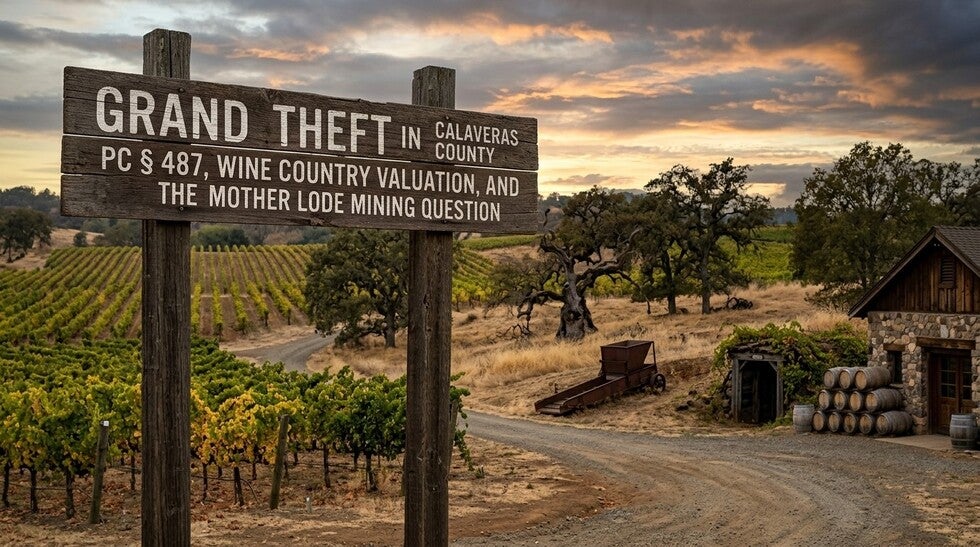
Grand Theft in Calaveras County depends on value, intent, and context. A case involving wine grapes near Murphys, mining equipment in the Mother Lode, a vehicle in San Andreas, livestock in the foothills, or property from a small business may be charged under Penal Code section 487 if prosecutors believe the value and circumstances meet California's grand theft rules.
The defense should not accept the first loss estimate as the truth. In Calaveras County, the difference between felony grand theft and misdemeanor petty theft may turn on fair market value, not replacement cost, retail markup, emotional value, projected future profit, or what the owner hoped the property would become.
Grand Theft in Calaveras County under PC § 487
Penal Code section 487 generally defines grand theft as theft of money, labor, real property, or personal property valued over $950, subject to special categories such as vehicles, firearms, certain agricultural products, and other statutory rules. Theft can include larceny, trick, false pretenses, embezzlement, or other theories depending on the facts.
The prosecution must prove the required taking, intent, lack of consent, and value. In many cases, intent is the most important issue. A civil dispute, business disagreement, ownership misunderstanding, mining claim conflict, contractor payment problem, or equipment-sharing arrangement should not automatically become a felony theft case.
A statewide comparison with Orange County grand theft under PC § 487 shows why the same statute can look very different depending on local property values, business practices, and prosecutorial theories.
Grand Theft in Calaveras County and fair market value
Fair market value means what a willing buyer would pay a willing seller at the time and place of the alleged theft. It is not always the same as the owner's purchase price, replacement estimate, insurance demand, retail price, sentimental value, or projected business loss.
Valuation defenses are especially important when the alleged value is near $950. If the prosecution cannot prove the value exceeds the felony threshold, the case may be reduced to petty theft or resolved differently. In wobbler cases, even where value exceeds $950, a misdemeanor resolution or later PC § 17(b) reduction may be part of the defense strategy.
Evidence that can matter includes:
- used equipment appraisals;
- commodity pricing reports;
- auction records;
- sales receipts and depreciation records;
- repair estimates versus replacement estimates;
- photos showing condition at the time of taking;
- expert valuation for specialized tools, vehicles, livestock, grapes, or mining equipment.
Wine country valuation in Murphys and the Calaveras AVA
Calaveras County wine cases can involve grapes, barrels, tanks, pumps, trailers, irrigation equipment, tasting-room inventory, point-of-sale funds, or winery tools. When the alleged theft involves grapes, the defense should challenge any attempt to value raw grapes as finished wine.
Zinfandel, Syrah, or other Calaveras AVA grapes should generally be valued at the grower-level fair market value at the time of taking, not by converting the crop into hypothetical retail bottles. Retail wine prices include fermentation, aging, bottling, branding, tasting-room overhead, distribution, taxes, and business profit. Those added values may not reflect what was allegedly taken.
For winery or vineyard equipment, replacement cost is often too high. A used pump, tractor attachment, tank, barrel rack, or press may have a market value far below the price of new equipment. Independent appraisal can be decisive.
The Mother Lode mining question: civil dispute or fraud?
Calaveras County's history as part of the Mother Lode creates theft and fraud allegations that may be rooted in complicated mining disputes. A conflict over placer claims, access roads, mineral production, equipment, historical boundaries, or recovery rights may be a civil mining law dispute rather than criminal theft.
The defense should examine claim records, Bureau of Land Management filings, maps, communications, production records, partnership agreements, equipment ownership, and the accused person's good-faith belief. Prosecutors must prove criminal intent beyond a reasonable doubt. A person who reasonably believed they had a right to access property, remove material, use equipment, or pursue a claim may have a defense to theft or fraud allegations.
Mining disputes often involve old documents, informal agreements, family history, handshake arrangements, and boundary uncertainty. Those facts can undercut a simple prosecution story that the case is just “stealing.”
Vehicle theft and grand theft auto in Calaveras County
Vehicle theft cases may involve cars, trucks, ATVs, trailers, ranch vehicles, work trucks, winery vehicles, motorcycles, or construction equipment. Prosecutors may charge grand theft auto, unlawful taking or driving, receiving stolen property, or enhanced vehicle theft depending on the facts and prior history.
The defense should separate ownership disputes, permission, temporary use, repossession issues, family access, business use, and mistaken identity from true intent to permanently deprive. In rural areas, shared equipment and informal vehicle access can complicate the evidence.
A comparison with Riverside County grand theft auto cases helps show how vehicle theft defenses often turn on consent, identification, possession, and the intent behind the taking. Orange County grand theft auto allegations may involve different urban patterns, while Monterey County grand theft auto defense may share some agricultural and rural equipment issues with Calaveras County.
Enhanced vehicle theft under PC § 666.5
Prior vehicle theft-related convictions can change the stakes. Penal Code section 666.5 can create enhanced punishment for a new vehicle theft or unlawful taking case when the person has a qualifying prior conviction.
The defense should review whether the prior conviction qualifies, whether the prosecution can prove it, whether the current charge fits the statute, and whether the prior record is being used to pressure a plea. enhanced vehicle theft charges under PC § 666.5 require a defense that addresses both the current facts and the prior conviction record.
Grand theft firearm and special theft categories
Some property categories are treated differently from ordinary value-based theft. Firearm theft can be charged as grand theft even when the firearm's market value is not high. This creates serious felony exposure, firearm-related consequences, and potential sentencing issues.
When the alleged property is a gun, the defense should review ownership, access, possession, fingerprints, storage, permission, reporting history, serial numbers, and whether the accused person knew the item was present. grand theft firearm under PC § 487(d)(2) is not just another property case because the firearm category can change the legal consequences.
Wage theft, embezzlement, and employer defense
Grand theft can also appear in business and employment settings. Penal Code section 487m allows certain intentional wage theft to be punished as grand theft when statutory thresholds are met. These cases may involve payroll disputes, gratuities, benefits, overtime, independent contractor classification, bookkeeping errors, or allegations that an employer knowingly deprived employees of compensation owed.
A business dispute is not automatically criminal wage theft. The defense should examine intent, accounting records, payroll practices, legal advice, good-faith classification issues, payment history, employee communications, and whether the alleged amount is accurately calculated. criminal wage theft charges under PC § 487m require careful separation of civil labor claims from intentional theft allegations.
Embezzlement is another theft theory. It generally involves property entrusted to someone who later fraudulently appropriates it. A comparison with the difference between embezzlement and theft matters when the accused person originally had lawful access to money, tools, vehicles, business inventory, or ranch equipment.
Retail theft, fire-related crimes, and SB 1242
Some theft cases involve organized retail theft, property damage, fire-related allegations, or conduct that prosecutors treat as part of a broader public safety issue. In a small county, a retail theft allegation from a hardware store, feed store, winery, outdoor supply business, or local market can become more serious if prosecutors allege coordination, repeated conduct, resale intent, or damage connected to a fire risk.
SB 1242 issues involving fire-related crimes and organized retail theft are relevant when theft allegations are tied to public safety, emergency response, fire danger, or organized conduct rather than a single isolated taking.
The defense should challenge overbroad labels. Organized conduct, fire risk, and felony theft enhancements require proof. A person should not be punished for a more serious narrative unless the evidence supports it.
Defenses to grand theft in Calaveras County
Grand theft defense is often built around the gap between what happened and what prosecutors can prove. The defense should examine each element and each valuation assumption.
Common defenses include:
- property value was $950 or less;
- the prosecution used replacement cost instead of fair market value;
- the accused had consent or a good-faith claim of right;
- the dispute was civil, not criminal;
- there was no intent to permanently deprive;
- the accused person was misidentified;
- the property was borrowed, shared, or returned;
- the valuation included items not actually taken;
- search, seizure, or interrogation evidence was obtained unlawfully;
- the case is overcharged compared with the proof.
In cases near the felony threshold, a valuation expert may be as important as a witness. In mining and wine country cases, industry-specific evidence can decide whether the charge remains a felony.
Calaveras County courthouse process
Grand theft cases in Calaveras County are handled in the Superior Court of California, County of Calaveras. The Calaveras Superior Court is located at 400 Government Center Drive, San Andreas, CA 95249-9794. This is a public court facility. Bulldog Law has no affiliation, endorsement, partnership, special access, or special relationship with the court.
A PC § 487 case may involve arraignment, release conditions, discovery, restitution claims, valuation disputes, subpoenas, negotiations, preliminary hearing in felony cases, motions, trial, sentencing, probation, restitution hearings, and possible later PC § 17(b) reduction or expungement if eligible.
Restitution is separate from guilt. The court may address victim losses even when the defense disputes the prosecution's value. A strong defense should prepare for both the charge and the restitution number.
What to do after a grand theft arrest or investigation
Do not discuss the property, value, ownership, permission, mining claim, payroll, vehicle use, firearm, or business records without legal advice. Statements made to “clear things up” can become admissions about intent, control, value, or knowledge.
Important steps include:
- preserve receipts, contracts, invoices, title documents, payroll records, and messages;
- save photos showing the condition of the property;
- identify witnesses who understood permission, ownership, or business practice;
- do not return or alter property without legal guidance;
- do not contact alleged victims in a way that creates new allegations;
- obtain independent appraisals when value is disputed;
- preserve mining claim filings, vineyard records, auction data, or equipment records;
- tell counsel about licensing, immigration, firearm, or employment consequences.
Grand Theft in Calaveras County lawyers in California
Bulldog Law helps clients facing Grand Theft in Calaveras County allegations, including PC § 487, wine grape valuation, vineyard and winery equipment theft, Mother Lode mining disputes, ranch and livestock theft, grand theft auto, enhanced vehicle theft, grand theft firearm, wage theft allegations, embezzlement theories, organized retail theft, restitution, and felony reduction strategy at the San Andreas courthouse.
No lawyer can promise dismissal, reduction, acquittal, or a specific sentence. What Bulldog Law can do is challenge value, identify civil disputes, test criminal intent, preserve industry evidence, examine search issues, negotiate restitution carefully, and build a defense focused on what prosecutors must prove beyond a reasonable doubt.