
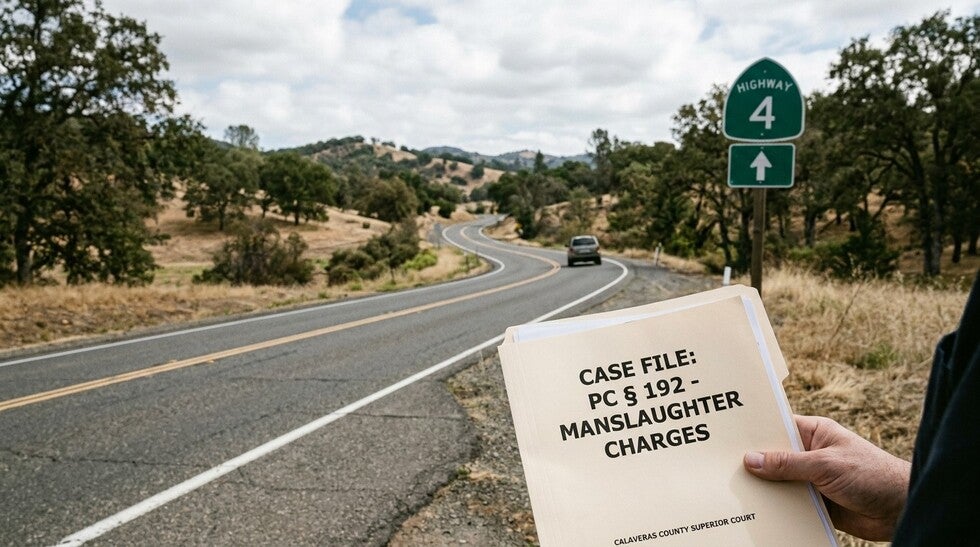
Manslaughter Charges in Calaveras County can arise from a fatal collision on Highway 4, a boating death on New Melones Lake, a confrontation in San Andreas or Angels Camp, or a fatal incident on a rural foothills road. California Penal Code section 192 defines manslaughter as an unlawful killing without malice, but the facts that separate accident, negligence, manslaughter, and murder can be deeply contested.
Calaveras County cases require local context. Highway 4 toward Ebbetts Pass has grades, curves, elevation changes, weather shifts, and seasonal hazards that do not look like flat freeway driving. New Melones Lake, the Calaveras River, and the Stanislaus River create boating and recreation conditions that require a different investigation. In a small county, prior relationships, community history, and witness networks can also matter in voluntary manslaughter and self-defense cases.
Manslaughter Charges in Calaveras County under PC § 192
Penal Code section 192 includes several manslaughter theories. Voluntary manslaughter generally involves a killing upon a sudden quarrel or in the heat of passion. Involuntary manslaughter generally involves an unlawful killing without malice during a non-felony unlawful act, or during a lawful act done without due caution. Vehicular manslaughter under Penal Code section 192(c) focuses on fatal driving conduct and the level of negligence involved.
The statewide framework for manslaughter defense under Penal Code § 192 matters because the prosecution's exact theory controls the evidence, possible sentence, defenses, and negotiation strategy.
Voluntary manslaughter can carry years in state prison. Involuntary manslaughter and vehicular manslaughter also carry serious exposure, and vehicular manslaughter with gross negligence is treated more severely than a misdemeanor vehicular manslaughter theory without gross negligence. The defense must identify which theory is actually supported by the evidence, not just by the charge filed.
Manslaughter Charges in Calaveras County on Highway 4
Highway 4 cases often require accident reconstruction because the roadway itself can be central to the defense. A fatal crash near Angels Camp, Murphys, Arnold, or the climb toward Ebbetts Pass may involve sharp curves, steep grades, winter conditions, limited shoulders, wildlife, tourist traffic, motorcycles, RVs, construction vehicles, or sudden weather changes.
Gross negligence requires more than ordinary carelessness. The prosecution must prove conduct that reflects a heightened disregard for human life. In a mountain-road case, the defense should ask whether the driving was truly grossly negligent or whether the collision occurred because of conditions that created ordinary driving risk.
Important evidence may include:
- CHP reports, collision diagrams, and scene measurements.
- Vehicle event data recorder information.
- Weather, lighting, road surface, grade, curve, and visibility evidence.
- Dashcam, surveillance, phone, GPS, and mapping data.
- Brake, tire, steering, and mechanical inspection records.
- Witness vantage points and timing.
- Independent accident reconstruction.
The legal analysis of vehicular manslaughter under PC § 192(c) is especially important when the defense is focused on the difference between ordinary negligence, gross negligence, and causation.
Watson murder risk after a fatal DUI crash
If a fatal crash involves alcohol or drugs, the case can become more serious than ordinary vehicular manslaughter. In some California cases, prosecutors may consider a Watson murder theory when the accused has a prior DUI history and the prosecution believes it can prove implied malice. A prior DUI advisement can be important, but it does not automatically prove murder.
The defense should examine whether the advisement was actually given, whether the accused understood it, whether language interpretation was adequate, and whether the facts of the new crash support implied malice rather than negligence or gross negligence. The difference can be enormous because second-degree murder exposure is far more severe than manslaughter exposure.
When intoxication is alleged, vehicular manslaughter while intoxicated under PC § 191.5 requires immediate review of toxicology, driving, causation, prior DUI history, and whether the prosecution is overreaching beyond what the evidence proves.
New Melones Lake and boating-related manslaughter
Fatal boating cases on New Melones Lake, the Calaveras River, or the Stanislaus River are different from roadway cases. California law separately addresses manslaughter involving vessel operation, and the investigation may involve boating rules, water conditions, vessel operation, passenger conduct, visibility, speed, alcohol or drug allegations, and equipment issues.
Boating cases should not be analyzed as if they happened on a straight road. The defense may need to examine current, wind, sun glare, heat exposure, dehydration, life jacket use, vessel traffic, wake, navigation lights, operator experience, mechanical condition, and rescue timing. If alcohol is alleged, a rising blood alcohol defense may look different after a full day on the water than after a roadside stop.
Evidence to preserve includes:
- vessel GPS data and electronics;
- photos and videos from passengers or nearby boats;
- rental, maintenance, and inspection records;
- toxicology timing and chain of custody;
- weather, wind, and water condition records;
- statements from passengers, marina staff, and rescuers.
Voluntary manslaughter, heat of passion, and imperfect self-defense
Not every homicide allegation is a driving or boating case. Some Calaveras County manslaughter cases involve fights, family disputes, neighbor conflicts, domestic incidents, property disagreements, business disputes, or long-running tensions in small communities.
Voluntary manslaughter may become the central issue when prosecutors initially consider murder but the facts support heat of passion or imperfect self-defense. Heat of passion focuses on provocation and whether the killing occurred before a reasonable cooling period. Imperfect self-defense can apply when a person actually believed deadly force was necessary, but that belief was legally unreasonable.
The difference between malice and manslaughter can decide the case. A careful comparison of manslaughter and murder differences is important when the defense is challenging a murder theory or seeking a reduction based on provocation, self-defense, or lack of malice.
SB 1437 and felony murder issues
California Senate Bill 1437 narrowed felony murder and natural-and-probable-consequences liability for many non-killer participants. In applicable cases, the prosecution must prove more than presence, association, or participation in an underlying felony. The analysis may involve whether the person was the actual killer, intended to kill, or was a major participant who acted with reckless indifference to human life.
For older convictions, Penal Code section 1172.6 may provide a resentencing pathway when the conviction depended on now-invalid felony murder or natural-and-probable-consequences theories. In a current Calaveras County case, SB 1437 issues can affect charging, plea negotiations, jury instructions, and co-defendant strategy.
Defenses to manslaughter in Calaveras County
The defense must force the prosecution to prove every element beyond a reasonable doubt. A death alone does not prove manslaughter. A tragic accident alone does not prove gross negligence. A prior argument alone does not prove malice. A boating fatality alone does not prove criminal vessel operation.
Common defense issues include:
- the conduct was ordinary negligence, not gross negligence;
- road, weather, mechanical, or environmental conditions caused the death;
- another person's conduct was the true cause;
- toxicology evidence does not prove impairment at the relevant time;
- the accused did not receive or understand a prior Watson advisement;
- self-defense or defense of others applies;
- heat of passion or imperfect self-defense reduces murder exposure;
- the prosecution's accident reconstruction is incomplete or biased;
- statements, searches, or tests were obtained unlawfully.
Defense investigation should begin quickly. Skid marks fade, vehicles are repaired, watercraft electronics are overwritten, road conditions change, witnesses talk to each other, and early media narratives can distort the case.
Calaveras County courthouse process
Manslaughter cases in Calaveras County are handled in the Superior Court of California, County of Calaveras. The Calaveras Superior Court is located at 400 Government Center Drive, San Andreas, CA 95249-9794. This is a public court facility. Bulldog Law has no affiliation, endorsement, partnership, special access, or special relationship with the court.
A felony manslaughter case may involve arraignment, bail or release conditions, protective orders, discovery, subpoenas, accident reconstruction, medical and toxicology records, preliminary hearing, motion practice, negotiations, trial, sentencing, restitution, and related civil claims. Vehicular and boating cases often require experts. Voluntary manslaughter and self-defense cases may require community investigation, prior-relationship evidence, witness interviews, and careful review of the deceased person's conduct when legally admissible.
How Calaveras County compares with other California manslaughter cases
California manslaughter statutes apply statewide, but local conditions matter. Calaveras County has mountain roads, recreation traffic, foothill weather, smaller communities, Gold Country tourism, ranch and construction vehicles, and lake or river incidents that may not resemble cases in larger urban counties.
Nearby and comparison counties show why local context matters. Sutter County manslaughter charges may involve flatter Valley roads and agricultural traffic. Ventura County manslaughter cases may involve coastal highways and different law enforcement patterns. Santa Clara County manslaughter defense may involve urban roadways, dense digital evidence, and different professional consequences.
What to do after a manslaughter arrest or investigation
Do not discuss the crash, fight, boating incident, drinking, drug use, speed, fault, fear, or what you think happened without legal advice. Statements made in shock or grief can become damaging admissions later.
Important steps include:
- do not speak with investigators without counsel present;
- preserve vehicles, vessels, phones, GPS data, photos, videos, and clothing;
- do not repair, move, sell, or alter evidence without legal guidance;
- write a private timeline for your attorney;
- save receipts, location data, weather information, and witness names;
- avoid contacting witnesses or the victim's family directly;
- tell counsel about prior DUI history, immigration, CDL, licensing, military, or firearm issues.
Manslaughter Charges in Calaveras County lawyers in California
Bulldog Law helps clients facing Manslaughter Charges in Calaveras County, including PC § 192 voluntary manslaughter, involuntary manslaughter, vehicular manslaughter, Highway 4 fatal collisions, Ebbetts Pass roadway cases, Highway 49 crashes, New Melones Lake boating fatalities, Watson murder risk, gross negligence disputes, SB 1437 issues, and cases at the San Andreas courthouse.
No lawyer can promise dismissal, reduction, acquittal, or a particular sentence. What Bulldog Law can do is preserve evidence, challenge causation, test gross negligence theories, investigate road and water conditions, review toxicology, develop self-defense or heat-of-passion evidence, and build a defense focused on what prosecutors must prove beyond a reasonable doubt.