
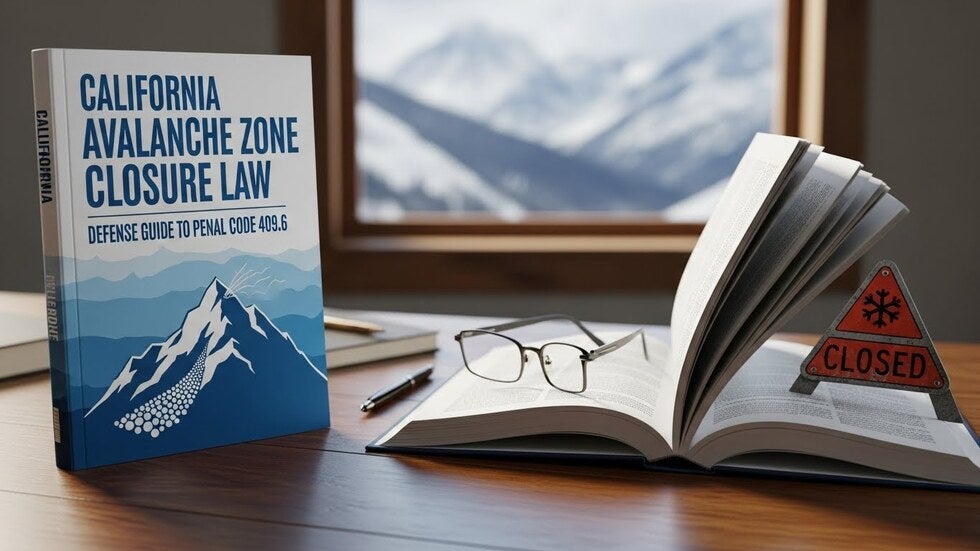
California Penal Code Section 409.6 grants law enforcement and other designated officials authority to close areas affected by avalanches and surrounding emergency command posts.
This statute makes it a misdemeanor to willfully enter or remain in these closed zones without authorization after receiving notice to leave. While avalanche closures serve legitimate public safety purposes in California's mountainous regions, understanding the precise requirements for lawful closures and what constitutes criminal violation becomes essential if you face charges under this section.
This comprehensive guide examines Section 409.6 from a defense perspective, exploring when area closures are legally valid and what protections exist when authorities charge you with violating avalanche zone restrictions.
Which Officials Can Close Avalanche Areas
Section 409.6 authorizes specific categories of peace officers and officials to establish closure zones around avalanche sites. Understanding who possesses this authority matters because closures established by unauthorized persons lack legal force, and charges based on such invalid closures cannot stand.
California Highway Patrol officers receive explicit authority to close avalanche affected areas. The CHP's jurisdiction over state highways and responsibility for traffic safety in rural and mountainous regions makes these officers logical choices for managing avalanche responses affecting roadways and adjacent areas. Highway patrol officers frequently encounter avalanche situations on mountain passes and remote highways throughout California's Sierra Nevada, Cascade, and other mountain ranges.
City police departments and county sheriff's offices can close avalanche areas within their respective jurisdictions. Local law enforcement agencies handle avalanche responses in populated mountain communities and recreational areas falling under municipal or county authority.
These officers possess familiarity with local geography and resources that aids effective emergency response.
Department of Forestry and Fire Protection employees designated as peace officers under Penal Code Section 830.2 subdivision g can establish avalanche closures. Cal Fire personnel often work in mountainous terrain where avalanches occur and possess expertise in emergency management that complements their firefighting duties.
Their inclusion reflects California's recognition that multiple agencies may need avalanche response authority depending on where incidents occur.
Department of Parks and Recreation officers designated as peace officers under Section 830.2 subdivision f possess closure authority in state parks and recreation areas.
Many of California's mountain parks experience avalanche risks, and park rangers require legal tools to protect visitors from these hazards. State parks in the Sierra Nevada and other ranges regularly implement avalanche safety measures during winter months.
Local health officers gain closure authority when avalanches create immediate menaces to public health. This provision recognizes that some avalanche situations pose health hazards beyond immediate physical danger, such as when avalanches damage water supplies, sewer systems, or create conditions fostering disease transmission.
Health officers' specialized expertise in public health threats complements law enforcement's general emergency powers.
What Constitutes a Valid Closure
Not every area cordoned off near avalanche sites creates legally enforceable closure zones under Section 409.6. The statute establishes specific requirements that authorities must satisfy before closures carry force of law and violations become criminal offenses.
Avalanches must create menaces to public health or safety before closures become authorized. This threshold requirement ensures that authorities use closure powers only when genuine hazards exist rather than exercising broad discretion to restrict access without substantial justification. The menace element provides a limiting principle preventing overreach.
Menaces to public safety encompass risks that avalanches or their aftermath pose to people in affected areas. Active avalanche danger where additional slides may occur, unstable snow conditions threatening to collapse, damaged structures at risk of further deterioration, disrupted utilities creating hazards, and blocked evacuation routes all constitute safety menaces justifying closures.
Public health menaces involve disease risks, contaminated water supplies, compromised sanitation systems, or other conditions threatening community health rather than immediate physical safety. While less common than safety based closures, health menaces justify closure authority when avalanches create these specific types of hazards.
The closure must exist for the duration of the menace, not indefinitely. This temporal limitation means that authorities cannot maintain closures after hazards have been abated or reduced to levels no longer threatening public health or safety. Extended closures continuing beyond when avalanche dangers have passed may exceed statutory authority.
Authorities must use ropes, markers, or guards to demarcate closed areas. This physical indication requirement ensures that people receive clear notice about closure boundaries.
Simply declaring areas closed without visible markers or personnel indicating closure zones does not satisfy Section 409.6's requirements. The statute recognizes that criminal liability for entering closed areas requires that people can reasonably identify those areas as closed.
Command Post Closure Authority
Section 409.6 subdivision b creates separate authority for closing areas around emergency field command posts activated to address avalanche hazards. This provision recognizes that effective emergency response requires protected spaces where personnel can coordinate operations without interference from unauthorized persons.
Command post closures differ from avalanche site closures in several respects. Command posts need not be located at or immediately adjacent to avalanche sites.
Authorities may establish command posts at safer locations removed from direct avalanche danger while still requiring security from unauthorized access. The statute explicitly authorizes closing areas around command posts regardless of their distance from actual avalanche locations.
The purpose requirement for command post closures specifies that posts must be activated for abating hazardous conditions created by avalanches. This limitation prevents authorities from using Section 409.6 to close areas around command posts addressing unrelated emergencies.
The nexus to avalanche response must exist even when command posts are located away from slide areas.
Only certain officials can close command post areas. California Highway Patrol officers, police departments, sheriff's offices, and Department of Forestry and Fire Protection peace officers possess this authority.
Notably, Department of Parks and Recreation officers and local health officers do not appear in subdivision b's list, suggesting they lack power to close command post areas even though they can close avalanche sites themselves under subdivision a.
The Criminal Violation Requirements
Section 409.6 subdivision c establishes misdemeanor liability for unauthorized persons who enter or remain in closed areas, but the statute includes specific mental state and notice requirements protecting people from prosecution for innocent or unknowing violations.
The conduct must be willful and knowing. These terms carry distinct legal meanings that prosecutors must prove beyond reasonable doubt. Willful means the person acted purposefully or deliberately rather than accidentally or inadvertently. Someone who wanders into a closed area without noticing barriers or signs may lack the willful conduct required for criminal liability.
Knowing requires awareness that the area is closed. People unfamiliar with locations who stumble into closed zones without recognizing them as such may lack the knowledge element. The prosecution must prove defendants understood they were entering or remaining in areas that authorities had closed under Section 409.6.
Two categories of violations exist under the statute. The first involves unauthorized persons who willfully and knowingly enter closed areas and who willfully remain within them.
This formulation suggests that both initial entry and continued presence must be willful for this violation category. Someone who entered unknowingly but remained after discovering the closure might not satisfy this first category's requirements.
The second violation category addresses unauthorized persons who willfully remain in closed areas after receiving notice to evacuate or leave from designated peace officers.
This provision clearly applies to people already present when authorities establish closures or who entered before recognizing the closure but refused to leave after officers directed them to evacuate.
The notice requirement proves critical for the second violation category. Officers must actually communicate evacuation orders to individuals before their continued presence becomes criminal. General announcements, posted signs, or constructive notice may not satisfy this actual notice requirement. The statute's language suggests personal communication of evacuation orders to specific individuals.
The Reasonable Force Provision
Section 409.6 authorizes peace officers to use reasonable force removing unauthorized persons who willfully remain in closed areas after receiving evacuation notices. This provision recognizes that some individuals may refuse voluntary compliance, requiring physical removal to protect their safety and facilitate emergency operations.
Reasonable force means force proportionate to the resistance encountered and necessary to accomplish the legitimate removal objective. Officers cannot use excessive force simply because people refuse to leave closed areas.
The force employed must match the level of resistance and remain within bounds that reasonable officers would consider appropriate under the circumstances.
This use of force authorization does not eliminate Fourth Amendment constraints or other constitutional protections. While officers may use reasonable force for removals, they cannot employ force as punishment for noncompliance or in ways that constitute excessive force under constitutional standards.
The statutory authorization operates within constitutional boundaries rather than superseding them.
Defense attorneys examine force incidents carefully when clients suffer injuries during removals from avalanche zones. Evidence that officers used force exceeding reasonable levels or employed violence disproportionate to any resistance supports both criminal defense claims and potential civil rights lawsuits against officers who exceeded their authority.
The Media Exception
Section 409.6 subdivision d protects duly authorized media representatives from closure restrictions, creating an important exception recognizing First Amendment interests in news gathering and public information about emergency situations.
The exception applies to authorized representatives of news services, newspapers, radio stations, television stations, and broadcast networks. This broad language encompasses traditional journalism outlets and reflects legislative recognition that public interest in avalanche emergency information justifies media access despite general closure orders.
The term "duly authorized representative" requires that individuals claiming media exception must possess legitimate credentials from actual news organizations. Freelance journalists, bloggers, social media personalities, and others not formally representing established news outlets may not qualify for the exception depending on how courts interpret authorization requirements.
The media exception is not absolute. While Section 409.6 prevents authorities from categorically excluding press from closed areas, officers retain discretion to impose reasonable restrictions protecting media safety and preventing interference with emergency operations.
Reporters who recklessly endanger themselves, obstruct rescue efforts, or otherwise impede legitimate emergency response may face removal despite their media credentials.
Questions sometimes arise about whether modern digital media creators qualify as news representatives under the statute. The law's reference to radio and television networks suggests legislative intent to cover broadcast media broadly, but whether this extends to internet based news operations, streaming services, or independent digital journalists remains somewhat uncertain.
Defenses to Section 409.6 Charges
Defending against avalanche zone violation charges requires examining whether prosecutors can prove each required element beyond reasonable doubt. Several defense strategies prove effective depending on case circumstances.
Challenging whether a valid closure existed provides a threshold defense. If authorities who lacked Section 409.6 authority established the closure, if no actual avalanche menace justified the closure, if authorities failed to properly mark closure boundaries, or if the closure extended beyond the menace's duration, the foundational predicate for criminal liability does not exist. Evidence about who established the closure, what hazards justified it, and how it was demarcated supports these challenges.
Demonstrating lack of willful or knowing conduct addresses the mental state requirements. Evidence that you entered the area accidentally, that closure markers were unclear or absent, that darkness or weather conditions prevented you from perceiving the closure, or that you lacked awareness of the restriction undermines the prosecution's case. Your testimony, witness accounts, and photographs documenting inadequate marking support these defenses.
Establishing that you never received notice to evacuate defeats charges based on willfully remaining after receiving such notice. If officers never personally communicated evacuation orders to you, the prosecution cannot prove this element regardless of whether general announcements were made or signs were posted.
Your account of interactions with officers, witness testimony, and absence of documentation showing personal notice support this defense.
Arguing authorization for your presence challenges the unauthorized person element. If you had legitimate reasons for being in the closed area such as residing there, working as an emergency responder, performing authorized media functions, or operating under official permission, you do not qualify as an unauthorized person subject to criminal liability.
Constitutional Considerations
Section 409.6 closures potentially implicate several constitutional rights, and examining these issues helps evaluate whether authorities exceeded their lawful powers or violated your rights in ways affecting criminal prosecutions.
Freedom of movement, while not absolute, receives constitutional protection against arbitrary government restrictions. Avalanche closures that serve legitimate public safety purposes and remain limited to hazardous areas and necessary duration generally withstand constitutional scrutiny.
However, closures extending beyond genuine menaces or maintained longer than hazards justify may constitute unreasonable restraints on liberty.
First Amendment protections for newsgathering and public access to government operations create tensions with closure authority. The statute's media exception acknowledges these constitutional concerns, but questions remain about whether the exception adequately protects First Amendment interests or whether broader public access rights should limit closure powers.
Property rights of landowners in closed areas may conflict with closure authority. People who own property within avalanche zones retain interests in accessing and using their land despite emergency closures. While public safety justifies temporary access restrictions, extended closures preventing property owners from reaching their land raise constitutional questions about takings and due process.
Due process requirements demand that people receive fair notice of conduct that subjects them to criminal liability. Section 409.6's requirements for physical marking of closed areas and personal notice before willful remaining constitutes a violation reflects due process concerns. Prosecutions that proceed without proving adequate notice violate constitutional principles regardless of statutory language.
Practical Considerations for Mountain Recreation
California's mountain regions attract millions of visitors annually for skiing, snowboarding, hiking, climbing, and other recreational activities. Understanding Section 409.6 helps outdoor enthusiasts avoid criminal liability while pursuing mountain recreation in areas where avalanches pose risks.
Recognize that avalanche closures serve genuine safety purposes and that respecting them protects both your life and the lives of rescue personnel who might need to save you from avalanche hazards. While this guide addresses legal defenses to charges, the wisest course involves heeding closure orders rather than testing boundaries and facing potential death or prosecution.
When you encounter closure markers in mountain areas, treat them seriously even if hazards are not immediately visible. Avalanche conditions can change rapidly, and snow that appears stable may collapse without warning. Officers and avalanche professionals who establish closures typically base decisions on expert assessment of conditions beyond what casual observers can evaluate.
If you live or own property in areas subject to avalanche closures, communicate with authorities about your need for access. Most closure protocols include provisions for resident and property owner access under appropriate conditions. Establishing your legitimate presence prevents misunderstandings that could lead to criminal charges.
Document closure conditions if you believe authorities have acted unreasonably or maintained closures beyond when hazards justify them. Photographs showing stable conditions, expert opinions about avalanche risk levels, and evidence of closure duration help challenge prosecutions if authorities charge you with violations.
Penalties and Consequences
Section 409.6 classifies violations as misdemeanors subject to California's default punishment provisions for unspecified misdemeanors. This means potential county jail sentences up to six months, fines reaching one thousand dollars, or both incarceration and monetary penalties.
Courts consider various factors when sentencing Section 409.6 violators including whether anyone was endangered by the violation, whether the defendant interfered with emergency operations, the degree of willfulness, the defendant's reasons for entering or remaining in closed areas, criminal history, and expressions of remorse.
First time offenders who entered closed areas through misunderstanding rather than defiance often receive minimal punishment.
Search and rescue costs may be assessed against violators who require rescue from avalanche zones. California law permits charging reckless individuals for emergency response expenses, and violating avalanche closures can constitute recklessness supporting cost recovery.
These financial consequences sometimes exceed criminal fines.
Beyond formal penalties, Section 409.6 convictions create criminal records affecting employment, professional licensing, and reputation. While avalanche zone violations are not violent crimes or moral turpitude offenses, any misdemeanor conviction can create obstacles in background check contexts.
Moving Forward After Avalanche Zone Charges
Facing charges for violating avalanche closures often results from misunderstandings, inadequate marking, or situations where legitimate needs conflicted with closure orders. Understanding Section 409.6's precise requirements and available defenses helps you protect your rights while addressing criminal allegations.
Whether challenging the validity of the closure, demonstrating lack of knowledge or willfulness, establishing that you never received required notice, or proving authorization for your presence, you need representation that understands both criminal defense principles and the specific framework Section 409.6 creates for avalanche emergency management.
California's avalanche closure authority serves important public safety purposes in mountain regions where these natural hazards threaten lives and property. While respecting legitimate closures makes sense, the law includes important limitations and protections preventing authorities from arbitrary restrictions or prosecutions without proper notice and proof of willful violations.
Understanding these boundaries protects both public safety and individual rights when avalanche emergencies require government intervention in mountain areas.
To get started, call Bulldog Law at (888) 928-1609 or send our team an email.