
A Property Type Most Californians Have Never Heard Of
California has several distinct forms of common interest ownership, and most people are at least familiar with condominiums and planned developments. But there is a third type that predates both of those structures and still exists throughout the state today the community apartment project. If you live in one, or if you are involved in a dispute connected to one, understanding what California law actually says about this form of ownership could be the difference between a strong defense and a losing argument.
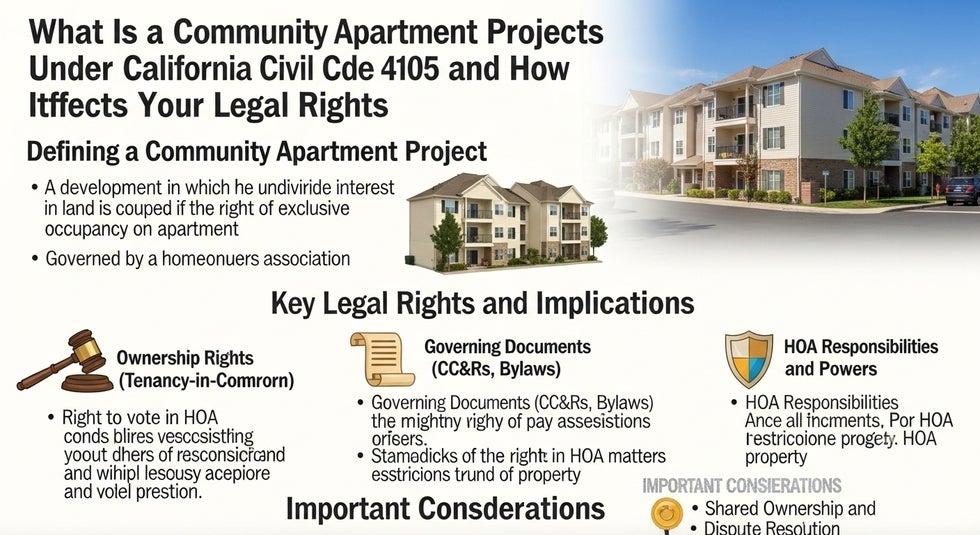
California Civil Code Section 4105 defines a community apartment project as a development in which an undivided interest in land is coupled with the right of exclusive occupancy of any apartment located on that land. That definition is short, but its legal consequences are anything but simple.
Breaking Down the Statutory Definition
To fully understand Civil Code 4105, it helps to look at each element of the definition separately.
The first piece is the undivided interest in land. When you own an undivided interest, you do not own a specific, physically separated parcel. Instead, you own a fractional share of the entire property alongside every other owner in the project. No single owner can point to a corner of the lot and say that portion is mine alone. Everyone owns everything together, proportionally.
The second piece is the right of exclusive occupancy of a specific apartment. This is what makes a community apartment project different from a generic form of co-ownership. Each owner is paired with a particular unit. You may not own that unit outright as a separate legal parcel the way a condominium owner does, but you have a legal right to occupy it exclusively. No other co-owner can claim the right to move into your unit simply because of their shared interest in the underlying land.
Together, these two elements create a hybrid form of ownership that sits somewhere between traditional co-tenancy and condominium ownership. Understanding this distinction is crucial whenever a legal dispute arises, because the rules that apply to one form of ownership do not always transfer cleanly to another.
How Community Apartment Projects Differ From Condominiums
This is where many property owners and even some attorneys get tripped up. Community apartment projects and condominiums can look nearly identical from the outside. Both involve people living in separate units within a larger building or complex. But the legal structures underneath are fundamentally different.
In a condominium, each owner holds title to their individual unit as a legally separate parcel of real property. The common areas are owned jointly, but the unit itself is its own distinct estate that can be bought, sold, financed, and encumbered independently.
In a community apartment project, there is no individual unit parcel. The entire property is a single legal parcel, and each resident owns a fractional share of that whole parcel. The right to occupy a specific apartment is a personal right attached to that fractional share, not a separate real property interest in the unit itself.
This distinction has real consequences. It affects how financing works, how title insurance applies, what happens when an owner defaults on a loan, and what legal claims are available in disputes involving individual units. If you are in a dispute and you or your HOA is treating a community apartment project as though it were a condominium, the legal analysis could be fundamentally flawed from the start.
Why This Structure Creates Unique Legal Vulnerabilities
Because ownership in a community apartment project is undivided, disputes among co-owners can take on a different character than disputes in other common interest developments. When one owner causes damage to the property, imposes new restrictions, or fails to pay their share of expenses, the shared nature of the underlying title means everyone is affected in a way that goes beyond what you might see in a standard HOA setting.
From a defense standpoint, this matters significantly. An HOA or co-owner asserting rights against you in a community apartment project context needs to establish that those rights are actually grounded in the legal structure of the project. Claims that might be valid in a condominium setting may not translate to a community apartment project, and vice versa.
One common area of dispute involves the scope of exclusive occupancy rights. While each owner has the right to exclusively occupy their assigned apartment, questions arise constantly about what improvements, modifications, or uses fall within that right and what encroaches on the shared interest in the land. The line between exercising your occupancy right and interfering with other co-owners interests is not always obvious, and the answers are not always intuitive.
Another frequent source of conflict involves what happens when an owner wants to sell or transfer their interest. Because the ownership structure is tied to an undivided land interest rather than a separately titled unit, the mechanics of transfer, financing, and encumbrance can be complicated. Disputes arising from these transactions often require careful attention to both the governing documents of the project and the statutory framework under the Davis-Stirling Common Interest Development Act.
The Davis-Stirling Act and Community Apartment Projects
California's Davis-Stirling Common Interest Development Act, which begins at Civil Code Section 4000, governs community apartment projects along with condominiums and planned developments. This means that many of the same rules around HOA governance, member rights, meeting requirements, assessment collection, and dispute resolution apply to community apartment projects that apply to other common interest developments.
However, applying those rules to the unique ownership structure of a community apartment project requires careful analysis. A provision that works straightforwardly in a condominium context may need to be interpreted differently when the underlying ownership is undivided rather than separately titled. Defense attorneys handling disputes in these communities need to understand both the general Davis-Stirling framework and the specific characteristics that make community apartment projects distinct.
If you are facing a dispute involving your rights in a community apartment project, whether it involves your occupancy, your share of expenses, governance issues, or a conflict with another co-owner, do not assume that general HOA rules answer every question. The starting point is always the specific legal structure that Civil Code 4105 defines. For more perspective on California HOA and common interest development disputes, visit our blog at thebulldog.law, where we regularly cover these topics in depth.
What Homeowners Should Know Before a Dispute Escalates
If you own an interest in a community apartment project, the most important thing you can do before a conflict escalates is to get a clear picture of what you actually own. Review your grant deed carefully. Confirm that it conveys an undivided interest in the project and identifies the apartment you are entitled to occupy. Read the project's governing documents, including its declaration and any bylaws or rules that apply to the community.
Pay particular attention to how the governing documents address the relationship between your undivided land interest and your occupancy right. Some projects have documents that are decades old and were drafted under different legal standards. Ambiguities or outdated provisions in those documents can either help or hurt your position depending on the nature of your dispute.
Understanding the distinction between what you own as an undivided interest holder and what rights you hold as an exclusive occupant gives you a framework for evaluating any demand, restriction, or claim that comes your way. When an HOA or co-owner tells you that you are required to do something or prohibited from doing something, that assertion should always be measured against both the governing documents and the statutory definition of what a community apartment project actually is.
Final Thoughts
California Civil Code 4105 establishes one of the most legally nuanced forms of property ownership in the state. The combination of undivided land ownership and exclusive occupancy rights creates a structure that does not behave like a condominium, does not behave like a simple co-tenancy, and cannot be fully understood by applying the rules of either. For homeowners living in these communities, and especially for those facing disputes, getting that distinction right is not optional it is foundational.
Whether you are dealing with a governance conflict, an assessment dispute, questions about your right to modify your unit, or a disagreement over how the property is being managed, the legal analysis has to start with an accurate understanding of what kind of ownership structure you are actually dealing with.
For more information on California common interest development law and how it applies to homeowners facing HOA disputes, explore the resources available on our blog at thebulldog.law.
We have multiple offices throughout California. Call us today at (888) 928-1609 to arrange your free consultation or contact us online.