
When the Lines of Governance Get Blurry, Homeowners Pay the Price
Life inside a common interest development involves more than just a homeowners association. Many communities have additional nonprofit entities operating alongside the HOA, running fitness programs, managing community centers, organizing events, or overseeing shared amenities that extend beyond the association's direct control. These entities often operate quietly in the background, and most residents never give them a second thought.
That changes quickly when a dispute arises. When a homeowner is denied access to a community facility, charged for services they never agreed to, or finds that a nonprofit entity is exercising authority that was never properly granted, the first legal question is often: what exactly is this organization and what rules apply to it?
California Civil Code Section 4110 answers that question by defining what qualifies as a community service organization or similar entity under the Davis Stirling Common Interest Development Act. The definition is precise, and the distinction between what is included and what is excluded carries real consequences for homeowners who find themselves on the wrong side of a governance decision made by one of these entities.
What Section 4110 Actually Defines
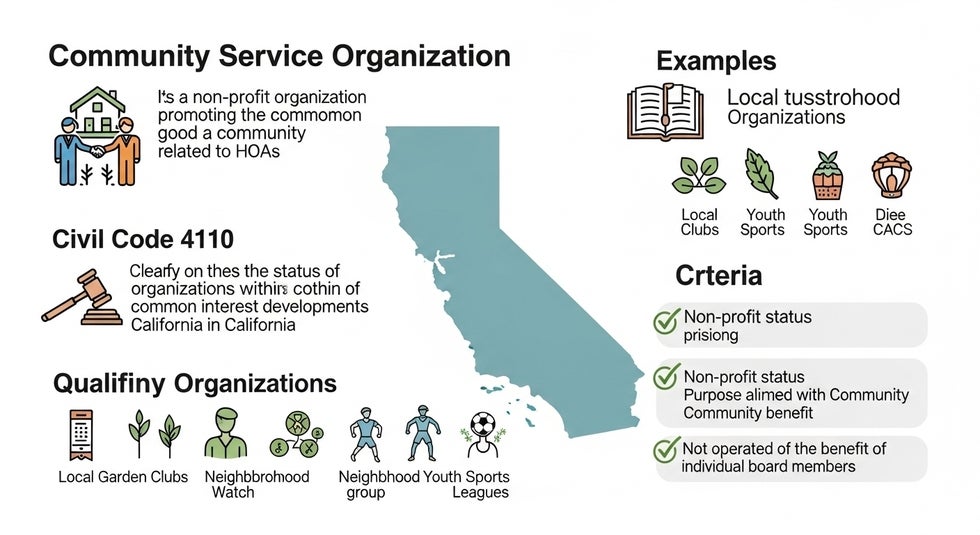
Section 4110 establishes that a community service organization or similar entity is a nonprofit entity, separate from the association itself, that is organized to provide services to residents of a common interest development or to the public, to the extent that community common areas or facilities are available to the public.
Several elements of this definition deserve careful attention because each one affects whether a particular organization qualifies and what legal framework applies to it.
First, the entity must be a nonprofit. For profit companies operating within a community, even those providing resident services, do not fall under this definition and are governed by entirely different rules.
Second, the entity must be distinct from the association. An HOA and a community service organization are legally separate things. An HOA is governed by its CC&Rs, bylaws, and the Davis Stirling Act. A community service organization that qualifies under Section 4110 is treated as a related but separate entity with its own governance obligations.
Third, the entity's purpose must be oriented toward providing services to residents or to the public where common areas and facilities are made publicly available. This is not a trivial distinction. An entity that serves only a narrow subset of insiders rather than the broader resident community may not qualify, and an entity that operates as though it is providing public services while actually restricting access could face legal scrutiny.
What Does Not Qualify Under Section 4110
The second part of the statute is just as important as the first, and it is the part that most homeowners never hear about until it matters. Section 4110 explicitly excludes from its definition any entity that has been organized solely to raise money and contribute those funds to other nonprofit organizations that are tax exempt under Section 501(c)(3) of the Internal Revenue Code and that provide housing or housing assistance.
In plain terms, a fundraising pass through organization is not a community service organization under California law, even if it is structured as a nonprofit and even if the ultimate beneficiaries are housing related charities.
Why does this exclusion matter? Because the label an entity uses to describe itself does not determine its legal status. An organization that calls itself a community service entity but whose actual operations consist entirely of collecting funds and passing them to outside housing nonprofits may not qualify for the protections, obligations, or governance rules that apply to genuine community service organizations under Section 4110.
From a defense perspective, this exclusion is a meaningful tool. If a homeowner is being assessed, charged, or otherwise obligated to support an entity based on the claim that it is a community service organization, that claim needs to hold up against the actual language of the statute. If the entity is structured primarily as a fundraising vehicle directed toward outside organizations, the legal foundation for that obligation may be much weaker than the association or the entity itself is representing.
Why This Definition Matters in Real Disputes
The practical importance of Section 4110 surfaces most clearly in three types of situations that Bulldog Law regularly encounters when representing homeowners in common interest development disputes.
The first situation involves access and use rights. When a community service organization controls or manages a common area facility, questions arise about who has the right to use it, on what terms, and at what cost. If the entity qualifies under Section 4110, it is subject to the Davis Stirling Act's broader framework, which includes obligations around fair treatment of residents and transparency in operations. If the entity does not qualify, a different legal analysis applies entirely.
The second situation involves assessments and fees. Homeowners are sometimes told that a portion of their monthly dues or a special assessment supports a community service organization. Whether that obligation is legally enforceable depends in part on whether the entity actually qualifies under Section 4110 and whether the governing documents properly authorize contributions to it. An entity that falls outside the definition cannot simply be funded through HOA assessments without proper legal grounding.
The third situation involves governance and accountability. Community service organizations operating within a common interest development are not free from oversight simply because they are separate from the HOA. Residents who are affected by the decisions of these entities have an interest in understanding what legal obligations those entities carry and what recourse is available when something goes wrong.
The Defense Angle: Challenging Authority That Was Never Properly Granted
One of the most consistent patterns in HOA and community governance disputes is the expansion of authority beyond what the law and governing documents actually allow. Boards do it. Management companies do it. And community service organizations do it too.
When an entity operating within a common interest development takes action that affects homeowners, the first question any defense minded attorney asks is whether that entity has the legal standing to take that action at all. Section 4110 is part of the answer to that question. If an organization has been misclassified, if it does not meet the statutory definition, or if it falls squarely within the exclusion for fundraising pass through entities, then the authority it claims to have may simply not exist under California law.
Homeowners should never assume that an organization operating within their community has the authority it claims simply because it has been operating that way for years. Longstanding practice is not the same as legal authority, and challenging improper authority is a legitimate and often effective defense strategy.
Know What Entities Have Power Over You and Why
The governance of a common interest development often involves more parties than residents realize. Section 4110 gives homeowners and their attorneys a concrete legal definition to work with when evaluating the role and authority of nonprofit entities operating alongside the HOA.
Whether you are being charged fees tied to a community service organization, denied access to a community facility, or simply trying to understand who has legitimate authority over your community, the answer starts with understanding what the law actually says.
At Bulldog Law, we help homeowners cut through the complexity of HOA governance and defend their rights against entities that have overstepped what the law allows. If something about how your community is being run does not feel right, it may not be.
Visit our blog for more plain language analysis of California HOA law and the Davis Stirling Act provisions that every homeowner in a common interest development should know.
We have multiple offices throughout California. Call us today at (888) 928-1609 to arrange your free consultation or contact us online.