
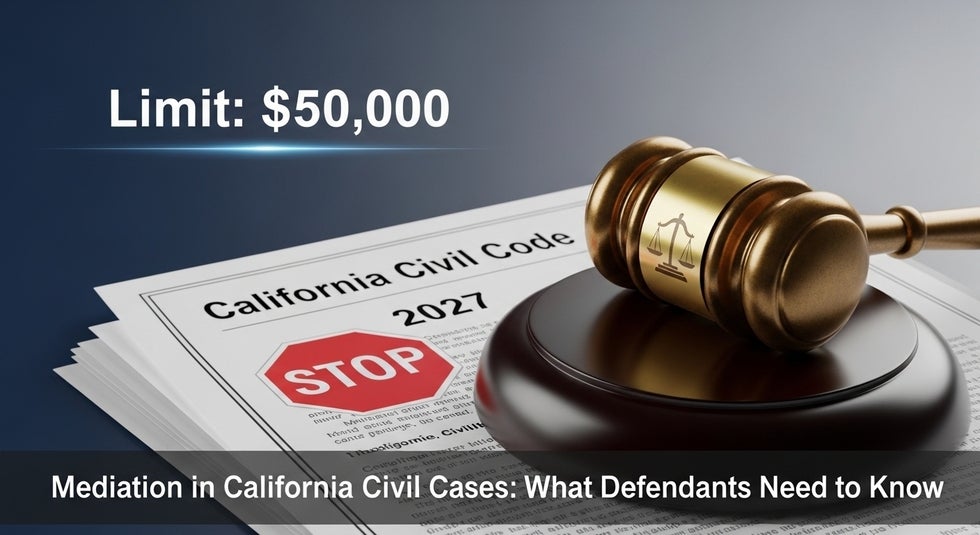
A Dollar Threshold That Controls Whether Your Case Goes to Mediation
Not every civil lawsuit in California is eligible for court ordered mediation. If you are a defendant facing a civil claim in Los Angeles County or another court that has adopted this framework, the dollar amount at the center of your dispute plays a decisive role in determining what process applies to your case.
Under California Code of Civil Procedure Section 1775.5, courts are prohibited from ordering a case into mediation when the amount in controversy exceeds fifty thousand dollars. That is not a suggestion or a loose guideline it is a hard ceiling. If your case crosses that threshold, court ordered mediation under this statutory framework is off the table entirely, regardless of whether both parties might otherwise benefit from it.
Understanding exactly how that threshold gets calculated, and what happens when it is disputed, is essential information for any defendant who wants to stay ahead of the process rather than react to it.
How Courts Determine the Amount in Controversy
The statute does not leave the determination of the amount in controversy to guesswork or advocacy. Instead, it ties the calculation to the same methodology used under Section 1141.16, which governs similar threshold determinations for judicial arbitration. That connection matters because it creates a predictable, defined framework that both sides can anticipate and work within.
What makes this particularly important from a defense standpoint is what the court is explicitly told not to consider when making this determination. The statute states that the court shall not look at the merits of questions of liability, defenses, or comparative negligence. In plain terms, the court is not weighing in on whether the plaintiff will actually win, how strong your defense might be, or whether a jury might reduce any award based on shared fault. The calculation is based on the claimed amount in controversy, not a forecast of the probable outcome.
For defendants, this creates a situation that requires careful attention. If a plaintiff has framed their complaint around damages that push above the fifty thousand dollar mark — even ambitiously or speculatively — the case may be pushed out of mediation eligibility regardless of whether those numbers are realistic. This is one reason why early legal review of a complaint's damages allegations can directly affect which procedural path your case ends up on.
Why the Defense Perspective on This Threshold Is Different
From a plaintiff's standpoint, the amount claimed in a complaint is often a starting point for negotiation. Plaintiffs sometimes plead higher damages with the expectation that the actual resolution will land somewhere lower. From a defense perspective, those pleaded numbers carry procedural consequences that go beyond strategy at the negotiating table.
If the claimed amount keeps your case out of the mediation track, you are likely heading toward judicial arbitration or trial, both of which tend to be more expensive and time consuming. That means the dollar figure in the complaint is not just a negotiating position — it is a variable that affects your litigation costs, your timeline, and your exposure.
Defendants who recognize this early can work with their attorneys to assess whether the amount in controversy as properly calculated actually exceeds fifty thousand dollars. There are situations where a thorough legal review reveals that the plaintiff's damages framing is overstated when measured against the statutory calculation method. In those situations, raising that issue before the court assigns a procedural track can preserve the option for mediation and everything that comes with it: lower costs, faster resolution, and a confidential setting that protects your interests.
Our attorneys at The Bulldog Law have written about related civil defense strategies and procedural considerations on our blog. If you are navigating a case where the amount in controversy is close to this threshold, reading up on the full landscape of options is time well spent.
The Sunset Clause: This Law Expires on January 1, 2027
Here is something that many defendants and even some attorneys overlook entirely: Section 1775.5 is not permanent law. The statute itself contains a sunset clause providing that it will be repealed as of January 1, 2027. After that date, the fifty thousand dollar cap on court ordered mediation will no longer be in effect under this provision.
What that means in practical terms remains to be seen. The California Legislature may elect to renew the provision, modify the threshold, or allow it to expire and replace it with something different. But for defendants whose cases are active right now or will be filed in the coming months, this expiration date is relevant context.
If your case is currently in its early stages and the amount in controversy sits near the fifty thousand dollar threshold, the timing of when your matter reaches the procedural assignment stage could actually affect which rules apply. Cases that are still moving through the system when the statute sunsets may operate under a different framework entirely. Whether that is advantageous or not depends on the specifics of your situation, which is exactly why proactive legal planning matters here.
Staying informed about these kinds of legislative changes is part of what effective civil defense looks like in practice. You can follow developments relevant to California civil defendants on The Bulldog Law blog, where our team regularly covers procedural updates and what they mean for clients on the defense side of the courtroom.
What Defendants Should Do Right Now
If you are facing a civil lawsuit and the damages alleged are anywhere near the fifty thousand dollar range, this statute deserves your attention today — not after your case has already been assigned to a track.
The first step is working with your attorney to conduct a precise analysis of how the amount in controversy would be calculated under Section 1141.16. That calculation does not include speculation about liability or comparative fault, so the analysis is more objective than it might initially appear. If there is a credible argument that the properly calculated amount falls below the threshold, your attorney can raise that before the court makes its procedural determination.
The second step is understanding the timeline. With the statute set to expire at the start of 2027, cases that are initiated in late 2025 or throughout 2026 may be resolved under one set of rules while cases filed shortly after January 1, 2027 operate under whatever framework replaces them. Defendants who plan ahead will be in a far stronger position to take advantage of mediation when it is available and to adapt when the rules shift.
Civil procedure in California is not static, and the defendants who come out ahead are usually the ones who treat procedural knowledge as part of their defense strategy rather than an afterthought. Section 1775.5 is a clear example of a provision that has real, immediate consequences and a built in expiration date that makes acting sooner smarter than waiting.