
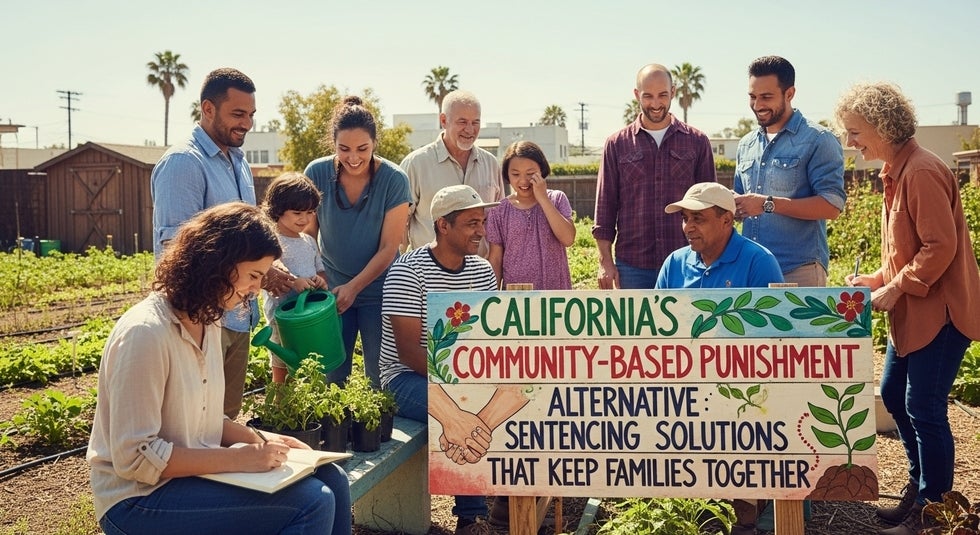
The traditional approach to criminal justice has long relied on incarceration as the primary response to criminal behavior, but California has pioneered innovative alternatives through community based punishment programs.
These programs recognize that not every person convicted of a crime requires removal from society to protect public safety or promote rehabilitation. Understanding how these alternative sentencing structures work and who can benefit from them provides hope for defendants seeking solutions that allow them to maintain family connections, employment, and community ties while serving their sentences.
Understanding Community Based Punishment Programs in California
California Penal Code Section 8061 establishes a comprehensive framework for developing, implementing, and evaluating community based punishment programs throughout the state.
Rather than imposing a one size fits all approach, this legislation creates collaborative partnerships between state agencies and local jurisdictions to design programs tailored to specific community needs and offender populations.
These programs represent a significant shift in criminal justice philosophy, acknowledging that effective punishment can occur outside traditional prison walls. By keeping certain offenders in their communities under supervision and structured programming, California aims to reduce recidivism, maintain family stability, preserve employment opportunities, and decrease the enormous costs associated with mass incarceration.
The framework emphasizes evidence based practices, rigorous evaluation, and continuous improvement based on data and outcomes. This scientific approach ensures programs deliver real results rather than simply offering lenient alternatives that fail to protect public safety or promote accountability.
The Role of State and Local Collaboration
Effective community based punishment requires coordination between multiple levels of government and diverse stakeholder organizations. The board responsible for administering these programs works closely with state agencies, county departments, and community organizations to create programming that serves both public safety and rehabilitation goals.
Defining Parameters for Effective Programs
The first responsibility involves describing what makes community based punishment programs effective and clarifying how state and local jurisdictions share responsibility for achieving program purposes. This foundational work ensures everyone involved understands program goals, expected outcomes, and their respective roles in implementation.
Effective programs balance several competing interests. They must protect public safety by ensuring appropriate supervision and swift consequences for violations.
They must promote offender accountability through meaningful sanctions that acknowledge harm caused by criminal behavior. They must facilitate rehabilitation by connecting participants with services addressing underlying issues like substance abuse, mental health challenges, or lack of job skills.
The relationship between state and local authorities in these programs differs significantly from traditional criminal justice administration. Rather than state prisons assuming complete control over convicted offenders, community based approaches empower local jurisdictions to design and implement programs suited to their unique populations and resources while receiving state support and funding.
This collaborative model recognizes that local officials understand their communities better than distant state administrators. Counties know which employers might hire program participants, which treatment providers deliver quality services, and which supervision strategies work with their specific populations.
Selecting Jurisdictions for Pilot Programs
Not every county participates in community based punishment programs simultaneously. The board develops processes for selecting jurisdictions to participate in pilot efforts that test new approaches before statewide expansion. This measured rollout allows careful evaluation of program effectiveness and identification of implementation challenges before investing resources across all counties.
The selection process considers factors like county readiness, existing correctional infrastructure, treatment provider availability, stakeholder support, and capacity for data collection and program evaluation. Counties expressing interest must demonstrate their ability to implement programs consistent with legislative goals and evidence based practices.
Pilot programs serve as laboratories for innovation, testing various approaches to determine what works best for different offender populations and community contexts. Successful pilot programs provide models other counties can adapt, while unsuccessful elements get refined before broader implementation.
Annual Planning and Funding Processes
Community based punishment programs operate through annual cycles of planning, funding, implementation, and evaluation. This iterative approach allows continuous improvement based on experience and outcome data.
County Program Proposal Submission
Counties participating in these programs must annually submit community based punishment program proposals for review and approval. This requirement ensures programs remain current, responsive to changing needs, and aligned with evidence based practices.
The proposal process requires counties to articulate their program designs, target populations, expected outcomes, budget needs, and evaluation methodologies. Counties must demonstrate how their proposed programs advance the purposes of community based punishment while maintaining public safety and promoting offender accountability.
The board reviews these proposals carefully, providing feedback, suggesting modifications, and ultimately approving plans that meet established standards. This oversight ensures state funds support quality programming rather than ineffective or poorly designed initiatives.
For defendants and their defense attorneys, understanding which programs operate in specific counties helps identify potential sentencing alternatives. Counties with robust community based punishment programs approved through this process offer more options for creative sentencing advocacy.
Annual Funding Awards and Monitoring
After approving county proposals, the board awards funds to participating jurisdictions for program implementation. The funding process includes clear guidelines about allowable expenditures, reporting requirements, and accountability measures.
Counties must demonstrate responsible use of state funds through regular reporting on expenditures, participant numbers, program activities, and outcome measures. This financial accountability ensures taxpayer dollars support effective programming while preventing waste or misuse of public resources.
The monitoring process extends beyond financial oversight to include program quality assessment. The board examines whether programs operate as designed, serve appropriate populations, maintain necessary supervision levels, and deliver promised services.
When problems arise, the board works with counties to implement corrective actions that get programs back on track.
Technical Assistance and Information Sharing
Successful community based punishment programs require expertise that not all counties possess internally. The board provides essential support services helping local jurisdictions develop and implement effective programming.
Supporting County Decision Making
Counties considering participation in community based punishment programs need information about program requirements, funding availability, expected outcomes, and implementation challenges. The board offers technical assistance helping county officials and correctional administrators determine whether participation makes sense for their jurisdictions.
This support includes sharing research about evidence based practices, connecting counties with experts in specific program areas, providing templates and tools for program development, and offering guidance on overcoming common implementation obstacles. By removing barriers to participation, the board encourages more counties to embrace community based punishment approaches.
For communities served by participating counties, this technical assistance translates into higher quality programs with better outcomes. Defendants sentenced to community based punishment benefit when programs receive expert support producing effective interventions rather than poorly designed alternatives.
Facilitating Knowledge Exchange
Counties implementing community based punishment programs accumulate valuable experience about what works, what doesn't, and how to navigate challenges. The board facilitates information sharing among counties and between local and state agencies, ensuring this knowledge benefits everyone involved in program development and implementation.
Information sharing covers numerous topics relevant to program success. Counties exchange insights about effective program structures, suitable offender populations for specific interventions, relationships with treatment providers and other community partners, supervision strategies that balance accountability and support, and responses to common program violations.
Beyond formal reports and data, the board helps share anecdotal information and practical wisdom gained through implementation experience. Sometimes the most valuable insights come from correctional professionals describing how they solved specific problems or adapted programs to local circumstances.
This collaborative learning environment accelerates program improvement across California. Counties don't need to reinvent solutions to problems other jurisdictions already solved, allowing faster development of effective programming serving more defendants with alternative sentencing needs.
Regulatory Framework and Program Evaluation
Effective administration of community based punishment programs requires clear regulations and rigorous evaluation processes ensuring programs achieve intended purposes while maintaining public safety.
Adopting and Revising Regulations
The board adopts regulations necessary for implementing community based punishment programs and periodically revises these rules based on experience and changing circumstances. Regulations provide structure and consistency while allowing flexibility for local adaptation.
These regulations address topics like eligibility criteria for program participation, minimum supervision standards, required program components, prohibited practices, reporting requirements, funding restrictions, and evaluation methodologies. By establishing clear expectations, regulations help counties develop programs meeting state standards while giving them latitude for innovation within established parameters.
The periodic revision process ensures regulations remain current and responsive to lessons learned through program implementation. As research reveals new evidence based practices or evaluation identifies needed improvements, regulations get updated to incorporate these advances.
Ensuring Rigorous Program Evaluation
Perhaps the most critical function involves designing and providing for regular, rigorous evaluation of community based punishment programming. Evaluation determines whether programs achieve intended outcomes, identifies areas needing improvement, and provides evidence justifying continued investment of public resources.
Evaluation examines multiple dimensions of program performance. It assesses whether programs serve intended populations, deliver promised services, maintain appropriate supervision levels, and operate within budget.
More importantly, evaluation measures outcomes like recidivism rates, program completion rates, employment outcomes, family stability, substance abuse treatment success, and cost effectiveness compared to traditional incarceration.
This commitment to evaluation reflects the evidence based philosophy underlying community based punishment programs. Rather than assuming programs work based on good intentions, California demands proof of effectiveness through careful measurement and analysis.
Comprehensive Analysis of Program Implementation
Beyond evaluating individual programs, the board conducts broader analysis examining how the entire community based punishment initiative functions and what impacts it produces across the criminal justice system.
Examining State and Local Relationships
Analysis includes evaluating the relationship between the board and counties submitting punishment plans. This examination determines whether the collaborative model works effectively, whether counties receive adequate support, whether oversight strikes the right balance between accountability and local autonomy, and whether the approval process encourages innovation while maintaining standards.
Understanding these dynamics helps refine the administrative structure supporting community based punishment programs, ensuring the framework facilitates rather than hinders effective local programming.
Measuring Program Effectiveness
Analysis assesses whether community based punishment programs effectively encourage use of intermediate sanctions alongside traditional penalties. Intermediate sanctions include options like electronic monitoring, day reporting centers, intensive supervision, community service, restorative justice programs, and specialized treatment courts.
The goal involves expanding the sentencing toolkit available to judges and correctional officials. Rather than choosing only between prison and standard probation, decision makers should have access to graduated sanctions matching punishment intensity to offense seriousness and offender risk levels.
Evaluation examines which offender categories prove most suitable for specific intermediate sanctions and program components. Not every defendant benefits from every program type, so understanding which interventions work for which populations helps match people with appropriate programming.
Assessing Public Safety and Cost Effectiveness
Two fundamental questions drive analysis of community based punishment programs: Do they maintain public safety? Are they cost effective compared to traditional incarceration?
Public safety analysis examines recidivism rates among program participants compared to similar offenders receiving traditional sentences. Programs that result in higher crime rates among participants fail the public safety test regardless of other benefits. Conversely, programs reducing recidivism demonstrate that community based punishment can protect public safety while offering additional benefits.
Cost effectiveness analysis compares the expense of community based programs against incarceration costs. Since housing someone in state prison costs significantly more than supervising them in the community, even moderately successful programs typically prove cost effective. Savings can fund program expansion, victim services, or other public priorities.
Impact on Correctional Populations
Finally, analysis examines how community based punishment programs affect prison, jail, and juvenile justice populations. One major goal involves reducing reliance on costly institutional corrections by diverting appropriate offenders to community programs.
Evaluation measures whether programs successfully reduce incarceration rates, how much capacity they free up in correctional facilities, and whether they allow focusing institutional resources on offenders who truly require secure custody. These impacts matter for defendants facing charges who might benefit from sentencing alternatives keeping them in their communities rather than sending them to prison or jail.
Advocating for Community Based Sentencing Solutions
Understanding California's framework for community based punishment programs empowers defendants and their attorneys to advocate for appropriate alternative sentences.
When programs exist in your county and your circumstances make you suitable for community based programming, knowledgeable advocacy can secure sentences allowing you to maintain employment, support your family, and access treatment services while serving your sentence in the community rather than behind bars.
Working with experienced criminal defense counsel familiar with available community based punishment options in your jurisdiction provides the best opportunity for accessing these alternatives when appropriate.
Not every case qualifies for community based sentencing, but when programs exist and circumstances align, these options offer hope for outcomes serving justice while preserving opportunities for successful reintegration and positive contribution to society.