
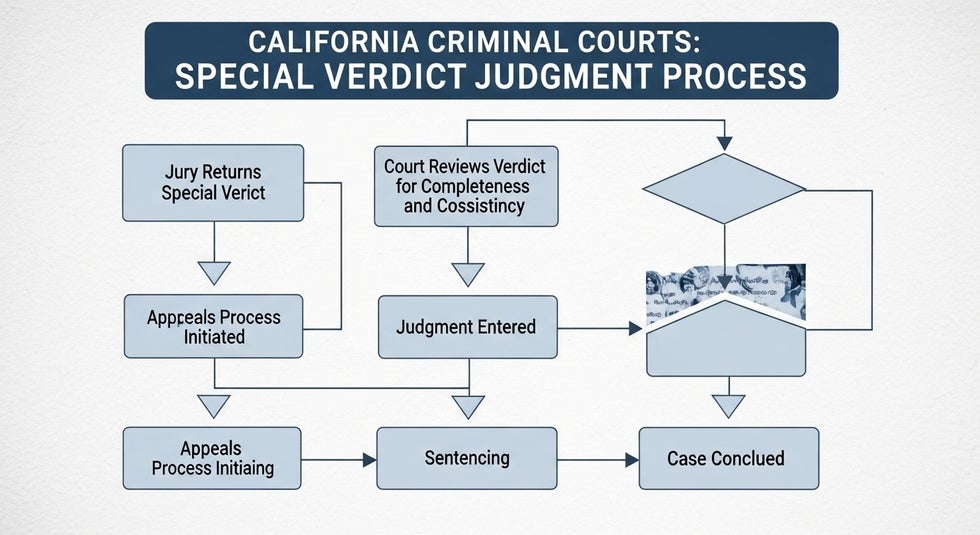
The moment a jury returns its verdict represents a critical juncture in any criminal case, but understanding how courts translate those findings into formal judgments can seem mysterious.
California Penal Code Section 1155 establishes the precise framework judges must follow when entering judgment based on special verdicts, creating a structured process that protects defendant rights while ensuring legal accuracy.
For anyone facing criminal charges, understanding this judgment process provides essential insight into how your case reaches its final resolution.
What Is a Special Verdict in Criminal Cases?
Before exploring how courts enter judgments, it helps to understand what special verdicts entail and how they differ from general verdicts. In a general verdict, juries simply state whether they find the defendant guilty or not guilty of charged offenses. Special verdicts, by contrast, require juries to make specific factual findings on particular issues presented to them.
Special verdicts break down complex cases into discrete factual questions. Rather than rendering a single conclusion, jurors answer detailed questions about what occurred, whether certain elements were proven, or what facts they believe the evidence established. The trial judge then applies the law to these factual findings to determine the appropriate judgment.
This approach serves several important purposes in criminal proceedings. Special verdicts ensure juries focus on specific factual issues without confusion about legal consequences. They create a clearer record for appellate review by documenting exactly what facts the jury found proven or unproven. They also help prevent jury nullification by separating factual determinations from the ultimate legal conclusions.
Understanding how judges translate these factual findings into formal judgments becomes crucial for defendants and their attorneys when evaluating case outcomes and potential grounds for appeal.
Entering Judgment When the Plea Is Not Guilty
The most common scenario involves cases where defendants plead not guilty and proceed to trial. After the jury returns its special verdict containing specific factual findings, the court must analyze those findings and enter the appropriate judgment according to established legal principles.
When Facts Prove Guilt of the Charged Offense
If the jury's factual findings establish that you committed the offense charged in the indictment or information, the court must enter judgment of conviction for that offense. The judge has no discretion to disregard the jury's factual findings when those findings satisfy all elements of the charged crime.
This straightforward application occurs when the evidence and jury findings align perfectly with the charges filed by the prosecution. For example, if charged with residential burglary and the jury's special verdict finds you entered an inhabited dwelling with intent to commit theft, the judge must enter judgment convicting you of that offense.
The court's role becomes ministerial at this point, translating the jury's factual conclusions into formal legal judgment. However, judges must carefully review whether the findings actually support conviction under applicable law, ensuring no gap exists between what the jury found and what the law requires for guilt.
Conviction of Lesser Included Offenses
California law recognizes that juries sometimes find facts proving guilt of offenses different from those originally charged. When the facts established by the special verdict prove you guilty of any offense of which you could be convicted under the charging document, even if it differs from the primary charge, the court must enter judgment accordingly.
This doctrine of lesser included offenses protects both prosecution and defense interests. The prosecution need not prove every element of the most serious charged offense to obtain a conviction when evidence supports a related lesser crime. Defendants benefit by potentially facing reduced penalties compared to the originally charged offense.
Common examples include juries finding facts supporting manslaughter rather than murder, simple assault instead of assault with deadly weapon, or petty theft rather than grand theft. When special verdict findings establish the elements of these lesser offenses without proving all elements of the greater charge, judges enter judgment for the appropriate lesser crime.
Working with knowledgeable criminal defense counsel becomes essential for understanding which lesser included offenses might apply to your charges and how special verdict findings could support reduced convictions.
The Power and Limits of Lesser Included Offense Convictions
The ability of courts to convict defendants of offenses not explicitly charged deserves deeper examination, as it significantly impacts defense strategy and case outcomes.
What Qualifies as a Lesser Included Offense
Not every related crime qualifies as a lesser included offense under California law. For an offense to be considered lesser included, it must meet specific criteria established by appellate courts. Generally, an offense is lesser included if the elements of the lesser crime are necessarily included within the statutory elements of the greater offense charged.
Two tests determine whether an offense qualifies as lesser included. The elements test examines whether all elements of the lesser offense are also elements of the greater offense. The accusatory pleading test looks at whether the facts actually alleged in the charging document include all elements of the lesser offense.
This legal framework prevents prosecutors from obtaining convictions for crimes bearing no relationship to the charged offenses while allowing appropriate flexibility when evidence proves somewhat different conduct than originally alleged.
Understanding these principles helps defendants anticipate possible outcomes beyond simple guilty or not guilty verdicts on charged offenses.
Strategic Implications for Defense
The possibility of lesser included offense convictions creates important strategic considerations for defense attorneys. Sometimes requesting jury instructions on lesser offenses benefits the defense by providing jurors a middle ground between conviction of serious charges and complete acquittal. Other times, such instructions increase conviction risk by offering compromise verdicts.
These tactical decisions require careful analysis of the evidence, jury dynamics, and relative penalties for various offenses. Experienced defense attorneys evaluate whether lesser included instructions serve your interests or increase conviction likelihood in your specific circumstances.
Judgment of Acquittal When Facts Don't Support Conviction
The flip side of conviction based on special verdict findings involves situations where those findings fail to establish guilt. California law mandates that judges enter acquittal judgments when jury findings don't prove the charged offense or any lesser included offense.
Insufficient Evidence of All Required Elements
Criminal convictions require proof of every element of the charged offense beyond reasonable doubt. When special verdict findings leave gaps in the required proof, courts must acquit defendants regardless of suspicions about guilt or partial proof of some elements.
For example, if charged with burglary requiring proof of entry, dwelling, and intent to commit theft, but the special verdict finds entry and dwelling status without finding intent, the facts don't support conviction. The court must enter judgment of acquittal because the findings fail to establish all necessary elements.
This protection ensures convictions rest on complete proof rather than assumptions or speculation about missing elements. It reinforces the prosecution's burden to prove every aspect of the charged crime through evidence resulting in explicit jury findings.
Protecting Against Conviction Without Adequate Proof
The requirement that courts enter acquittal judgments when findings don't support conviction serves as a critical safeguard against wrongful convictions. Even when juries return confusing or contradictory special verdicts, judges must carefully analyze whether the findings actually prove guilt under applicable law.
This judicial review function provides an additional layer of protection beyond the jury's factual determinations. Judges versed in legal elements and proof requirements can identify gaps or inconsistencies that require acquittal despite jury findings that might seem to suggest guilt.
Understanding this protection helps defendants recognize that special verdicts require rigorous analysis before conviction judgments become final. Challenging insufficient findings before judgment provides an important opportunity to secure acquittal when evidence falls short.
Judgments Based on Previous Conviction or Acquittal Pleas
The second major category of special verdict judgments involves cases where defendants plead former conviction, former acquittal, or once in jeopardy of the same offense. These pleas invoke double jeopardy protections preventing multiple prosecutions for the same criminal conduct.
The Double Jeopardy Defense
The Fifth Amendment to the United States Constitution and Article I, Section 15 of the California Constitution protect against being prosecuted twice for the same offense. When you raise previous conviction, acquittal, or jeopardy as a defense, the court must determine whether your current charges constitute the same offense as the previous prosecution.
This determination requires examining the elements of both offenses and the facts of both prosecutions. If the current charges arise from the same criminal episode previously prosecuted, or if the offenses are legally identical, double jeopardy protections apply.
Special verdicts in these cases focus on specific factual questions about the previous prosecution. Did a previous conviction or acquittal occur? Did it involve the same offense? Was jeopardy properly attached in the prior proceeding? The jury's findings on these questions determine whether double jeopardy bars the current prosecution.
Entering Judgment After Double Jeopardy Findings
Once the jury returns special verdict findings on double jeopardy issues, the court must enter judgment according to what those findings prove or fail to prove. If the findings establish that you were previously convicted or acquitted of the same offense, or that jeopardy previously attached, the court must enter judgment of acquittal in the current case.
Conversely, if the findings show no previous conviction, acquittal, or jeopardy for the same offense, the court must enter judgment of conviction if other elements are proven. The constitutional protection applies only when the specific requirements for double jeopardy are established through the special verdict findings.
This framework ensures double jeopardy defenses receive fair consideration through jury factfinding while providing clear guidance for courts entering final judgments. Successfully raising double jeopardy defenses requires thorough investigation of prior prosecutions and skilled presentation of evidence supporting the defense.
Working with attorneys experienced in constitutional criminal defenses becomes essential when double jeopardy issues arise in your case, as these defenses involve complex legal and factual analysis.
The Importance of Precise Special Verdict Analysis
The process of translating special verdict findings into formal judgments might seem mechanical, but it requires careful legal analysis and protects important defendant rights. Judges must meticulously compare jury findings against legal elements, identify which offenses the findings support, and ensure judgments rest on adequate factual foundations.
For defendants, understanding this process illuminates how cases reach final resolution and where opportunities exist to challenge improper judgments. When special verdict findings don't truly support conviction, identifying these gaps before judgment becomes final can mean the difference between wrongful conviction and rightful acquittal.
The judgment phase represents your last opportunity before appeal to ensure the jury's factual findings are properly applied under California law. Engaging experienced criminal defense representation throughout trial and judgment ensures your rights receive full protection at every stage of proceedings.