
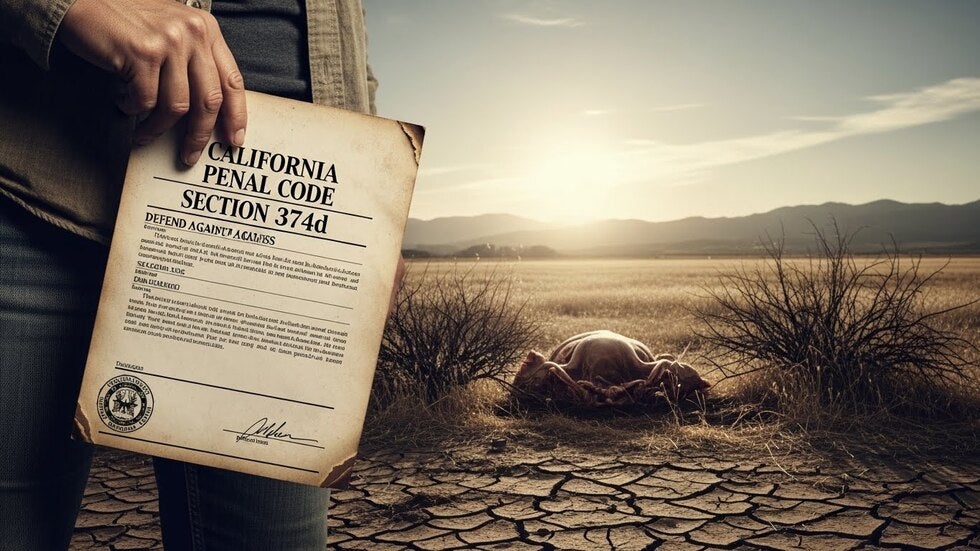
California Health and Safety Code Section 374d addresses a specific public health concern that many property owners and ranchers may not fully understand until they face criminal charges. This statute makes it a misdemeanor to place or allow dead animal carcasses to remain within 100 feet of public roadways. While the law seems straightforward on its surface, defending against these charges requires understanding the nuances of ownership, knowledge requirements, and what constitutes reasonable carcass disposal under various circumstances.
Understanding the Scope of Section 374d
Section 374d establishes criminal liability for two distinct scenarios involving dead animal carcasses near public thoroughfares. The first scenario applies to animal owners who knowingly allow carcasses of animals they owned at the time of death to be placed or to remain within 100 feet of streets, alleys, public highways, or roads in common use. The second scenario targets anyone who puts a dead animal carcass within this protected zone, regardless of whether they owned the animal.
The statute's language reflects California's longstanding public health and safety concerns about dead animals near traveled roads. Decomposing carcasses create health hazards, attract scavengers and pests, produce offensive odors, and can pose dangers to motorists who may swerve to avoid them or encounter animals attracted to the site. However, the law's application can create unexpected legal problems for property owners, ranchers, farmers, and even good samaritans trying to address dead animal situations.
The 100 foot distance requirement represents the legislature's determination of an adequate buffer zone between carcasses and public roadways. This specific measurement becomes crucial in many cases, as the difference between 95 feet and 105 feet determines whether criminal liability exists. Property owners with livestock near rural roads may find that natural death locations or disposal areas they believed were sufficient actually fall within the prohibited zone.
The Knowledge Requirement for Animal Owners
For animal owners facing charges under the first scenario, the prosecution must prove that the defendant knowingly allowed the carcass to be put or remain within 100 feet of a public roadway. This knowledge requirement creates important defense opportunities that experienced attorneys can explore.
Knowledge in this context means more than mere awareness that you owned an animal and that it died. The prosecution must establish that you knew or reasonably should have known that the carcass was positioned within the prohibited distance from a public road. Factors affecting this knowledge determination include the size of your property, the terrain and vegetation that might obscure visibility, the location where the animal died, and whether you had reason to believe the carcass was in a compliant location.
Large rural properties present particular challenges for applying the knowledge standard. A rancher with hundreds of acres and livestock that graze freely over vast areas cannot reasonably be expected to know the precise location of every animal at all times. If an animal dies naturally in a remote pasture area that happens to fall within 100 feet of a rarely used ranch road, establishing that the owner knowingly allowed this becomes difficult for prosecutors.
The duration that a carcass remains in the prohibited location also affects the knowledge analysis. A carcass that appeared overnight and was discovered and removed the next day presents different knowledge issues than one that remained in place for weeks. Defense attorneys often focus on demonstrating that their clients took prompt action once they became aware of the situation, negating the knowing allowance element.
What Constitutes a Public Roadway Under the Statute
The statute's reference to streets, alleys, public highways, or roads in common use requires careful interpretation in many cases. Not every path or track qualifies as a protected roadway under Section 374d, and disputes about road classification can form the basis of effective defenses.
Public highways and streets maintained by governmental entities clearly fall within the statute's scope. However, the phrase "road in common use" creates ambiguity that defense attorneys can exploit. Does a seldom traveled dirt road on private property that neighbors occasionally use with permission constitute a road in common use? What about a private ranch road that crosses multiple properties under easement agreements?
Courts generally interpret "roads in common use" to mean routes regularly traveled by the public or multiple parties, not exclusively private driveways or paths used only by the property owner. Establishing that the nearest road to the carcass location was actually a private access route rather than a public thoroughfare can defeat charges entirely. This analysis often requires investigating road ownership records, easement documents, and usage patterns.
The measurement of 100 feet from "any street, alley, public highway, or road" raises questions about what point of the road serves as the measuring point. Is it measured from the road's center line, from the edge of pavement, from the maintained shoulder, or from the property line? While courts typically measure from the edge of the traveled portion of the roadway, ambiguities in specific cases can create measurement disputes that affect liability.
Common Scenarios Leading to Section 374d Charges
Understanding the typical situations that result in charges under this statute helps property owners recognize risks and prepare defenses if accusations arise. Several scenarios occur with particular frequency in California's diverse agricultural and rural communities.
Livestock deaths on ranches and farms represent the most common source of Section 374d cases. Cattle, horses, sheep, and other large animals die from natural causes, accidents, predator attacks, and illness. When these deaths occur in pastures or ranges near roads, owners may lack immediate awareness of the death or may face practical challenges in quickly removing large carcasses from difficult terrain. Prosecutors sometimes view delayed removal as knowing allowance, while property owners view it as dealing with practical realities.
Vehicle strikes create another frequent scenario. When animals escape confinement and are struck by vehicles on or near roadways, questions arise about who bears responsibility for carcass removal and whether the owner knowingly allowed the resulting situation. These cases often involve disputes about fence maintenance, animal escape prevention, and the reasonableness of the owner's response time.
Pet deaths can also trigger charges, particularly in rural residential areas where properties border public roads. A dog or cat that dies on an owner's property within 100 feet of a street may violate the statute if the owner does not promptly remove it. These cases often involve elderly or infirm pet owners who may have lacked physical ability to quickly dispose of deceased pets, creating sympathetic circumstances for defense.
Wildlife situations present unique challenges. Property owners sometimes discover dead wild animals on their land near roadways. While the statute primarily targets animals "which belonged to him at the time of its death," disputes can arise when wildlife die in locations suggesting human involvement or when property owners are accused of placing wildlife carcasses in prohibited areas.
Available Defenses and Legal Strategies
Defending against Section 374d charges requires careful analysis of the specific circumstances and application of various legal strategies depending on the evidence and facts involved. Several defense approaches prove effective in appropriate cases.
Lack of knowledge represents a primary defense for animal owners. Demonstrating that you had no awareness of the animal's death or its location until after you took corrective action can negate the knowing allowance element. Evidence supporting this defense includes property size and layout documentation, testimony about normal inspection routines, and proof of prompt removal once discovery occurred.
Challenging ownership allegations provides another defense avenue. If you did not own the animal at the time of its death, the first scenario does not apply. Questions about ownership may arise with animals under lease arrangements, animals recently sold but not yet removed from the property, or situations involving disputed ownership or strayed animals.
Measurement disputes can defeat charges when surveys or accurate measurements establish that the carcass was actually beyond 100 feet from any qualifying roadway. Hiring a surveyor to document precise distances provides objective evidence that can create reasonable doubt or demonstrate that the prosecution cannot prove the distance element beyond a reasonable doubt.
Road classification challenges attack whether the nearby thoroughfare qualifies as a street, alley, public highway, or road in common use under the statute. Research into road ownership, maintenance responsibility, usage patterns, and legal status can establish that the road does not meet statutory requirements, eliminating the basis for charges.
Necessity and emergency defenses may apply in limited circumstances. If unusual events prevented normal carcass disposal, such as natural disasters, extreme weather, or public safety emergencies that made removal temporarily impossible, these factors may provide mitigation even if they do not constitute complete defenses.
Practical Considerations for Property Owners
Property owners, particularly those with livestock or animals on rural properties, should implement practices that minimize the risk of Section 374d violations and create documentation useful for defense if charges arise. Several practical steps provide both compliance benefits and defense preparation.
Regular property inspections, especially of areas near public roads, allow early detection of animal deaths and prompt removal before violations occur. Maintaining logs or records of these inspections documents your diligence and can support lack of knowledge defenses if accusations arise. Photographic documentation of inspection areas and their distances from roads provides additional evidence.
Establishing relationships with rendering services, dead animal removal companies, or veterinarians who provide carcass disposal creates options for quick response when animal deaths occur. Having these contacts readily available reduces the time between discovery and proper disposal, minimizing exposure under the statute.
Understanding the precise boundaries between your property and adjacent public roads helps you identify areas requiring special attention. Professional surveys or GPS mapping of the 100 foot buffer zones around all road frontages allows strategic planning of animal areas, disposal locations, and inspection priorities. This information becomes invaluable if distance disputes arise in criminal cases.
Fencing and animal management practices that minimize the likelihood of animals dying near roadways reduce overall risk. While deaths from natural causes cannot always be prevented, strategic placement of feeding areas, shelter locations, and pasture rotation away from road frontages decreases the probability of problematic carcass locations.
The Misdemeanor Classification and Potential Penalties
Section 374d classifies violations as misdemeanors, which carries specific penalty ranges and collateral consequences that defendants should understand. While misdemeanors represent less serious offenses than felonies, convictions still create criminal records and can impose substantial punishments.
California misdemeanors generally allow punishment of up to six months in county jail, fines up to $1,000, or both imprisonment and fines. Courts also routinely impose probation terms that may include community service, restitution for any cleanup costs incurred by governmental agencies, and compliance monitoring. The specific penalties in individual cases depend on factors including the circumstances of the violation, the defendant's criminal history, any aggravating or mitigating factors, and the preferences of the sentencing judge.
Beyond direct criminal penalties, misdemeanor convictions create criminal records that can affect employment opportunities, professional licensing, and housing applications. Agricultural professionals, veterinarians, animal control officers, and others whose work involves animals may face particular scrutiny from licensing boards following convictions under animal related statutes.
For property owners facing civil litigation related to the same circumstances, such as nuisance claims from neighbors or personal injury cases from accidents allegedly caused by carcasses near roads, criminal convictions under Section 374d can provide damaging evidence in those civil proceedings. This potential collateral impact makes vigorous criminal defense even more important.
Why Legal Representation Matters in Carcass Cases
Although Section 374d violations may seem minor compared to other criminal offenses, the unique circumstances of these cases and the potential defenses available make experienced legal representation valuable. An attorney familiar with California health and safety code violations can identify factual and legal issues that non lawyers might overlook.
Many Section 374d cases involve factual disputes about measurements, property boundaries, road classifications, and timelines that require investigation and expert testimony to resolve favorably. Defense attorneys can retain surveyors, obtain property records, interview witnesses, and gather photographic or video evidence that establishes reasonable doubt about key elements of the charges.
Negotiation with prosecutors often produces favorable outcomes in appropriate cases, particularly when defendants can demonstrate good faith efforts at compliance, prompt corrective action, or sympathetic circumstances explaining the violation. Attorneys experienced in handling these matters understand what evidence and arguments resonate with prosecutors and can advocate effectively for charge reductions or dismissals.
For defendants whose livelihoods depend on animal ownership or agricultural operations, avoiding convictions that might affect licensing or business reputations becomes especially critical. Strategic defense that protects both your immediate legal interests and your long term professional standing requires knowledgeable counsel who understands the broader implications of these cases.
If you face charges under Section 374d or have questions about compliance with California's dead animal carcass disposal laws, consulting with an experienced criminal defense attorney protects your rights and provides guidance tailored to your specific situation.