
By The Bulldog Law Criminal Defense Team • Reviewed by a licensed California criminal defense attorney
California Health & Safety Code § 11351 makes it a felony to possess certain controlled substances with the intent to sell them. It can also apply when a person purchases a controlled substance for the purpose of selling it.
A conviction under § 11351 can lead to serious penalties. The basic sentencing range is 2, 3, or 4 years in county jail, along with possible fines and other consequences. The exact sentence can depend on the drug involved, the amount, prior convictions, and other facts.
The most important difference is between simple possession and possession for sale.
California Health & Safety Code § 11350 generally deals with simple possession. You can learn more in our guide to California drug possession under HS 11350.
For § 11351, the prosecution must prove more than possession. It must show that the person possessed the drugs with the required intent to sell them.
That intent is often the main issue in the case.
This guide from The Bulldog Law's drug crimes defense practice explains what prosecutors must prove, what evidence they may use to claim the drugs were for sale, and how the defense can challenge that evidence.
What Must the Prosecution Prove?
A § 11351 case usually focuses on four main issues.
The prosecution generally must prove that:
-
The person possessed a controlled substance.
-
The person knew the substance was present.
-
The person knew the substance was a controlled substance.
-
The person intended to sell the substance.
The last element is often the hardest part for the prosecution.
People do not usually carry a note saying, "These drugs are for sale."
Instead, prosecutors often use other evidence to argue that the person planned to sell the drugs.
This evidence is sometimes called indicia of sales.
How Prosecutors Try to Prove Intent to Sell
Police and prosecutors may look at the entire situation.
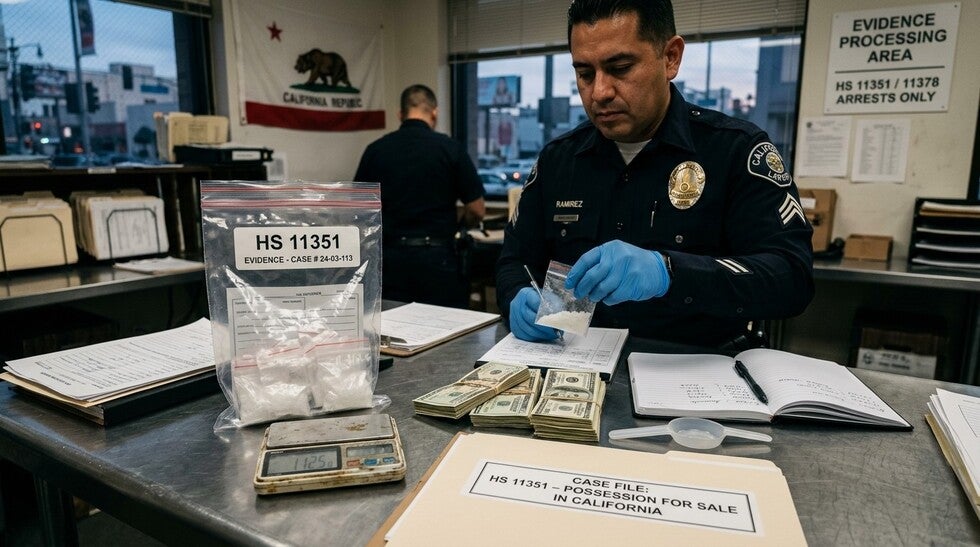
Evidence may include:
-
The amount of drugs
-
Small individual packages
-
Baggies
-
Scales
-
Large amounts of cash
-
Cash in different denominations
-
Text messages
-
Social media messages
-
Multiple phones
-
Pay-owe notes
-
Customer communications
-
Other evidence of possible drug sales
The presence of one item does not automatically prove an intent to sell.
For example, a person who uses drugs may own a scale to measure what they purchased. A person may also have cash for normal reasons.
The defense can explain why the evidence does not necessarily mean the drugs were for sale.
Quantity Does Not Always Prove Intent to Sell
The amount of drugs can be important, but quantity alone does not always answer the question.
Some people buy larger amounts for personal use because buying in bulk can cost less.
The defense may look at:
-
How much of the drug was found
-
The person's history of drug use
-
How long the supply would normally last
-
How the drugs were packaged
-
Whether there was evidence of customers
-
Whether there were sales messages
-
Whether money was connected to the alleged sales
The prosecution may ask a drug expert to explain why the amount suggests sales.
The defense can challenge that opinion and provide another explanation for the evidence.
Packaging and Scales Can Have More Than One Meaning
Small bags, scales, and other items are often used by prosecutors as evidence of sales.
But these items can have innocent explanations.
For example:
-
A scale can be used to measure a personal supply.
-
Baggies may come with drugs when they are purchased.
-
Cash may be from employment or other legal sources.
-
A phone may contain messages unrelated to drug sales.
The defense should look at the complete evidence rather than treating one item as proof of criminal intent.
Drugs Found in a Shared Home or Car
Another important issue is possession.
The drugs may not be found directly on the accused person.
They may be found in:
-
A shared apartment
-
A family home
-
A bedroom
-
A vehicle
-
A backpack
-
A common area
-
A friend's property
In these situations, the prosecution may rely on a theory called constructive possession.
The basic question becomes whether the evidence connects the person to the drugs and shows that they knew about them and had control over them.
Simply being near drugs does not automatically prove that they belonged to you.
For example, drugs found in a shared bedroom may raise different questions from drugs found inside a person's locked backpack.
The defense should examine who had access to the area, who owned the property, and what other evidence connects the accused to the drugs.
The Fourth Amendment Can Be Critical
Many drug cases begin with a traffic stop, search, probation search, or search of a home.
That makes constitutional search-and-seizure rules very important.
A defense lawyer may examine:
-
Why the police stopped the vehicle
-
Whether the stop was lawful
-
Whether the officer kept the person longer than allowed
-
Whether officers had a legal reason to search
-
Whether the person gave consent
-
Whether a warrant was required
-
Whether a drug dog was used
-
Where the drugs were found
-
How the police found the evidence
If the search or seizure violated the person's constitutional rights, the defense may be able to challenge the evidence.
In some cases, removing important evidence can seriously weaken the prosecution's case.
Common Defenses to an HS 11351 Charge
1. The Drugs Were for Personal Use
The defense may argue that the drugs were intended for personal use rather than sale.
This can be supported by evidence about:
-
The person's drug-use history
-
Quantity
-
Packaging
-
Lack of customer communications
-
Lack of sales records
-
Lack of large amounts of unexplained cash
-
The circumstances of the arrest
If the evidence does not prove the required intent to sell, the prosecution may have difficulty proving § 11351.
2. The Drugs Did Not Belong to You
If drugs were found in a shared home, car, or other location, the defense may challenge the connection between the drugs and the accused person.
The prosecution must prove the required elements of possession.
Questions may include:
-
Who owned the room?
-
Who owned the vehicle?
-
Who had access to the area?
-
Who owned the bag?
-
Who knew the drugs were there?
-
Were other people present?
The fact that drugs were found near someone does not automatically answer these questions.
3. Challenge the Search
If police found the drugs during an illegal search, the defense may challenge the evidence.
A lawyer can review the police reports, body-camera footage, search records, warrant documents, and other evidence to determine whether officers followed the law.
4. Challenge the Drug Expert's Opinion
Police officers may give expert opinions about whether drugs appear to be intended for sale.
The defense can question the basis of that opinion.
For example:
-
How was the amount evaluated?
-
Why does the packaging prove sales?
-
Could the scale have another purpose?
-
Was there evidence of actual customers?
-
Were there sales messages?
-
Was the cash connected to drugs?
-
Did the officer consider personal use?
An expert opinion is evidence that can be tested and challenged.
5. Challenge Statements and Messages
Text messages, phone records, and statements can be important in a drug case.
The defense should look at the complete conversation instead of only selected messages.
A single message can sometimes have several possible meanings.
The full context may show that the prosecution's interpretation is not the only reasonable explanation.
HS 11351 vs. HS 11350
The difference between these two charges is extremely important.
HS 11350: Simple Possession
HS 11350 generally deals with possession for personal use.
Depending on the facts and the person's history, a simple possession case may have access to treatment or diversion options.
Read our detailed guide on California Health & Safety Code § 11350 drug possession.
HS 11351: Possession for Sale
HS 11351 requires the prosecution to prove the additional intent-to-sell element.
It is a felony offense with a basic sentencing range of 2, 3, or 4 years.
This difference can have a major effect on the case.
A defense lawyer may therefore focus heavily on challenging the evidence that the drugs were intended for sale.
Can an HS 11351 Charge Be Reduced?
In some cases, a defense attorney may negotiate a reduction to a less serious charge.
The possibility depends on the facts and evidence.
For example, if the evidence of intent to sell is weak, the defense may argue that the facts support simple possession instead.
A reduction can change the legal consequences significantly.
It may also open the door to treatment or diversion programs that are not generally available for a possession-for-sale charge.
Our guide explaining California Proposition 36 and drug crimes provides additional information about California drug treatment and sentencing options.
Can I Get Drug Diversion for HS 11351?
Generally, a person charged with HS 11351 is not eligible for the standard pretrial drug diversion program available for qualifying simple-possession offenses. Penal Code § 1000 is generally aimed at qualifying personal-use possession cases, not possession-for-sale charges.
However, the situation can change if the charge is reduced to an eligible possession offense.
This is one reason the intent-to-sell issue can be so important.
The defense may work toward a resolution that changes the charge rather than simply focusing on the sentence.
Eligibility for any treatment or diversion program should be reviewed based on the current law and the person's individual case.
Penalties for HS 11351
A basic § 11351 conviction carries a sentence of 2, 3, or 4 years under California law.
Other consequences can include:
-
Fines
-
Probation in appropriate cases
-
Drug treatment requirements
-
Search conditions
-
Restrictions related to future offenses
-
Immigration consequences for noncitizens
The sentence can also increase when special circumstances apply.
For example, California law provides additional penalties for certain large quantities of heroin, cocaine, or cocaine base under Health & Safety Code § 11370.4.
The exact penalty depends on the drug, amount, prior convictions, and other facts.
Drug Quantity Enhancements
Large quantities of certain controlled substances can result in additional sentencing exposure.
For certain heroin, cocaine, and cocaine-base cases, Health & Safety Code § 11370.4 provides additional prison terms based on the amount involved. The additional terms can become very large in cases involving extremely high quantities.
These enhancements make it especially important to review the amount alleged and how the substance was measured.
Immigration Consequences of an HS 11351 Conviction
Drug convictions can create very serious immigration problems for noncitizens.
Federal immigration law treats certain drug-trafficking convictions as aggravated felonies. California appellate courts have specifically recognized that a conviction under HS 11351 can qualify as an aggravated felony for immigration purposes.
The immigration consequences can include removal and loss of eligibility for certain forms of immigration relief.
The exact result depends on the conviction, the record of conviction, and the person's immigration status.
For this reason, a noncitizen should receive a careful criminal and immigration review before accepting a plea.
Our criminal immigration and deportation consequences guide explains this issue in more detail.
Why the Exact Charge Matters
A person may think that the sentence is the only important part of a plea agreement.
That is not always true.
The exact statute of conviction can affect:
-
Whether the offense is a felony
-
Treatment or diversion eligibility
-
Immigration status
-
Future criminal penalties
-
Professional licensing
-
Employment
-
Other legal rights
For a noncitizen, the difference between a possession charge and a possession-for-sale conviction can be especially important.
That is why the exact language of any plea agreement should be reviewed carefully before it is accepted.
Frequently Asked Questions
What is the difference between HS 11350 and HS 11351?
The main difference is the prosecution's claim about intent.
HS 11350 generally involves simple possession for personal use.
HS 11351 involves possession of certain controlled substances with the intent to sell.
The evidence may look similar in both cases. The prosecution may rely on packaging, quantity, scales, cash, messages, or other evidence to argue that the drugs were intended for sale.
Can I get diversion for a possession-for-sale charge?
Generally, no.
Standard drug diversion programs such as Penal Code § 1000 generally focus on qualifying simple-possession cases rather than possession-for-sale charges.
However, if the charge is reduced to an eligible possession offense, treatment or diversion may become possible.
Eligibility depends on the exact charge and the person's circumstances.
What if the drugs were found in a shared apartment or car?
The prosecution still needs to connect you to the drugs and prove the required elements of possession.
If several people had access to the location, the defense can examine who actually controlled the area and who knew the drugs were there.
The mere fact that drugs were found near you does not automatically prove that you possessed them for sale.
Can the police use scales and cash as evidence of intent to sell?
Yes.
Police may use scales, cash, packaging, messages, quantity, and other evidence to argue that drugs were intended for sale.
But none of these items automatically proves intent.
The defense can provide another explanation for the evidence and challenge the prosecution's interpretation.
Can an HS 11351 charge affect immigration status?
Yes.
A conviction can create severe immigration consequences for a noncitizen. California courts have recognized that an HS 11351 conviction can qualify as an aggravated felony under federal immigration law.
The exact consequences depend on the conviction and the person's immigration situation.
A noncitizen should get immigration advice before accepting any plea agreement.
Can an HS 11351 charge be reduced?
It may be possible in some cases.
A lawyer may negotiate for a lower charge when the evidence does not strongly support an intent to sell.
The possibility depends on the evidence, the person's criminal history, the drug involved, and other facts.
A reduction can also change eligibility for certain treatment or diversion options.
What should I do if I am arrested for possession for sale?
Do not try to explain the entire case to police.
Ask for a lawyer and avoid making statements about ownership, sales, or where the drugs came from until you have legal advice.
Do not delete messages or other evidence.
Preserve relevant records and give them to your attorney.
The earlier your lawyer can review the search, evidence, and charging decision, the more options may be available.
Building a Defense to an HS 11351 Charge
An HS 11351 case often depends on an inference.
The prosecution may say:
Drugs + cash + packaging + scale = intent to sell.
The defense does not have to accept that conclusion.
Each piece of evidence can be examined.
The defense can ask:
-
Were the drugs actually connected to the accused?
-
Was the search legal?
-
Was the amount consistent with personal use?
-
Was there proof of customers?
-
Were the messages really about drug sales?
-
Was the cash connected to the drugs?
-
Could the packaging have another explanation?
-
Is the officer's expert opinion supported by the full evidence?
When the evidence is examined piece by piece, the prosecution's theory may become much less certain.
Take an HS 11351 Charge Seriously
A possession-for-sale charge is much more serious than a simple possession charge.
The prosecution must prove the required elements, including the intent to sell. Evidence such as quantity, packaging, cash, scales, messages, and the location of the drugs may be used to argue that intent, but each piece of evidence can be challenged.
A defense may involve attacking the search, challenging possession, questioning the intent-to-sell evidence, or negotiating for a lower charge when the facts support it.
For noncitizens, the immigration consequences should be reviewed before any plea is accepted.
The Bulldog Law's drug crimes defense team represents people facing serious drug charges throughout California.
Contact the firm online or call (888) 928-1609 to discuss your case.