
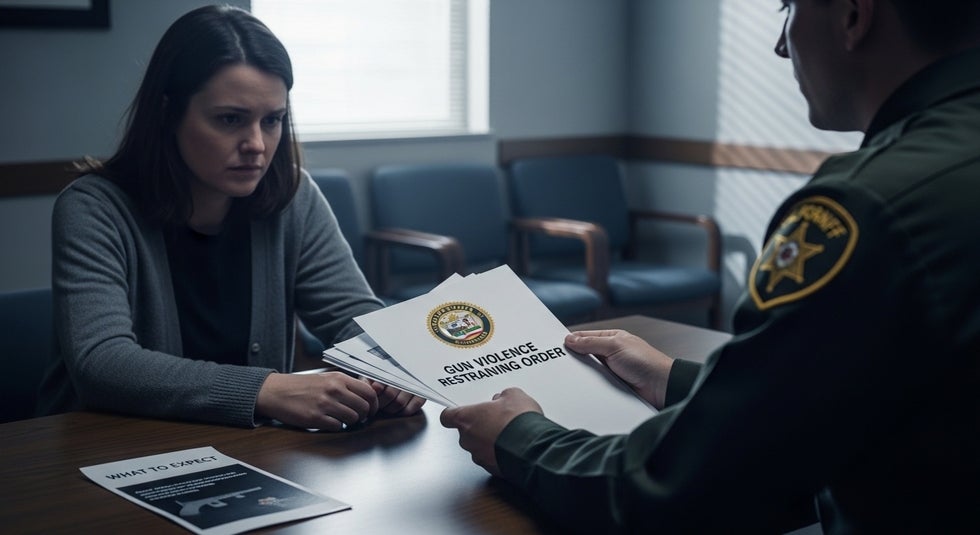
Receiving service of a gun violence restraining order represents one of the most stressful moments a gun owner can face. Law enforcement officers arrive at your door, hand you legal documents, and inform you that a court has temporarily stripped away your Second Amendment rights. Understanding what these documents contain and what happens next becomes critical to protecting your interests.
Required Components of the Order
California law mandates specific information that every ex parte gun violence restraining order must contain. Courts cannot issue valid orders without including these essential elements, and missing components may provide grounds for challenging the order's validity.
Statement of Grounds
The order must include a statement explaining why the court issued it. This section outlines the specific evidence and factors the judge considered when determining that grounds existed to restrict your firearm rights temporarily.
Many respondents find these ground statements frustratingly vague or incomplete. Courts issuing emergency orders sometimes provide minimal explanation beyond citing statutory factors without detailing specific allegations. Defense attorneys can challenge orders containing insufficient grounds statements that fail to adequately inform you of the basis for restricting your constitutional rights.
Reading the grounds statement carefully helps identify factual errors, mischaracterizations, or weak allegations you can challenge at the upcoming hearing. Document any inaccuracies immediately and share them with your attorney so they can prepare an effective response.
Expiration Date and Time
Every ex parte gun violence restraining order must specify exactly when it expires. These emergency orders cannot last longer than 21 days from the date of issuance.
The expiration date creates urgency for both petitioners and respondents. Petitioners must prepare for a full hearing before expiration, while respondents must quickly gather evidence and retain legal counsel to contest the order at that hearing.
Never assume the order will simply expire without consequences. Courts often convert temporary orders into longer term gun violence restraining orders lasting one to five years if respondents fail to appear at scheduled hearings or cannot overcome the evidence against them.
Court Address Information
The order must provide the superior court address where you should file any responsive pleading. This information tells you where to direct legal filings if you choose to contest the order or present evidence in your defense.
Filing responsive pleadings requires understanding court procedures and deadlines. While California law does not require respondents to file written responses before the hearing, doing so can strategically benefit your case by putting the petitioner on notice of your defenses and the evidence you plan to present.
Bulldog Law helps clients prepare and file appropriate responsive pleadings that preserve legal arguments, challenge defective petitions, and set the stage for successful hearing outcomes.
Scheduled Hearing Information
The order must specify the exact date and time when the court will hold a hearing to determine whether to issue a longer term gun violence restraining order. This hearing typically occurs within the 21 day period before the temporary order expires.
Mark this hearing date immediately and prioritize retaining defense counsel. The hearing represents your first opportunity to appear before the judge, present evidence, cross examine witnesses, and challenge the allegations against you. Arriving unprepared or unrepresented dramatically increases the likelihood of adverse outcomes.
Some respondents mistakenly believe they can ignore the hearing since the temporary order will expire anyway. This represents a serious tactical error. Courts routinely issue multi year gun violence restraining orders against respondents who fail to appear, accepting the petitioner's evidence as uncontested truth.
Mandatory Warning Statement
Every order must include a specific warning statement informing you of your obligations and the upcoming hearing. This statement serves multiple purposes including ensuring you understand the firearm surrender requirements, the prohibition on possessing or purchasing firearms during the order's duration, and the consequences of failing to appear at the hearing.
The warning explicitly states that failure to appear may result in a court order valid for one to five years. This language underscores the high stakes involved in these proceedings and the importance of taking the temporary order seriously despite its brief duration.
The warning also advises you to seek legal counsel promptly so an attorney can assist with matters connected to the order. Courts include this language recognizing that most respondents lack legal expertise to navigate these complex proceedings without professional guidance.
The Personal Service Requirement
California law requires personal service of gun violence restraining orders on restrained persons whenever they can reasonably be located. This means someone must physically hand you the documents rather than leaving them at your residence or mailing them.
Who Serves the Order
Law enforcement officers typically serve gun violence restraining orders, though private process servers authorized under California Code of Civil Procedure Section 414.10 may also effect service in appropriate circumstances.
When law enforcement serves these orders, the encounter often feels intimidating and confrontational. Officers arrive in uniform, sometimes with multiple personnel, creating an atmosphere of criminal suspicion even though gun violence restraining orders are civil proceedings.
Understanding your rights during service becomes important. You must accept the documents and comply with lawful orders, but you should limit what you say to law enforcement. Anything you tell officers can become evidence used against you at the hearing.
Information Officers Must Provide
Law enforcement officers serving gun violence restraining orders must inform you about the scheduled hearing. This verbal notification supplements the written hearing information contained in the order itself.
Officers also must verbally ask whether you have firearms, ammunition, or magazines in your possession or under your custody or control. This question serves multiple purposes including initiating the surrender process and documenting your compliance or lack thereof.
How you respond to this question carries significant consequences. Lying to law enforcement creates separate criminal liability, but providing detailed information about your firearms may assist in their confiscation. This situation illustrates why having legal counsel becomes critical immediately upon receiving service.
Your Immediate Obligations
Once served with a gun violence restraining order, you face immediate legal obligations that begin the moment you receive the documents. Violating these requirements carries serious criminal penalties including potential felony charges.
Firearm Surrender Requirements
The order prohibits you from having in your custody or control, owning, purchasing, possessing, or receiving any firearm, ammunition, or magazine while it remains in effect. You must surrender all such items in accordance with California Penal Code Section 18120.
The surrender process requires careful attention to legal requirements and deadlines. You generally have 24 hours to surrender firearms to law enforcement or transfer them to licensed dealers. Failing to surrender firearms within required timeframes constitutes a criminal violation regardless of whether you intended to defy the order.
Some respondents attempt to hide firearms or claim they lost them to avoid surrender. These strategies backfire dramatically when law enforcement discovers the deception. Courts view failure to surrender firearms as evidence of dangerousness and routinely issue long term orders against respondents who violate surrender requirements.
Prohibition on New Acquisitions
Beyond surrendering existing firearms, the order prohibits attempting to purchase or receive new firearms, ammunition, or magazines during its effective period. This means you cannot visit gun stores, order ammunition online, or accept firearms as gifts even if you plan to store them with someone else.
Background check systems flag individuals subject to gun violence restraining orders, preventing legal purchases. Attempting to acquire firearms through private transfers or straw purchases compounds your legal problems by adding new criminal violations.
Preparing for the Hearing
The period between service and the scheduled hearing represents your opportunity to build a defense. Courts issue ex parte orders based solely on the petitioner's one sided presentation of evidence. The hearing allows you to present contrary evidence, challenge witness credibility, and demonstrate that you pose no danger justifying firearm restrictions.
Gathering Evidence
Effective hearing preparation requires collecting evidence that undermines the petitioner's allegations or provides context showing you pose no threat. This may include character reference letters, employment records, medical documentation, text message exchanges, social media posts, photographs, or other materials demonstrating responsible behavior.
Witnesses who can testify about your character, dispute the petitioner's allegations, or provide context for misunderstood incidents become valuable defense resources. Identifying and preparing witnesses requires time, making early consultation with defense counsel essential.
Understanding Burden of Proof
At the hearing to determine whether to issue a longer term gun violence restraining order, the petitioner bears the burden of proving by clear and convincing evidence that you pose a significant danger of personal injury to yourself or others by having firearms. This represents a higher standard than the probable cause showing required for the initial ex parte order.
While petitioners carry the burden of proof, respondents who fail to present contrary evidence or challenge witness testimony effectively face uphill battles. Courts often give significant weight to allegations in sworn petitions unless respondents provide compelling reasons to doubt their accuracy.
Legal Representation Benefits
Navigating gun violence restraining order hearings without legal representation puts you at a severe disadvantage. Most respondents lack understanding of evidence rules, cross examination techniques, and legal arguments that could defeat the petition.
Bulldog Law provides experienced defense representation for individuals facing gun violence restraining order hearings. Our attorneys understand the statutory factors courts consider, know how to challenge weak evidence, and present compelling cases that protect your Second Amendment rights.
We work quickly to gather evidence, interview witnesses, and develop defense strategies tailored to the specific allegations against you. Our legal team files appropriate responsive pleadings, conducts thorough cross examinations of petitioners and their witnesses, and presents evidence demonstrating you pose no danger.
Consequences of Ignoring the Order
Some respondents make the catastrophic mistake of ignoring gun violence restraining orders, believing temporary restrictions do not warrant serious attention. This approach virtually guarantees long term firearm prohibitions and potential criminal charges.
Default Orders
Courts issue multi year gun violence restraining orders by default against respondents who fail to appear at scheduled hearings. Without your testimony or contrary evidence, judges accept the petitioner's allegations as true and find that grounds exist for extended restrictions.
Default orders typically last the maximum five year period, as courts view failure to appear as evidence of irresponsibility or dangerousness. Overturning default orders after the fact proves extremely difficult, requiring you to demonstrate good cause for your absence and relitigate the entire matter.
Criminal Penalties
Violating gun violence restraining orders by possessing firearms, failing to surrender them, or attempting to purchase new ones exposes you to criminal prosecution. Even technical violations based on misunderstanding the order's requirements can result in charges.
Protecting Your Rights
Gun violence restraining orders represent serious legal proceedings with lasting consequences for your constitutional rights, reputation, and future firearm ownership. Taking these orders seriously from the moment of service and obtaining experienced legal representation dramatically improves your chances of favorable outcomes.
Bulldog Law stands ready to defend your rights when you face gun violence restraining order proceedings. Contact our office immediately upon receiving service so we can begin building your defense and protecting your Second Amendment rights. The hearing date approaches quickly, and early preparation makes the difference between success and years of firearm restrictions.
We would be happy to review your case and guide you through your options for pursuing compensation. Call (888) 928-1609 or reach out through our website to request your free consultation.