
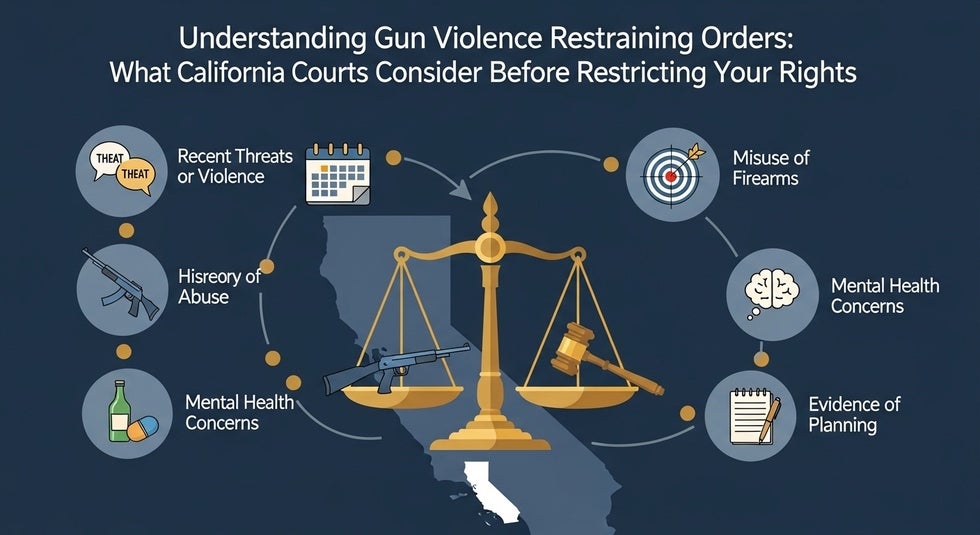
California's gun violence restraining order laws grant courts significant power to temporarily remove firearms from individuals deemed to pose a threat. If you're facing a gun violence restraining order petition, understanding what evidence courts evaluate becomes critical to protecting your Second Amendment rights and mounting an effective defense.
The Ex Parte Emergency Process
Courts can issue ex parte gun violence restraining orders without your presence or knowledge. This emergency procedure allows judges to restrict your firearm rights based solely on a petitioner's testimony and supporting evidence, without giving you an opportunity to present your side of the story initially.
The ex parte process creates an immediate disadvantage for respondents. By the time you learn about the order, law enforcement may already be at your door demanding surrender of your firearms. This is why having experienced legal representation becomes essential from the moment you receive notice of any gun violence restraining order proceeding.
Judges issuing these emergency orders must examine the petitioner under oath or review sworn written affidavits. However, this one sided presentation of evidence often lacks the context and counterevidence that would emerge through full adversarial proceedings.
Evidence Courts Must Consider
California law establishes specific factors courts must evaluate when determining whether grounds exist for a gun violence restraining order. Understanding these mandatory considerations helps respondents identify weaknesses in petitions filed against them.
Recent Threats or Acts of Violence
Courts must examine whether you allegedly made recent threats of violence or committed violent acts directed toward others or yourself. The statute defines "recent" as within six months prior to the petition filing date.
This six month window creates both opportunities and challenges for defense attorneys. Petitioners cannot rely on stale allegations from years past, but they may mischaracterize normal conflicts or heated arguments as threatening behavior.
Defending against violence allegations requires careful examination of context. What seemed threatening to a petitioner may have been a misunderstood statement, a venting of frustration with no actual threat intended, or words taken completely out of context. Character witnesses, text message exchanges, and other evidence can demonstrate that alleged threats were not genuine expressions of violent intent.
Protective Order Violations
Courts must consider recent violations of emergency protective orders or unexpired protective orders issued under various California statutes. They also evaluate patterns of protective order violations from your history.
The mere existence of a protective order does not automatically justify a gun violence restraining order. Courts should examine the circumstances surrounding any alleged violation, whether the underlying protective order was properly issued, and whether you actually violated its terms or simply had unfortunate contact that fell within gray areas of the order's language.
Many protective orders contain vague or overly broad provisions that make technical violations nearly unavoidable. Defense counsel can challenge whether alleged violations genuinely demonstrate dangerousness or simply reflect the difficulty of complying with unclear restrictions.
Criminal Convictions
Courts must consider convictions for specific offenses listed in California Penal Code Section 29805, which enumerates crimes that prohibit firearm possession for ten years following conviction.
However, the existence of a qualifying conviction does not automatically mean you pose a current threat. Defense attorneys can present evidence that you've completed rehabilitation programs, maintained law-abiding behavior since conviction, and pose no danger to yourself or others despite past mistakes.
Patterns of Violent Behavior
Courts must evaluate whether you've engaged in a pattern of violent acts or violent threats within the past twelve months. This factor requires petitioners to demonstrate multiple incidents rather than isolated events.
Defending against pattern allegations involves scrutinizing each alleged incident to determine whether it actually constituted violence or a genuine threat. Often, petitioners string together unrelated disagreements, verbal arguments, or property damage incidents to manufacture an appearance of dangerous patterns where none exist.
Additional Evidence Courts May Consider
Beyond mandatory factors, courts may consider a wide range of additional evidence suggesting increased risk of violence. Understanding these discretionary factors helps respondents prepare comprehensive defenses.
Reckless Firearm Use
Courts may consider allegations of unlawful or reckless firearm use, display, or brandishing. This includes social media posts, text messages, or emails depicting firearms in ways petitioners characterize as threatening.
Many lawful gun owners post photos of firearms on social media, discuss firearms in text messages, or display firearms in their homes. Defense attorneys must distinguish between lawful firearm ownership and genuine recklessness or threats. Context matters enormously in evaluating whether firearm-related communications actually indicate dangerousness.
History of Physical Force
Courts may examine your history of using, attempting to use, or threatening to use physical force against others. Defense counsel should investigate whether alleged incidents actually occurred, whether you acted in self-defense, and whether petitioners accurately described the circumstances.
Prior Arrests
Courts may consider prior felony arrests even without convictions. This factor raises serious constitutional concerns, as arrests do not establish guilt and considering them potentially violates due process.
Defense attorneys should vigorously challenge reliance on arrests that did not result in convictions. Prosecutors dismissed charges or juries acquitted you for good reasons, and courts should not resurrect those allegations to justify firearm restrictions.
Substance Abuse
Courts may consider evidence of recent criminal offenses involving controlled substances or alcohol, or ongoing substance abuse. Police reports and conviction records can support these allegations.
Substance abuse issues do not automatically render someone dangerous. Many people struggling with addiction pose no threat to others and maintain safe firearm storage practices. Treatment participation and sobriety efforts demonstrate reduced risk rather than increased danger.
Recent Firearm Acquisitions
Courts may consider evidence of recent firearm or ammunition purchases. Notably, judges can still issue gun violence restraining orders even if you own no firearms, based on attempted acquisitions.
Lawful firearm purchases do not indicate dangerousness. Gun owners frequently acquire firearms for legitimate purposes including self-defense, hunting, collecting, or sport shooting. Defense counsel should emphasize the lawful nature of any purchases and the absence of threatening behavior accompanying them.
Body Armor Acquisition
Courts may consider body armor purchases as evidence of increased violence risk. However, many law-abiding citizens purchase body armor for lawful protective purposes without any intention of engaging in violence.
Stalking Behavior
Courts may evaluate evidence of stalking as defined under California law. Defending against stalking allegations requires careful examination of whether your conduct actually meets statutory definitions or simply reflects normal social contact that someone found unwelcome.
Animal Cruelty
Courts may consider animal cruelty evidence. While genuine animal cruelty raises legitimate concerns, petitioners sometimes mischaracterize pet discipline, hunting activities, or livestock management as cruelty to strengthen their cases.
Bias-Motivated Threats
Courts may consider threats motivated by race, ethnicity, nationality, religion, disability, gender, or sexual orientation. These allegations carry serious weight and require immediate attention from experienced defense counsel who can investigate whether statements were actually made, whether they constituted genuine threats, and what context surrounded them.
Property Damage for Intimidation
Courts may evaluate property damage committed to intimidate others or interfere with their constitutional rights based on protected characteristics. Defense attorneys must examine whether property damage actually occurred, whether it was intentional, and whether bias motivated it.
Political Violence Threats
Courts may consider threats made to advance political objectives or interfere with others' constitutional rights. In our politically polarized environment, passionate political speech sometimes gets mischaracterized as violent threats. Defense counsel should emphasize First Amendment protections for political expression while distinguishing genuine threats from protected speech.
Building Your Defense Strategy
Successfully defending against gun violence restraining orders requires immediate action. Courts issue ex parte orders based on limited evidence, but you'll have opportunities to challenge them at subsequent hearings where full presentation of evidence occurs.
Bulldog Law represents clients throughout California facing gun violence restraining order petitions. Our defense attorneys understand the evidence courts consider and develop strategies that challenge weak allegations, provide context for misunderstood behavior, and present compelling evidence that you pose no danger justifying firearm restrictions.
We gather character witnesses, documentary evidence, and expert testimony demonstrating that petitioners have mischaracterized your conduct or exaggerated threats. Our legal team scrutinizes every factor courts must and may consider, identifying weaknesses in the petition and building comprehensive defenses protecting your rights.
Time is critical when facing gun violence restraining orders. Contact Bulldog Law immediately if you've received notice of a petition or believe someone may file one against you. Early intervention by experienced defense counsel dramatically improves outcomes in these proceedings.
Protecting Your Second Amendment Rights
Gun violence restraining orders carry serious consequences beyond temporary firearm restrictions. They create records that may affect future firearm purchases, professional licenses, and employment opportunities. Fighting these orders aggressively from the outset protects both immediate and long-term interests.
Bulldog Law provides the experienced defense representation you need when facing gun violence restraining orders. Contact our team today to discuss your situation and learn how we can protect your constitutional rights throughout these proceedings.