
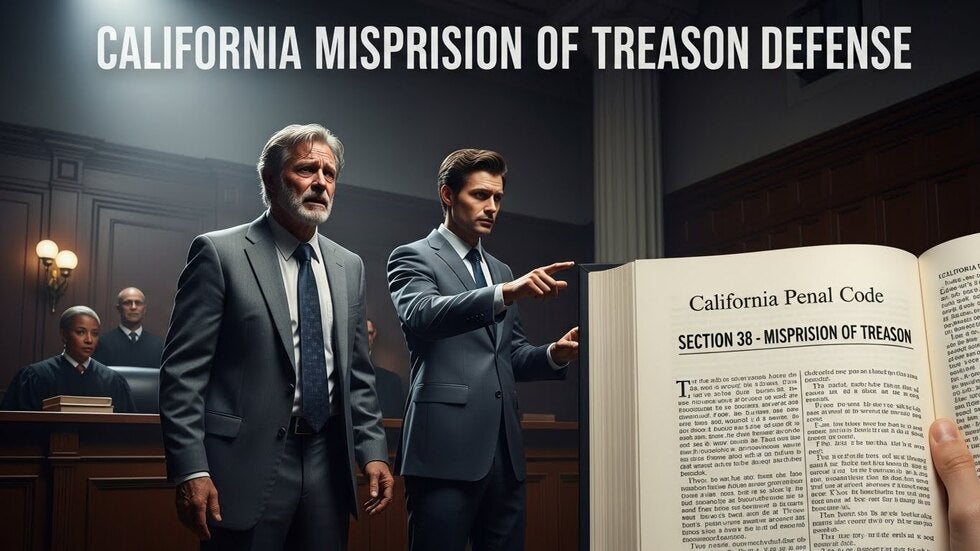
The Ancient Crime in Modern Times: When Silence Becomes Criminal
In an era of political polarization and heightened security concerns, California Penal Code Section 38's misprision of treason provision represents one of the most serious yet misunderstood crimes in the state's legal framework. This ancient offense, which criminalizes the mere knowledge and concealment of treason without participation, carries profound implications for anyone who might encounter treasonous activity and choose to remain silent rather than report it to authorities.
As a defense attorney who has studied the complexities of political crimes and national security cases, I understand how quickly individuals can find themselves facing misprision charges based on knowledge they never sought and silence they never intended as criminal conduct. The rarity of these prosecutions makes them particularly dangerous, as few attorneys have experience defending against charges that bridge criminal law, constitutional principles, and national security concerns.
Understanding California Penal Code Section 38
California Penal Code Section 38 creates the crime of misprision of treason, defining it as having knowledge of treason and concealing it without otherwise assenting to or participating in the treasonous crime itself. This definition establishes a unique category of criminal liability based on passive conduct rather than active participation.
The Elements of Misprision of Treason
To secure a conviction under Section 38, prosecutors must prove several distinct elements:
Knowledge of Treason: The defendant must have actual knowledge that treason has been committed or is being planned. This knowledge requirement is crucial because it distinguishes between those who genuinely know of treasonous activity and those who merely suspect or speculate about potential threats.
Concealment Without Participation: The defendant must have concealed their knowledge without otherwise assenting to or participating in the treason itself. This element creates the unique situation where the defendant is neither innocent of knowledge nor guilty of the underlying crime.
Absence of Reporting: Implicit in the concealment element is the failure to report known treasonous activity to appropriate authorities, though the statute doesn't specify exactly how or to whom such reports must be made.
The Punishment Framework
Section 38 specifies that misprision of treason is punishable by imprisonment pursuant to subdivision (h) of Section 1170, placing it within California's felony sentencing structure. This reference to Section 1170(h) indicates that the offense is treated as a serious felony with potential state prison consequences.
The severity of the potential punishment reflects the legislature's view that citizens have a fundamental duty to report treasonous activity and that failure to fulfill this duty warrants significant criminal sanctions.
The Lauria Decision: Context and Implications
The case of People v. Lauria, 251 Cal. App. 2d 471, provides crucial context for understanding how courts view the duty to report criminal activity and the special considerations that apply to serious crimes like treason.
The Court's Reasoning in Lauria
While the Lauria case didn't directly involve misprision of treason charges, the court's analysis provides important guidance on how California law views the duty to act against criminal activities:
Felony vs. Misdemeanor Distinction: The court emphasized that the duty to act against criminal activities is more compelling for felonies than for misdemeanors, recognizing that serious crimes create greater social obligations for citizen intervention.
Societal Expectations: The decision reflects the court's understanding that society expects citizens to take action against particularly heinous crimes, with treason representing one of the most serious threats to governmental authority and public safety.
Knowledge and Duty Correlation: The court's analysis suggests that knowledge of serious crimes creates corresponding duties to act, with the severity of those duties matching the seriousness of the underlying offense.
Implications for Modern Prosecutions
The Lauria court's reasoning provides prosecutors with powerful arguments for why misprision of treason charges serve important public policy goals:
Public Safety Imperative: The court's emphasis on suppressing heinous acts supports prosecutorial arguments that misprision laws protect public safety by encouraging reporting of dangerous criminal activity.
Civic Duty Framework: The decision's discussion of citizen duties provides a foundation for arguing that misprision prosecutions enforce fundamental civic obligations rather than creating unfair criminal liability.
Proportionality Principle: The court's felony-misdemeanor distinction supports the legislature's decision to treat misprision of treason as a serious felony warranting substantial punishment.
Constitutional Challenges to Misprision Prosecutions
Misprision of treason charges raise significant constitutional issues that defense attorneys must understand and be prepared to challenge.
First Amendment Considerations
The criminalization of silence raises profound First Amendment questions about the government's power to compel speech:
Compelled Speech Doctrine: The Supreme Court has generally held that the government cannot compel individuals to speak, making misprision laws potentially vulnerable to First Amendment challenges.
Political Speech Protection: When misprision charges involve political activities or dissent, they may implicate the First Amendment's strongest protections for political expression and association.
Overbreadth and Vagueness: Misprision statutes may be challenged as overbroad or vague if they fail to provide clear guidance about what knowledge triggers reporting obligations.
Due Process Challenges
The unique nature of misprision charges creates several due process concerns:
Fair Notice Requirements: Defendants must have fair notice of what conduct is prohibited, but misprision laws may fail to provide adequate guidance about reporting obligations and deadlines.
Burden of Proof Issues: The prosecution's burden to prove knowledge and concealment may create unfair presumptions or shift burdens inappropriately to defendants.
Penalty Proportionality: The severity of misprision penalties compared to the passive nature of the conduct may violate due process proportionality requirements.
Equal Protection Implications
Misprision prosecutions may raise equal protection concerns when they appear to target specific groups or political viewpoints:
Selective Prosecution: If misprision charges are brought primarily against individuals with particular political beliefs or associations, they may violate equal protection principles.
Discriminatory Application: Uneven enforcement of misprision laws could demonstrate discriminatory application that violates constitutional equality requirements.
Political Motivation: When prosecutions appear politically motivated rather than based on legitimate law enforcement concerns, they may violate equal protection guarantees.
Defense Strategies for Misprision Cases
Defending against misprision of treason charges requires sophisticated strategies that address both the specific elements of the offense and the broader constitutional issues these prosecutions raise.
Challenging the Knowledge Element
The knowledge requirement provides several defense opportunities:
Actual vs. Constructive Knowledge: Demonstrating that defendants lacked actual knowledge of treasonous activity, even if circumstances might have suggested something suspicious was occurring.
Knowledge Specificity: Challenging whether defendants knew of specific treasonous acts rather than general suspicious activity or political dissent that doesn't constitute treason.
Source Reliability: Questioning the reliability of information sources and whether defendants had reason to believe that reported treasonous activity was accurate or credible.
Temporal Issues: Addressing whether defendants' knowledge was sufficient and timely enough to trigger reporting obligations under the statute.
Attacking the Concealment Element
The concealment requirement creates additional defense opportunities:
Affirmative Concealment vs. Passive Silence: Distinguishing between active concealment efforts and mere failure to report, arguing that passive silence shouldn't constitute criminal concealment.
Reporting Attempts: Demonstrating that defendants made efforts to report suspected treasonous activity, even if those efforts were unsuccessful or inadequate.
Reasonable Reporting Channels: Challenging prosecutions when defendants lacked clear guidance about appropriate reporting channels or methods.
Personal Safety Concerns: Arguing that defendants reasonably feared for their safety if they reported treasonous activity, particularly in cases involving dangerous individuals or organizations.
The Intersection with Federal Law
Misprision of treason prosecutions often intersect with federal law enforcement and national security concerns, creating complex jurisdictional and strategic issues.
Federal vs. State Jurisdiction
The intersection of state misprision charges with federal treason and national security law creates several considerations:
Dual Sovereignty: Both state and federal authorities may have jurisdiction over misprision-related conduct, potentially leading to parallel prosecutions or conflicting legal theories.
Federal Preemption: Federal national security law may preempt state misprision prosecutions in some circumstances, particularly when they involve federal officials or national security matters.
Cooperation vs. Conflict: State and federal authorities may cooperate in misprision investigations, but they may also have conflicting priorities or legal theories.
National Security Implications
Misprision cases often involve national security considerations that affect both prosecution and defense strategies:
Classified Information: When misprision cases involve classified information, special procedures may apply that affect both prosecution and defense access to evidence.
Security Clearance Issues: Defendants with security clearances may face additional consequences beyond criminal prosecution, including clearance revocation and employment termination.
Intelligence Community Involvement: Federal intelligence agencies may be involved in misprision investigations, creating additional complexity regarding evidence and witness availability.
Practical Defense Considerations
Successfully defending misprision cases requires attention to both legal theory and practical case management issues.
Investigation and Evidence Development
Misprision cases often involve complex factual scenarios that require thorough investigation:
Timeline Development: Creating detailed timelines of defendants' knowledge and actions to identify gaps in the prosecution's case or demonstrate reasonable explanations for conduct.
Witness Development: Identifying witnesses who can testify about defendants' knowledge, intent, and actions, particularly regarding any efforts to report suspected activity.
Expert Testimony: Utilizing experts on national security law, intelligence procedures, or psychology to explain reasonable responses to knowledge of potential treasonous activity.
Character Evidence: Developing character evidence to demonstrate defendants' loyalty and good citizenship, undermining prosecutorial arguments about criminal intent.
Managing Media and Public Attention
Misprision cases often attract significant media attention that can affect both prosecution strategy and jury selection:
Pretrial Publicity: Managing pretrial publicity to ensure fair jury selection and avoid prejudicial coverage that could influence potential jurors.
Security Concerns: Addressing security concerns that may arise from public attention to misprision cases, particularly when they involve ongoing national security threats.
Client Counseling: Helping clients understand the risks and benefits of public statements or media engagement during misprision prosecutions.
Alternative Theories and Reduced Charges
When complete defense against misprision charges isn't viable, alternative theories and plea strategies may provide better outcomes for defendants.
Lesser Included Offenses
Misprision prosecutions may involve lesser included offenses that carry reduced penalties:
Failure to Report: Some jurisdictions have specific failure-to-report statutes that carry lesser penalties than misprision charges.
Obstruction of Justice: In some cases, conduct underlying misprision charges might be better characterized as obstruction of justice with more favorable penalty structures.
Accessory After the Fact: When defendants provided minimal assistance after learning of treasonous activity, accessory charges might be more appropriate than misprision.
Cooperation and Sentencing Mitigation
When defendants can provide valuable cooperation, it may affect both charging decisions and sentencing outcomes:
Substantial Assistance: Defendants who can provide substantial assistance in investigating or prosecuting treason cases may receive significant sentencing benefits.
Information Value: The quality and uniqueness of information defendants can provide affects their leverage in plea negotiations and cooperation agreements.
Timing Considerations: Early cooperation often provides greater benefits than delayed assistance after formal charges are filed.
The Future of Misprision Prosecutions
As political tensions and national security concerns evolve, misprision of treason prosecutions may become more common, making understanding of these issues increasingly important.
Legislative Developments
State and federal legislatures may modify misprision laws in response to changing security threats and constitutional concerns:
Reporting Requirements: New legislation might clarify reporting requirements and deadlines to address due process concerns about fair notice.
Penalty Modifications: Legislative changes might adjust penalty structures to better reflect the passive nature of misprision conduct.
Constitutional Clarifications: New statutes might address constitutional concerns while preserving the core policy goals of misprision laws.
Judicial Evolution
Courts will continue to interpret misprision laws and their constitutional limitations:
Constitutional Boundaries: Future decisions will clarify the constitutional boundaries of misprision prosecutions and the limits on government power to compel reporting.
Element Interpretation: Courts will continue to interpret the specific elements of misprision offenses and their application to various factual scenarios.
Penalty Proportionality: Judicial decisions will address whether misprision penalties are proportional to the conduct involved and consistent with constitutional requirements.
Conclusion: Defending Liberty in the Shadow of Ancient Laws
California Penal Code Section 38's misprision of treason provision represents a unique intersection of ancient legal principles and modern constitutional rights. While the statute serves important public safety goals by encouraging reporting of treasonous activity, its criminalization of silence raises profound questions about individual liberty and the limits of governmental power to compel citizen cooperation.
For defendants facing misprision charges, the stakes extend far beyond criminal penalties to include fundamental questions about citizenship, loyalty, and individual autonomy. These cases require defense attorneys who understand not only the technical elements of the offense but also the broader constitutional and policy issues at stake.
Success in misprision defense requires early intervention, thorough investigation, and sophisticated legal analysis that addresses both the specific charges and the broader constitutional framework. Given the rarity and complexity of these cases, defendants need experienced constitutional criminal defense representation that can navigate the intersection of criminal law, constitutional rights, and national security concerns.
The evolution of misprision law will continue to reflect the ongoing tension between collective security and individual liberty that defines much of modern constitutional law. For now, those facing these serious charges must rely on skilled advocacy that protects both their immediate interests and the broader principles of constitutional democracy that make such protection possible.
If you are facing charges under misprision statutes or related federal or state laws, contact Bulldog Law at thebulldog.law or call (888) 928-1609 for experienced, strategic defense representation. Early consultation can safeguard your rights and protect your future.