
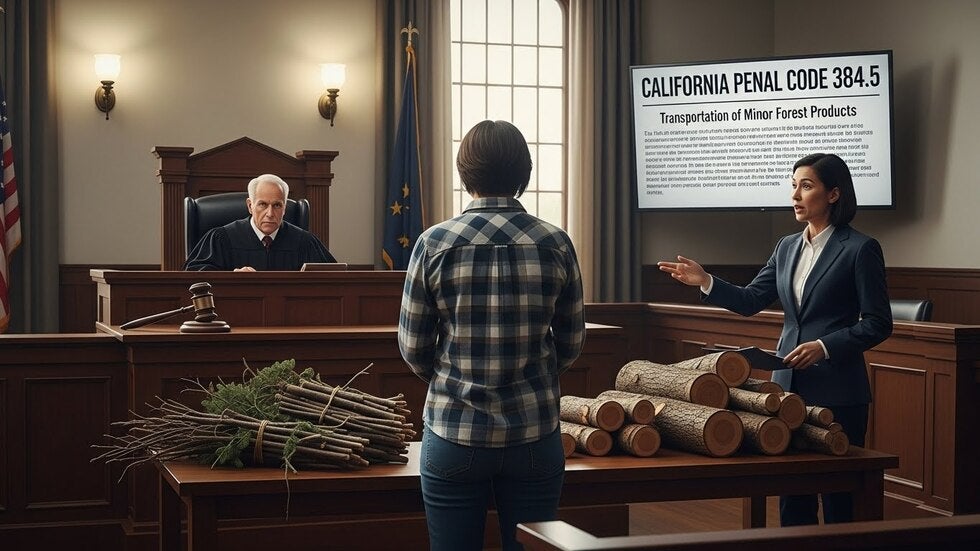
Many Californians who harvest firewood, fence posts, or other forest products for personal use or small business operations face unexpected legal trouble when transporting these materials.
California Penal Code 384.5 establishes specific documentation requirements for transporting minor forest products on public roads, and violations can result in misdemeanor charges. Understanding this statute and available defense strategies is essential if you're facing prosecution under this law.
What California Penal Code 384.5 Covers
California Penal Code 384.5 requires anyone transporting minor forest products on public roads to carry proper documentation proving legal acquisition. The statute aims to prevent theft of forest resources from private and public lands while allowing legitimate harvest and transport with appropriate paperwork.
The law defines minor forest products as firewood, posts, shakeboards, shake and shingle bolts, or split products exceeding 20 cubic feet in volume, and burlwood or stumps in quantities of two or more. These thresholds mean that small amounts transported for personal use often fall outside the statute's scope.
Required Documentation Elements
When transporting minor forest products, you must possess either a valid bill of sale or a written permit from the property owner. The statute specifies detailed information that these documents must contain to satisfy legal requirements.
Required elements include the name, address, and signature of the landowner plus phone number if available, the name, address, and signature of the person removing the products, a description of the amount, species, and type of products being transported, sufficient property description to identify the source location, the issuance date and duration period for removal, and any additional conditions the landowner wishes to impose.
Federal permits issued by the United States Forest Service or Bureau of Land Management satisfy the documentation requirement even if they don't include all specific elements listed in the statute. This exception recognizes that federal agencies follow their own permitting procedures.
Important Exemptions to Understand
The statute contains a critical exemption that many people overlook. Minor forest products transported in passenger vehicles, as defined in the California Vehicle Code, are exempt from documentation requirements. This means you can legally transport small quantities in your car, SUV, or minivan without a permit or bill of sale.
Understanding what qualifies as a passenger vehicle becomes important when developing defense strategies. The Vehicle Code definition focuses on vehicle design and intended use rather than how you're currently using it.
This exemption protects individuals gathering modest amounts of firewood or similar products for personal use.
Common Scenarios Leading to Charges
Law enforcement officers typically discover potential violations during traffic stops or at inspection stations. Common scenarios include transporting firewood in a pickup truck without documentation, hauling fence posts from rural property without proper permits, moving burlwood or decorative stumps without bills of sale, or carrying shake bolts or split products for woodworking projects.
Many people charged under this statute had no intent to steal forest products. They may have harvested materials from their own property without realizing documentation was required, received verbal permission from landowners without obtaining written permits, purchased products from sellers who failed to provide proper bills of sale, or misunderstood the volume thresholds triggering documentation requirements.
Effective Defense Strategies
Several defense approaches can successfully challenge Penal Code 384.5 charges.
Challenging the Volume Requirements
The statute only applies to quantities exceeding specific thresholds. Firewood and similar products must exceed 20 cubic feet, while burlwood and stumps require quantities of two or more. Challenging volume calculations can result in charge dismissal if products fell below statutory thresholds.
Defense attorneys can present evidence that law enforcement miscalculated volumes, that measurements included non-covered materials, or that products were measured incorrectly at the scene. Expert testimony about proper measurement techniques for irregularly shaped forest products can support these challenges.
Passenger Vehicle Exemption
Demonstrating that products were transported in a passenger vehicle provides complete defense to charges. Even if you used a vehicle's cargo capacity extensively, if it qualifies as a passenger vehicle under the Vehicle Code definition, the documentation requirement doesn't apply.
This defense requires careful analysis of vehicle classification. Many SUVs and crossover vehicles qualify as passenger vehicles despite significant cargo capacity. Your attorney can present vehicle registration documents, manufacturer specifications, and Vehicle Code definitions to establish this exemption.
Documentation Deficiencies versus Absence
The statute requires specific information in permits and bills of sale, but minor deficiencies may not constitute violations. Courts recognize differences between complete absence of documentation and documentation with technical shortcomings.
If you possessed documentation lacking certain required elements, this demonstrates good faith compliance efforts rather than knowing violation. Defense attorneys can argue that substantially compliant documentation should satisfy the statute's purposes even if technically incomplete.
Valid Documentation Existed but Wasn't Present
Sometimes people have proper documentation but don't carry it during transport. While this creates evidentiary challenges, presenting valid permits or bills of sale that existed at the time of transport can support reduced charges or favorable plea agreements.
Documentation showing you obtained proper permissions, even if you failed to carry papers during transport, demonstrates lack of criminal intent. This evidence distinguishes your situation from theft of forest products, which is the statute's primary concern.
Ownership of Source Property
If you removed products from your own property, this negates theft concerns underlying the statute. While the law technically requires documentation even when harvesting from owned property, demonstrating ownership provides strong mitigation evidence and supports arguments for charge dismissal or reduction.
Property deeds, tax records, and title documents proving you owned the source property show you weren't stealing forest resources. Prosecutors may decline to pursue charges or offer favorable resolutions when property ownership is established.
Understanding the Penalties
Penal Code 384.5 violations are misdemeanors punishable by fines up to one thousand dollars, county jail sentences up to six months, or both. However, these maximum penalties rarely apply to first time offenders without aggravating circumstances.
Many defendants receive probation, reduced fines, or diversionary programs, particularly when they demonstrate good faith efforts at compliance. Criminal defense attorneys can negotiate favorable outcomes emphasizing lack of intent to steal forest products and steps taken to comply with legal requirements.
Distinguishing Civil from Criminal Violations
Not every documentation deficiency warrants criminal prosecution. The statute aims to prevent forest product theft, not punish innocent mistakes or technical violations. When circumstances show you weren't stealing resources, civil remedies or administrative penalties may be more appropriate than criminal charges.
Defense attorneys can argue that prosecutors have overreached by pursuing criminal charges when the situation involves honest mistakes, property owner permission obtained informally, documentation deficiencies rather than complete absence, or first time violations without aggravating factors.
The Importance of Early Legal Consultation
Consulting with experienced criminal defense counsel immediately after learning of potential charges provides significant advantages. Your attorney can gather evidence supporting available defenses, communicate with prosecutors to provide context, negotiate before formal charges are filed, and develop comprehensive defense strategies.
Many cases resolve favorably when defense attorneys present evidence showing property ownership, valid documentation that existed, passenger vehicle exemption applicability, or good faith compliance efforts. Early intervention often results in charge dismissal or reduction before significant legal expenses accumulate.
Practical Compliance Guidance
Understanding compliance requirements helps prevent future issues and supports defense arguments demonstrating good faith efforts. When harvesting minor forest products, always obtain written permits or bills of sale before transport, ensure documentation includes all required elements, keep permits accessible during transport, understand volume thresholds triggering requirements, and maintain records of forest product transactions.
Property owners allowing others to harvest should provide detailed written permits rather than informal verbal permissions. Sellers of forest products must provide proper bills of sale to purchasers. These practices protect everyone involved from potential legal complications.
Building Your Defense
Successful defense requires thorough investigation of the circumstances surrounding your charges. Your attorney should analyze whether products exceeded volume thresholds, determine if vehicle exemption applies, review any documentation you possessed, investigate property ownership, and identify evidence supporting lack of criminal intent.
Witness testimony from property owners, purchasers, or others familiar with the transaction can establish that you acted in good faith. Photographic evidence, receipts, correspondence, and other documentation supports defense arguments even if formal permits were lacking.
Federal Land Considerations
When harvesting from federal lands, proper permits from the United States Forest Service or Bureau of Land Management satisfy documentation requirements. These agencies issue permits for firewood cutting, Christmas tree harvest, and other minor forest product removal following their own procedures.
Federal permits suffice under California law regardless of format, so understanding federal permitting processes becomes important for those harvesting from national forests or BLM lands. Your defense attorney can verify whether federal permits were properly obtained and remain valid.
Moving Forward After Charges
Facing criminal charges for transporting forest products without proper documentation can feel disproportionate to the conduct involved, particularly when you weren't stealing resources. Remember that prosecutors must prove every element of the offense beyond a reasonable doubt.
With experienced legal representation, many defendants successfully challenge these charges or negotiate favorable resolutions. Understanding your rights, available defenses, and the statute's purposes provides the foundation for protecting yourself.
If you're facing charges under California Penal Code 384.5 or have questions about forest product transportation requirements, consulting knowledgeable criminal defense counsel should be your first step. For additional information about criminal defense strategies, visit our blog for more resources addressing California criminal law.