
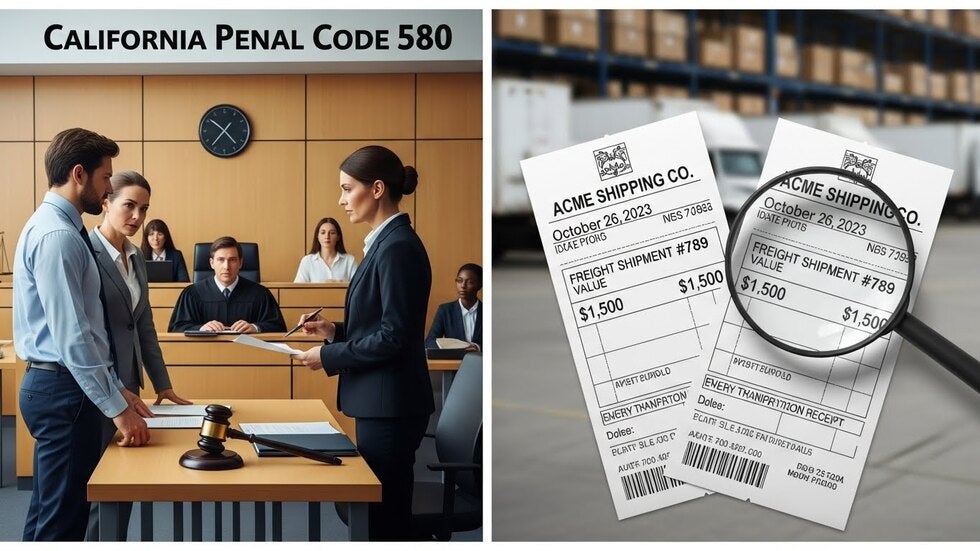
In the fast paced world of transportation and logistics, documentation errors can happen in the blink of an eye. When carriers, warehouse operators, or shipping companies issue duplicate receipts without proper marking, they may face criminal charges under California Penal Code 580.
This statute criminalizes the issuance of second or duplicate receipts for merchandise when an original receipt remains outstanding, unless the duplicate is clearly marked as such. If you're facing these charges, understanding the law and your defense options is essential to protecting your livelihood and freedom.
What Does California Penal Code 580 Prohibit?
California Penal Code 580 addresses a specific type of documentation offense that can occur in commercial shipping and storage operations. The law applies to individuals mentioned throughout the chapter dealing with fraudulent transportation documents, including masters, owners, or agents of vessels, officers or agents of railroads, express companies, transportation companies, and other carriers.
The offense occurs when someone in one of these positions issues a second or duplicate receipt or voucher for merchandise while a previous receipt for the same goods remains outstanding and has not been cancelled. The critical element is the failure to write the word "Duplicate" across the face of the second receipt in a plain and legible manner.
This requirement exists to prevent fraud in commercial transactions. Receipts and vouchers for stored or transported goods often serve as negotiable documents that can be used to claim merchandise, secure financing, or prove ownership. When multiple receipts exist for the same goods without clear indication that they are duplicates, it creates opportunities for the same merchandise to be claimed multiple times or used fraudulently in financial transactions.
The statute recognizes that legitimate business reasons sometimes require issuing duplicate receipts. Perhaps the original was lost, damaged, or needed by multiple parties for different purposes. The law does not prohibit issuing duplicates entirely but rather requires clear marking to prevent confusion and fraud.
Penalties for Violating Penal Code 580
Violations of California Penal Code 580 carry serious consequences that can impact both your personal life and professional career. The statute classifies this offense as a wobbler, giving prosecutors discretion to charge it as either a misdemeanor or a felony based on the circumstances of your case and your criminal background.
When prosecuted as a felony, a conviction can result in imprisonment pursuant to subdivision (h) of Section 1170. This provision typically means serving time in county jail rather than state prison, though the length of incarceration can still be substantial. The court may also impose a fine of up to one thousand dollars, either instead of or in addition to jail time.
Beyond the direct criminal penalties, a conviction under this statute can devastate your career in the transportation, warehousing, or logistics industry. Background checks revealing a conviction involving fraudulent business documentation can make finding employment extremely difficult. Many positions in these fields require handling valuable merchandise and maintaining accurate records, and employers are understandably reluctant to hire individuals with convictions suggesting dishonesty in these exact responsibilities.
For business owners and operators, the consequences extend to your company's reputation and viability. Customers and partners rely on accurate documentation, and a conviction can damage the trust necessary to maintain business relationships. Insurance rates may increase, bonding requirements may become more difficult to meet, and regulatory agencies may subject your operations to increased scrutiny.
Professional licenses and certifications may also be at risk following a conviction. Many transportation and logistics credentials require holders to maintain clean records regarding honesty and business integrity. A conviction under Penal Code 580 could trigger license suspension or revocation proceedings.
Common Scenarios Leading to Duplicate Receipt Charges
Understanding how these charges typically arise can help identify potential defenses and weaknesses in the prosecution's case. Many Penal Code 580 violations occur in legitimate business contexts where documentation practices failed to keep pace with operational realities.
One common scenario involves lost or misplaced original receipts. When a customer or business partner loses the original receipt and requests a replacement, busy employees may issue a new receipt without properly marking it as a duplicate. In high volume operations processing hundreds or thousands of transactions daily, these oversights can happen despite good faith efforts to maintain accurate records.
System transitions and technological upgrades create another frequent source of problems. When companies move from paper records to electronic systems or upgrade their software, receipts may be regenerated or reprinted without carrying forward the duplicate marking from previous versions. Similarly, when different departments or locations use separate systems that do not communicate effectively, duplicate receipts may be issued without anyone realizing another receipt already exists.
Emergency situations and time pressure can also contribute to documentation errors. When customers need immediate proof of shipment or storage for insurance claims, customs clearance, or business transactions, employees may prioritize speed over proper documentation procedures. In the rush to help a customer meet a deadline, the requirement to mark duplicates may be overlooked.
Multi-party transactions involving transfer of goods between carriers or storage facilities can create confusion about which receipts remain outstanding. When merchandise moves through several hands, each party may issue its own documentation, and determining whether a new receipt constitutes a duplicate of an earlier one may not be straightforward.
Building an Effective Defense Strategy
Successfully defending against charges under California Penal Code 580 requires careful analysis of the facts and strategic presentation of evidence. Several defense approaches may be effective depending on your specific situation.
The most fundamental defense involves challenging the element of knowledge and intent. The prosecution must prove you knew the original receipt remained outstanding and uncancelled when you issued the second receipt. If you genuinely believed the original had been returned, cancelled, or was otherwise no longer valid, this lack of knowledge defeats an essential element of the offense.
Evidence supporting this defense might include testimony about your company's standard procedures for cancelling receipts, records showing attempts to retrieve or verify the status of the original receipt, or documentation of communications where you were told the original was no longer outstanding. Many businesses have protocols requiring customers to surrender original receipts before duplicates are issued, and evidence that you followed these procedures can demonstrate lack of criminal intent.
Another important defense addresses whether the second document actually qualifies as a duplicate under the statute. If the second receipt differs materially from the first in terms of what merchandise it covers, the time period involved, or other significant details, it may not be a true duplicate requiring special marking. This distinction can be particularly relevant in cases involving partial shipments, split deliveries, or modified orders.
Technical defenses may challenge whether the prosecution can prove all elements of the offense. For example, can they establish beyond reasonable doubt that the first receipt was actually "outstanding and uncanceled" at the moment you issued the second one? In busy commercial operations with numerous transactions, proving the precise timing and status of documents can be more difficult than it initially appears.
The question of what constitutes marking the duplicate in a "plain and legible manner" may also offer defensive opportunities. If you did make some notation on the document, even if imperfect, arguments can be made that you substantially complied with the statute's purpose of preventing confusion. The law's purpose is to ensure people understand they are dealing with a duplicate, and any marking that accomplishes this goal may satisfy the statute's requirements even if the exact word "Duplicate" was not used.
The Role of Business Practices and Training
Evidence about your company's standard operating procedures, employee training, and quality control measures can significantly strengthen your defense. Documentation showing that your business has established protocols for handling duplicate receipts, that employees receive training on proper documentation procedures, and that management conducts regular audits to ensure compliance demonstrates that any violation resulted from an isolated error rather than intentional wrongdoing or systematic negligence.
Many successful defenses emphasize that the accused individual and their company take documentation requirements seriously and have invested resources in maintaining accurate records. When a single incident occurs despite these good faith efforts, it supports characterizing the situation as an honest mistake rather than criminal conduct.
Why Immediate Legal Representation Matters
The moment you learn about an investigation or potential charges under Penal Code 580, consulting with an experienced criminal defense attorney should be your top priority. Early legal intervention provides several critical advantages in these cases.
First, an attorney can prevent you from making statements to investigators that might be misinterpreted or taken out of context. In commercial documentation cases, explaining the technical details of your business operations without legal guidance can inadvertently create problems. What seems like a helpful explanation may actually provide prosecutors with evidence they otherwise would struggle to obtain.
Second, early involvement allows your attorney to begin gathering evidence while it remains fresh and accessible. In business environments, records may be routinely purged, employees may leave the company, and memories may fade. Prompt investigation preserves evidence that could be critical to your defense.
Third, in some cases, early intervention by an attorney can result in charges being reduced or not filed at all. When prosecutors understand the full context of what occurred and see evidence of good faith business practices, they may conclude that criminal prosecution is not appropriate. This possibility disappears once charges are formally filed and the case enters the court system.
Understanding Similar Transportation Fraud Offenses
California law contains several related statutes addressing fraudulent documentation in transportation and storage contexts. Understanding how Penal Code 580 fits within this broader framework can be important for your defense. For instance, charges involving false bills of lading under different sections may involve overlapping facts, and strategy in one case may affect another.
Your attorney should evaluate whether prosecutors might be overreaching by charging conduct under Penal Code 580 when it might be better characterized under a different, potentially less serious statute. Sometimes multiple charges stem from the same underlying conduct, and negotiating a resolution to one charge may resolve others as well.
Moving Forward After Facing These Charges
Facing criminal charges related to your professional activities can be frightening, especially when the alleged offense involves technical documentation requirements in your industry. However, many individuals successfully defend against these charges or negotiate favorable outcomes that minimize impact on their lives and careers.
The key is understanding that documentation errors, even those involving duplicate receipts, do not always constitute criminal conduct. Honest mistakes, system failures, communication breakdowns, and the pressures of fast paced commercial operations can all contribute to situations where technical violations occur without criminal intent.
If you're facing allegations under California Penal Code 580 or related transportation fraud statutes, protecting your rights and your future requires experienced legal representation.
Every case involves unique facts and circumstances, and early consultation with an attorney who understands both criminal defense and the realities of the transportation industry can make all the difference in achieving the best possible result.
Call immediately at (888) 928-1609 or email our law firm to arrange a free consultation.