
The Prosecution's Burden Just Got Lighter: Understanding Section 70.5's Impact
California Penal Code Section 70.5 fundamentally changes how prosecutors approach public corruption cases by eliminating certain intent requirements that traditionally provided strong defenses for accused officials.
This seemingly technical provision has profound implications for anyone facing charges related to accepting unauthorized payments, gifts, or benefits while serving in public office.
As a defense attorney specializing in public corruption cases, I've seen how Section 70.5 has shifted the landscape of these prosecutions. What once required prosecutors to prove complex criminal intent now allows for convictions based on the simple act of accepting unauthorized compensation, regardless of the defendant's state of mind or ultimate purpose.
Breaking Down California Penal Code Section 70.5
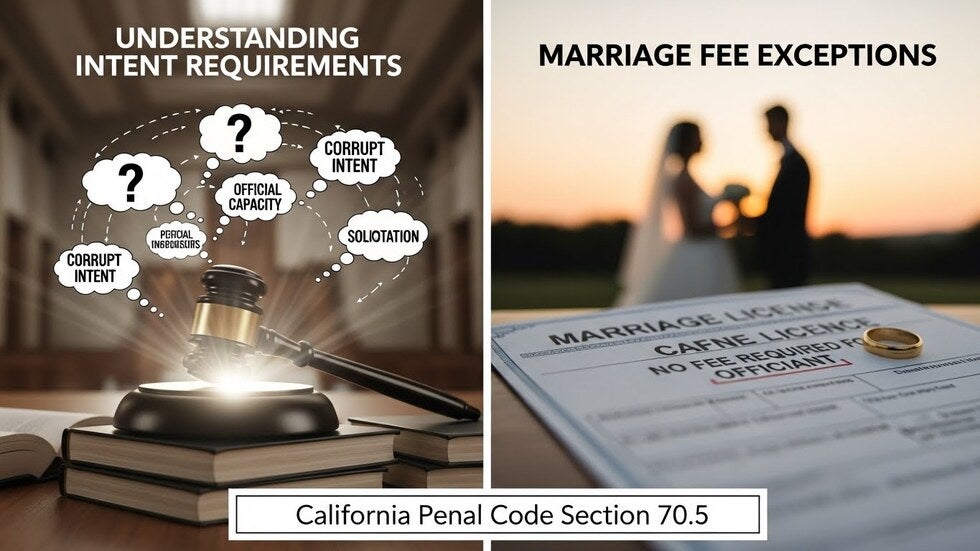
Section 70.5 serves as a clarifying provision that addresses two critical aspects of public corruption prosecutions: the elimination of certain intent requirements and specific exceptions for marriage-related fees. Understanding both components is essential for anyone involved in defending or prosecuting these cases.
The Intent Elimination Provision
The most significant aspect of Section 70.5 states that prosecutors don't need to prove the defendant accepted money or other things of value with intent to commit extortion or with any other criminal intent. This provision dramatically simplifies the prosecution's burden in corruption cases by removing complex questions about the defendant's motivations and ultimate goals.
This change represents a significant departure from traditional criminal law principles, which typically require proof of criminal intent (mens rea) for conviction. By eliminating this requirement, California has created a form of strict liability for public officials who accept unauthorized compensation.
Marriage Fee Exceptions
Section 70.5 also creates specific exceptions for marriage-related fees, recognizing legitimate compensation arrangements for certain marriage officiants. These exceptions apply to:
- Retired commissioners of civil marriages who request or accept fees for performing marriages
- Officials who accept fees for performing marriages on Saturdays, Sundays, or legal holidays
These exceptions acknowledge the practical reality that marriage ceremonies often occur outside normal business hours and that retired officials provide valuable services that justify compensation.
The Prosecution's Advantage: Eliminating Intent Requirements
Section 70.5's elimination of intent requirements creates significant advantages for prosecutors while creating new challenges for defense attorneys.
Traditional Intent Requirements in Criminal Law
Historically, criminal convictions required proof of both a criminal act (actus reus) and criminal intent (mens rea). This dual requirement protected defendants who engaged in technically illegal conduct without understanding its nature or intending criminal consequences.
In public corruption cases, intent requirements traditionally allowed defendants to argue they:
- Didn't understand the compensation was improper
- Intended to report or return the payment
- Believed the compensation was authorized
- Lacked any corrupt or criminal purpose
The New Reality Under Section 70.5
With Section 70.5's elimination of intent requirements, prosecutors can now secure convictions by proving only that defendants accepted unauthorized compensation, regardless of their state of mind or ultimate intentions. This creates a form of strict liability that makes convictions significantly easier to obtain.
This change means that public officials can face criminal liability even when they:
- Genuinely believed their conduct was proper
- Intended no criminal or corrupt purpose
- Made honest mistakes about applicable rules
- Acted in good faith throughout
Strategic Defense Implications
While Section 70.5 eliminates certain intent requirements, skilled defense attorneys can still develop effective strategies to protect their clients.
Challenging the Underlying Elements
Even though intent to commit extortion or other crimes need not be proven, prosecutors must still establish the basic elements of the underlying offense. This includes proving:
- The defendant held a covered public position
- They accepted money or things of value
- The compensation was not authorized by law
- The payment was connected to official duties
Authorization Defenses Remain Viable
Section 70.5 doesn't eliminate the "authorized by law" exception that appears in related statutes. Defense attorneys can still argue that challenged compensation was actually permitted under applicable laws, regulations, or policies.
This defense requires thorough research into:
- Specific statutory authorizations
- Regulatory provisions allowing the compensation
- Official policies permitting the practice
- Historical precedent establishing authorization
Constitutional Challenges
The elimination of intent requirements may create constitutional vulnerabilities that defense attorneys can exploit. Potential challenges might include:
- Due process arguments regarding strict liability
- Vagueness challenges to broad compensation prohibitions
- Equal protection claims regarding selective enforcement
- First Amendment issues when compensation involves speech or association
Understanding the Marriage Fee Exceptions
The specific exceptions for marriage fees in Section 70.5 reflect legislative recognition that certain compensation arrangements serve legitimate public purposes and should not be criminalized.
Retired Commissioners Exception
The exception for retired commissioners of civil marriages acknowledges that these individuals provide valuable services to the public after their official retirement. This exception recognizes that:
- Retired commissioners have specialized knowledge and authority
- Their services meet genuine public demand
- Compensation arrangements don't create corruption risks
- The fees serve legitimate purposes rather than corrupt exchanges
Weekend and Holiday Exception
The exception for weekend and holiday marriage fees addresses the practical reality that couples often prefer to marry outside normal business hours. This exception recognizes that:
- Officials who work weekends and holidays deserve compensation
- Special arrangements are necessary for non-business hour services
- These fees don't represent corrupt payments but legitimate overtime compensation
- Public demand justifies these arrangements
Practical Applications
These exceptions provide guidance for other situations where public officials might receive compensation for services. While narrowly written, they suggest legislative intent to permit reasonable compensation arrangements that serve legitimate public purposes without creating corruption risks.
Broader Implications for Public Official Defense
Section 70.5's approach reflects broader trends in public corruption enforcement that defense attorneys must understand to effectively represent their clients.
Strict Liability Trends
The elimination of intent requirements represents part of a broader trend toward strict liability in public corruption cases. This trend reflects:
- Public demands for stronger anti-corruption enforcement
- Prosecutorial frustration with complex intent requirements
- Legislative belief that public officials should know their obligations
- Simplified prosecution strategies that reduce litigation costs
Prevention-Focused Approach
By eliminating intent requirements, Section 70.5 shifts focus from punishing corrupt intent to preventing potentially problematic conduct. This approach suggests that lawmakers prioritize deterrence over traditional notions of criminal culpability.
Professional Responsibility Implications
The strict liability approach means that public officials can no longer rely on good faith or honest mistakes as complete defenses. This creates heightened professional responsibility for officials to:
- Understand applicable compensation rules
- Seek guidance when questions arise
- Document authorization for any compensation received
- Err on the side of caution in uncertain situations
Defending Against Charges Under the New Framework
With intent requirements eliminated, defense strategies must adapt to focus on other aspects of the prosecution's case.
Factual Challenges
Defense attorneys must carefully examine the factual basis for charges, focusing on whether the prosecution can prove the basic elements of the offense without relying on intent. This might involve:
- Challenging the characterization of payments as compensation
- Disputing the connection between payments and official duties
- Questioning whether the defendant actually received the alleged benefits
- Demonstrating that payments were personal rather than official
Authorization Research
With intent defenses limited, proving authorization becomes even more critical. This requires:
- Comprehensive research into applicable legal authorities
- Analysis of regulatory provisions and official policies
- Review of historical practices and precedents
- Consultation with ethics officials and legal experts
Mitigation Strategies
Even when convictions seem likely, effective defense requires developing mitigation strategies that minimize consequences. This might include:
- Demonstrating the defendant's good faith throughout
- Showing lack of harm to the public interest
- Proving the defendant's otherwise exemplary service record
- Negotiating favorable plea arrangements that preserve career options
Ethics Compliance in the Section 70.5 Era
The elimination of intent requirements makes proactive ethics compliance more important than ever for public officials.
Enhanced Training Requirements
Officials need comprehensive training that goes beyond basic ethics rules to include:
- Specific compensation restrictions applicable to their positions
- Procedures for seeking guidance on uncertain situations
- Documentation requirements for any compensation received
- Recognition of potential problem areas before they arise
Policy Development
Government agencies should develop clear, comprehensive policies that provide specific guidance on compensation issues. These policies should:
- Address common situations officials encounter
- Provide clear procedures for seeking approval
- Establish documentation requirements
- Include regular review and update mechanisms
Regular Compliance Audits
With strict liability applying, regular compliance audits become essential for identifying and correcting potential problems before they result in criminal charges.
The Federal Intersection
While Section 70.5 applies to California state law, federal prosecutors may pursue parallel charges under federal corruption statutes that maintain traditional intent requirements. This creates complex strategic considerations for white-collar criminal defense attorneys.
Parallel Prosecution Risks
Defendants may face both state charges under the strict liability framework and federal charges requiring proof of corrupt intent. This dual exposure requires careful coordination of defense strategies across jurisdictions.
Plea Negotiation Considerations
The different intent requirements between state and federal law create opportunities for strategic plea negotiations that might resolve cases favorably across both jurisdictions.
Future Implications and Trends
Section 70.5 represents part of a broader evolution in public corruption law that defense attorneys must understand to serve their clients effectively.
Legislative Trends
Other states may adopt similar strict liability approaches, creating a national trend toward simplified corruption prosecutions. Defense attorneys should monitor these developments to understand emerging challenges.
Enforcement Patterns
With easier prosecution standards, enforcement agencies may pursue cases they previously would have declined, leading to increased caseloads and different prosecution priorities.
Professional Standards Evolution
Legal and ethical standards for public officials continue to evolve in response to these legal changes, requiring ongoing education and adaptation.
Conclusion: Adapting Defense Strategies for a New Era
California Penal Code Section 70.5 represents a fundamental shift in how public corruption cases are prosecuted, eliminating traditional intent requirements while creating specific exceptions for legitimate activities. For defense attorneys and public officials, understanding these changes is crucial for effective representation and compliance.
The elimination of intent requirements doesn't eliminate all defenses, but it does require attorneys to adapt their strategies to focus on other aspects of the prosecution's case. Success in this new framework requires thorough preparation, comprehensive legal research, and strategic thinking about how to protect clients' interests.
For public officials, Section 70.5 serves as a reminder that good intentions alone no longer provide protection against criminal charges. Proactive compliance, comprehensive training, and careful attention to applicable rules have become more important than ever.
The key to successful navigation of this new landscape lies in understanding both the limitations and opportunities created by Section 70.5, developing effective strategies that work within the new framework, and maintaining the highest standards of professional conduct. With proper guidance and preparation, even the challenges created by strict liability can be addressed effectively.
We make it easy to get started. Simply call (888) 928-1609 or reach out online for your free initial consultation – no obligation and no strings attached.