
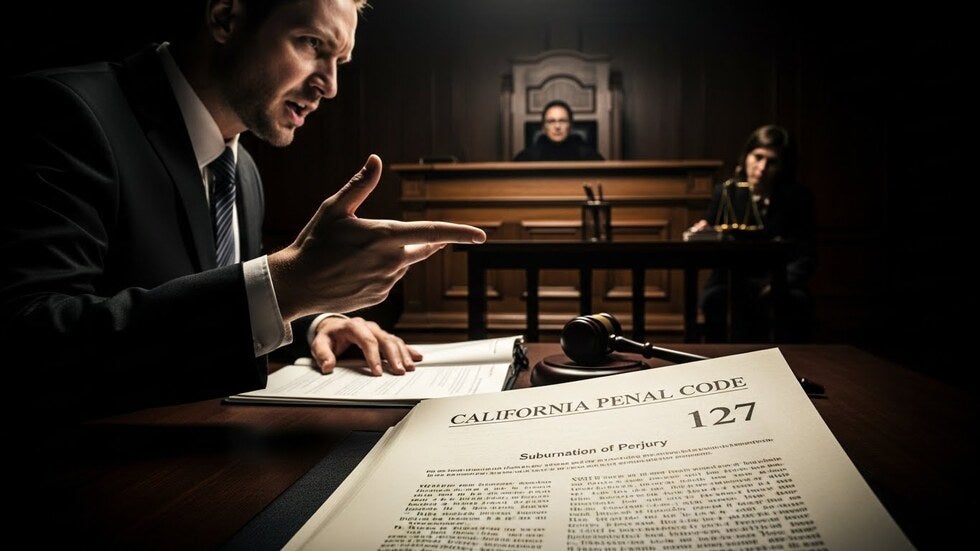
California Penal Code Section 127 creates one of the most complex and serious charges in criminal law, criminalizing the act of willfully procuring another person to commit perjury. This felony charge carries the same severe penalties as the underlying perjury itself, making aggressive defense representation absolutely essential.
Understanding both the statute's demanding elements and available defense strategies becomes crucial when facing allegations that you influenced, induced, or caused another person to provide false sworn testimony.
Understanding the Complex Elements of Subornation of Perjury
California Penal Code Section 127 establishes subornation of perjury as a distinct felony that requires prosecutors to prove several interconnected elements beyond a reasonable doubt.
Unlike simple perjury charges that focus on false statements themselves, subornation cases involve the more complex dynamics of influence, persuasion, and corrupt agreements between multiple parties.
The statute requires proof of a corrupt agreement to testify falsely, establishing that defendants didn't merely request testimony but actively engaged in corrupt conduct designed to produce false sworn statements. This element distinguishes between legitimate witness preparation and criminal conduct that corrupts the truth-seeking process.
Prosecutors must also prove that actual perjury occurred as a result of defendants' actions. This requirement creates a direct link between defendants' conduct and the false testimony, meaning that unsuccessful attempts to procure perjury or situations where witnesses ultimately told the truth cannot support subornation convictions.
The materiality element requires that false statements were significant to the proceedings in which they were made, not merely trivial or irrelevant details. This requirement protects defendants from charges based on minor inconsistencies or unimportant false statements that don't affect case outcomes.
Finally, prosecutors must establish that defendants knew the statements they were procuring were false. This knowledge requirement creates significant opportunities for defense when clients believed they were encouraging truthful testimony or lacked knowledge about the actual facts.
The Critical "Procure" Element: A Key Defense Opportunity
The meaning of "procure" under Section 127 has been clarified by People v. Jones, 254 Cal. App. 2d 200, which defined the term as persuading, inducing, prevailing upon, or causing another to commit perjury. This definition creates important boundaries around what conduct constitutes criminal procurement versus legitimate activities.
From a defense perspective, the procurement element requires more than mere request or suggestion that someone testify in a particular way. Prosecutors must prove active persuasion, inducement, or causation that goes beyond normal witness preparation or case discussion.
The distinction between legitimate witness preparation and criminal procurement often determines case outcomes in subornation prosecutions. Defense attorneys frequently argue that clients engaged in proper case preparation, provided legal advice, or discussed strategy rather than corruptly procuring false testimony.
The timing and context of alleged procurement activities significantly affect their interpretation under Section 127. Communications that occur during normal case preparation, strategic discussions, or legitimate legal consultation may not constitute criminal procurement even when they influence witness testimony.
Understanding these boundaries allows defense counsel to challenge prosecutorial theories that criminalize legitimate attorney-client relationships, case preparation activities, or normal litigation strategy discussions.
Challenging the Knowledge and Intent Requirements
The requirement that defendants know the procured statements are false creates one of the most important defense opportunities in subornation cases. This element requires prosecutors to prove defendants' actual knowledge of falsity, not merely that reasonable persons might have suspected the statements were untrue.
Defense attorneys often challenge the knowledge element by demonstrating that clients reasonably believed the testimony they were encouraging was truthful. When defendants relied on information provided by witnesses, other evidence, or professional advice, these circumstances can support arguments against the requisite knowledge.
The willfulness requirement adds another layer of intent that prosecutors must establish. Defendants must have acted with deliberate intent to procure false testimony, not merely encouraged testimony that happened to be inaccurate or incomplete.
Distinguishing between knowledge of falsity and reasonable belief in truthfulness often proves decisive in subornation cases. Defense counsel must carefully analyze what defendants actually knew versus what they reasonably believed based on available information.
The burden of proving knowledge beyond a reasonable doubt creates significant challenges for prosecutors, particularly when defendants' communications were ambiguous or when multiple interpretations of their conduct are possible.
The Corrupt Agreement Element: More Than Simple Communication
Section 127's requirement for a "corrupt agreement" to testify falsely establishes that subornation involves more than casual conversation or suggestion. This element requires proof of an actual understanding or agreement between parties to provide false testimony.
From a defense perspective, the corrupt agreement element distinguishes between criminal conduct and legitimate activities such as witness preparation, case strategy discussions, or legal advice. Many communications that prosecutors characterize as corrupt agreements actually represent normal litigation activities.
The agreement element also requires mutuality between defendants and witnesses, meaning that unilateral attempts to influence testimony without witness agreement may not satisfy Section 127's requirements. When witnesses reject defendants' suggestions or independently decide their testimony, the corrupt agreement element may be absent.
Challenging prosecutorial theories about the existence and nature of alleged corrupt agreements often provides effective defense strategies. Defense attorneys must carefully analyze the evidence of actual agreement versus mere communication or attempted influence.
Constitutional and Procedural Defenses
Subornation of perjury cases often raise significant constitutional issues, particularly involving First Amendment protections for speech and attorney-client privilege concerns. These constitutional dimensions create additional defense opportunities beyond challenging the statutory elements.
Due process challenges may arise when prosecutions criminalize legitimate attorney-client communications or normal case preparation activities. The constitutional right to effective assistance of counsel can be compromised when prosecutors broadly interpret procurement to include standard legal representation.
Attorney-client privilege issues frequently complicate subornation prosecutions, particularly when prosecutors attempt to use privileged communications as evidence of corrupt agreements. These privilege protections can shield legitimate legal advice from prosecutorial scrutiny.
The intersection of subornation charges with ongoing civil litigation creates complex procedural issues about the proper relationship between criminal and civil proceedings. Defense counsel must consider how criminal charges might affect parallel civil cases and vice versa.
Defending Against Complex Multi-Party Prosecutions
Subornation cases often involve multiple defendants and complex relationships that create both challenges and opportunities for defense counsel. Understanding how individual defendants' conduct relates to broader alleged schemes becomes crucial for effective representation.
The relationship between subornation charges and conspiracy theories can create additional complexity when prosecutors attempt to establish broad criminal schemes involving multiple participants. Defense attorneys must understand how individual clients' conduct fits within prosecutorial theories about overall criminal enterprises.
Joint defense considerations become particularly important in multi-defendant subornation cases where cooperation between defense counsel can benefit all defendants while protecting individual clients' interests.
The sequential nature of subornation prosecutions, where perjury charges often precede subornation allegations, creates strategic considerations about timing and coordination of defense efforts across related cases.
Professional and Ethical Considerations
Subornation charges against attorneys create unique challenges involving both criminal liability and professional discipline. Understanding how criminal charges relate to ethical obligations and professional licensing becomes crucial for attorney defendants.
The intersection of subornation law with rules of professional conduct creates complex issues about what constitutes legitimate witness preparation versus criminal procurement. Defense counsel must understand both criminal law and professional responsibility requirements.
Non-attorney defendants may face professional consequences in licensed occupations, making comprehensive defense strategies essential for protecting both criminal and professional interests.
Strategic Considerations for Defense Counsel
Early intervention proves crucial in subornation cases where the relationship between legitimate activities and alleged criminal conduct often determines case outcomes. Experienced counsel can sometimes influence prosecutorial charging decisions through effective advocacy.
The technical nature of subornation elements creates opportunities for pretrial motion practice designed to challenge prosecutorial theories before trial. Many subornation cases can be resolved favorably through comprehensive pretrial advocacy.
Plea negotiation strategies must consider both the felony classification of subornation charges and their relationship to underlying perjury allegations. Creative resolution approaches can sometimes address prosecutorial concerns while minimizing defendants' exposure.
Expert Witnesses and Technical Defenses
The complex nature of subornation cases often requires expert testimony about legal standards, professional practices, and communication interpretation. These experts can help juries understand the distinctions between legitimate and criminal conduct.
Legal ethics experts prove particularly valuable in cases involving attorney defendants, providing testimony about standard practices and professional obligations that can distinguish between proper representation and criminal conduct.
Communication experts occasionally contribute to subornation defenses by analyzing recorded conversations or written communications to demonstrate their legitimate rather than corrupt nature.
Protecting Your Rights and Professional Standing
Facing subornation of perjury charges requires immediate action from experienced criminal defense counsel who understand both the complex legal elements and professional implications involved. The felony nature of these charges and their relationship to professional licensing create multiple levels of consequences.
The intersection of criminal liability with professional ethics requires defense counsel who can address both immediate criminal consequences and long-term professional implications of subornation allegations.
Conclusion: Fighting Complex Subornation Charges
California Penal Code Section 127 creates serious felony exposure for individuals accused of procuring perjury, but the statute's complex elements also create numerous defense opportunities for experienced counsel. Understanding the distinctions between legitimate activities and criminal conduct becomes crucial for effective representation.
The technical nature of subornation elements, combined with constitutional protections and professional considerations, requires comprehensive defense strategies that address multiple aspects of these complex cases.
If you're facing subornation of perjury charges or investigation, the serious nature of these felony allegations demands immediate professional legal assistance from counsel experienced in complex perjury-related prosecutions.
Contact qualified criminal defense attorneys immediately to analyze the specific elements of your case and develop comprehensive strategies that protect both your immediate freedom and long-term professional interests.
This article provides general information about California Penal Code Section 127 from a defense perspective. Every case involves unique circumstances requiring individualized legal analysis and strategy development by qualified criminal defense attorneys experienced in complex perjury and subornation prosecutions.