
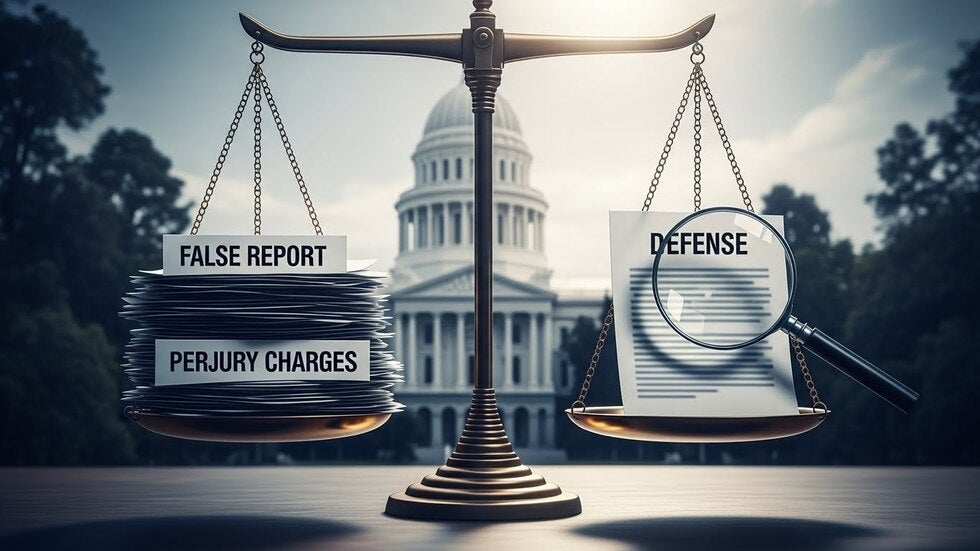
California Penal Code Section 129 creates a dangerous trap for individuals required to file legal documents, returns, or reports under oath, establishing perjury liability even when no formal oath ceremony occurs.
This specialized statute criminalizes false statements in legally required filings that purport to be under oath, creating serious felony exposure for business owners, professionals, and others who must submit sworn documents to government agencies.
Understanding both the statute's broad reach and available defense strategies becomes essential when facing these potentially devastating charges.
The Expansive Scope of California Penal Code Section 129
California Penal Code Section 129 significantly expands traditional perjury liability by criminalizing false statements in returns, statements, or reports that purport to be under oath, regardless of whether formal oath ceremonies actually occurred. This approach reflects the modern reality that most sworn documents are executed through written attestations rather than ceremonial oath-taking.
The statute applies to any person "required by law" to make returns, statements, or reports under oath, creating broad coverage that encompasses tax returns, regulatory filings, professional licensing documents, court filings, and numerous other legally mandated submissions.
This expansive application means that virtually anyone who deals with government agencies or regulatory bodies faces potential Section 129 exposure.
From a defense perspective, the statute's broad language creates both challenges and opportunities. While prosecutors can pursue charges based on various types of document submissions, they must still prove that defendants were actually "required by law" to make specific filings and that these filings purported to be under oath.
The "purporting to be under oath" element provides crucial defense opportunities when documents don't clearly indicate oath requirements or when defendants reasonably believed their submissions weren't subject to perjury liability. Understanding these distinctions becomes essential for effective defense representation.
The case of People v. Torterice, 66 Cal. App. 115, provides important guidance for interpreting Section 129's requirements and establishing precedent for defense arguments about the statute's proper application.
Critical Elements Prosecutors Must Prove Under Section 129
Successfully defending against Section 129 charges requires understanding exactly what prosecutors must establish beyond a reasonable doubt. The statute contains several specific elements that create opportunities for experienced defense counsel to challenge prosecutorial theories effectively.
The "required by law" element demands proof that defendants had actual legal obligations to file specific documents, not merely that filing might have been advisable or customary. Defense attorneys often challenge this element by demonstrating that clients weren't subject to particular filing requirements or that alleged obligations don't actually exist under applicable law.
Prosecutors must prove that defendants "willfully" made false statements, requiring evidence of deliberate intent rather than mere negligence or mistake. This willfulness requirement creates significant defense opportunities when clients made honest errors, relied on professional advice, or acted without intent to deceive.
The knowledge element requires proof that defendants knew their statements were false "in any particular," meaning prosecutors must establish actual knowledge of falsity rather than mere negligence or reasonable mistake. This requirement protects defendants who made good faith errors or relied on incomplete information.
The "purporting to be under oath" element creates additional defense opportunities when documents don't clearly indicate oath requirements or when defendants reasonably believed their submissions weren't subject to perjury standards.
The "Whether or Not the Oath Was Actually Taken" Provision
Section 129's elimination of formal oath requirements represents a significant departure from traditional perjury law, creating liability based on document content rather than ceremonial procedures. This provision reflects legislative recognition that modern legal and business practices rely primarily on written attestations rather than formal oath ceremonies.
However, the elimination of formal oath requirements doesn't eliminate all procedural protections for defendants. Courts still require that documents clearly indicate their sworn nature and that defendants understand the legal significance of their attestations.
From a defense perspective, the absence of formal oath procedures can create opportunities to argue that defendants didn't understand they were making statements subject to perjury liability. When documents lack clear perjury warnings or attestation language, these circumstances can support arguments against the requisite knowledge and intent.
The relationship between Section 129 and traditional perjury statutes creates potential defense opportunities when prosecutors charge under incorrect statutes or fail to prove elements specific to sworn document submissions.
Common Defense Strategies for Section 129 Cases
Challenging the legal requirement element represents a fundamental defense approach in Section 129 cases. Defense attorneys must carefully analyze whether clients were actually required by law to file specific documents and whether alleged requirements have proper legal foundation.
The willfulness challenge focuses on defendants' intent and knowledge at the time of document submission. When clients made honest mistakes, relied on professional advice, or acted without intent to deceive, these circumstances can support arguments against criminal intent.
Good faith reliance on professional advice provides another crucial defense avenue. When defendants relied on accountants, attorneys, or other professionals in preparing documents, this reliance can support arguments against willful falsification even when documents contain inaccuracies.
Constitutional challenges occasionally arise in Section 129 cases, particularly involving due process concerns when perjury warnings are inadequate or when defendants couldn't reasonably understand their legal obligations.
The statute of limitations defense may apply when charges are filed years after document submission, particularly when defendants' circumstances have changed or when delayed prosecution creates unfair disadvantage.
Professional and Business Context Defenses
Section 129 frequently affects business owners, professionals, and others who must regularly file sworn documents with government agencies. Understanding how the statute applies to professional and business contexts becomes crucial for effective defense representation.
Professional standard of care defenses argue that defendants followed accepted professional practices in preparing documents, even when those documents contained inaccuracies. These defenses recognize that professional judgment and industry standards affect how documents should be prepared.
Complex business transaction defenses address situations where multiple parties, professional advisors, and regulatory requirements create circumstances where honest mistakes occur despite good faith efforts to comply with legal obligations.
The intersection of Section 129 with regulatory compliance creates opportunities for defense arguments about reasonable interpretation of complex legal requirements and good faith efforts to satisfy unclear or conflicting obligations.
The Role of Professional Advisors and Reliance Defenses
Many Section 129 cases involve defendants who relied on professional advisors in preparing sworn documents. Understanding how reliance on professional advice affects criminal liability becomes crucial for defense strategy development.
Reasonable reliance on qualified professionals can support arguments against willful falsification when defendants acted in good faith based on professional guidance. These defenses recognize that individuals often must depend on expert advice when dealing with complex legal and regulatory requirements.
The scope and nature of professional advice significantly affects reliance defenses. Detailed consultation with qualified advisors typically provides stronger defense support than casual or limited professional guidance.
Documentation of professional relationships and advice becomes crucial for establishing reliance defenses. Defense counsel must obtain complete records of professional consultations and advice to support these arguments effectively.
Procedural Defenses and Motion Practice
Section 129's technical requirements create opportunities for pretrial motion practice designed to challenge prosecutorial theories before trial. The legal nature of filing requirements and oath obligations makes them particularly suitable for resolution through demurrer or motion to dismiss.
Discovery practice in Section 129 cases must focus on obtaining evidence about filing requirements, professional advice, and defendants' understanding of their legal obligations at the time of document submission.
Statute of limitations issues frequently arise in Section 129 cases when prosecution is delayed, creating opportunities for dismissal based on untimely filing of charges.
Constitutional challenges to vague filing requirements or inadequate perjury warnings can provide additional grounds for pretrial dismissal in appropriate cases.
Expert Witnesses and Technical Defenses
The technical nature of many Section 129 cases requires expert testimony about professional standards, regulatory requirements, and document preparation practices. These experts can help juries understand complex legal and professional contexts that affect criminal liability.
Professional practice experts can testify about standard procedures, reasonable interpretations of regulatory requirements, and acceptable approaches to document preparation in specific industries or professions.
Legal experts occasionally contribute to Section 129 defenses by explaining complex regulatory frameworks and demonstrating that defendants' conduct fell within reasonable interpretations of unclear legal requirements.
Accounting and tax experts prove particularly valuable in cases involving financial filings, providing testimony about accepted practices and reasonable approaches to complex reporting requirements.
Strategic Considerations for Complex Cases
Section 129 cases often involve parallel civil proceedings, regulatory enforcement actions, and professional discipline matters that create strategic considerations beyond immediate criminal consequences. Defense counsel must understand how criminal charges relate to these parallel proceedings.
The intersection of criminal liability with civil penalties, regulatory sanctions, and professional discipline requires comprehensive defense strategies that address multiple aspects of clients' legal exposure.
Early intervention by experienced counsel can sometimes influence prosecutorial charging decisions and prevent the development of cases that criminalize honest mistakes or reasonable business practices.
Protecting Professional and Business Interests
Understanding Section 129's requirements becomes crucial for professionals and business owners who must regularly file sworn documents. The statute's broad application and elimination of formal oath requirements create significant exposure that demands careful attention to document preparation and professional advice.
Preventive strategies include understanding filing obligations, maintaining detailed records of professional consultations, and ensuring that document preparation follows accepted professional standards and practices.
The importance of qualified legal and professional advice cannot be overstated when dealing with complex regulatory requirements that might trigger Section 129 exposure.
Conclusion: Navigating Section 129's Complex Requirements
California Penal Code Section 129 creates serious felony exposure for individuals required to file sworn documents, but the statute's technical requirements also create numerous defense opportunities for experienced counsel. Understanding the distinctions between honest mistakes and criminal conduct becomes crucial for effective representation.
The technical nature of filing requirements, combined with professional and business contexts in which Section 129 cases typically arise, requires comprehensive defense strategies that address both legal elements and practical realities of regulatory compliance.
If you're facing Section 129 charges or investigation involving false statements in required filings, the serious nature of these perjury allegations demands immediate professional legal assistance from counsel experienced in complex document-related prosecutions.
Contact qualified criminal defense attorneys immediately to analyze whether prosecutorial theories meet Section 129's specific requirements and develop comprehensive defense strategies that protect both your immediate freedom and long-term professional interests.
This article provides general information about California Penal Code Section 129 from a defense perspective. Every case involves unique circumstances requiring individualized legal analysis and strategy development by qualified criminal defense attorneys experienced in perjury law and regulatory compliance issues.