
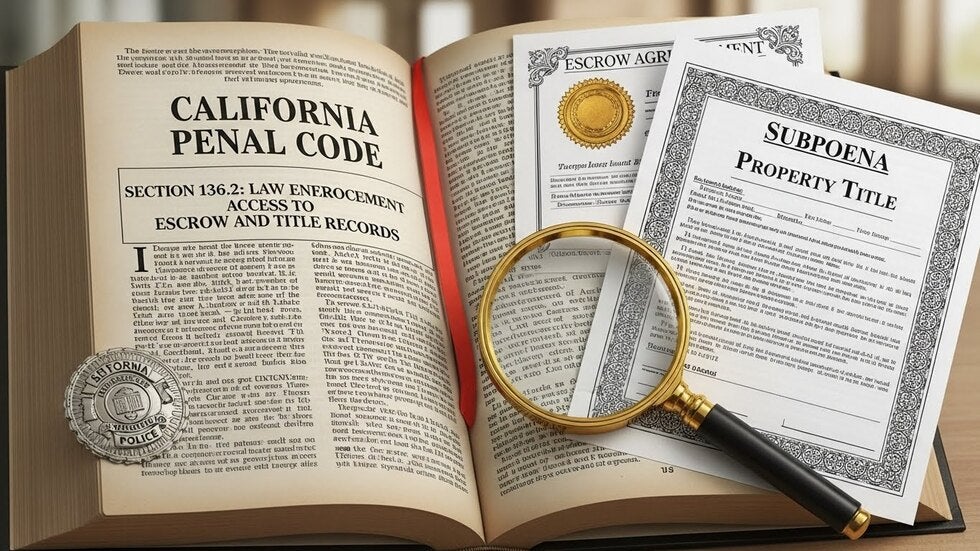
Real estate transactions generate extensive documentation revealing financial resources, property ownership patterns, and business relationships. California Penal Code Section 1326.2 governs when law enforcement can access these sensitive escrow and title records during criminal investigations. Understanding this statute is essential for anyone facing investigation involving allegations of money laundering or gang activity, as well as for property owners concerned about financial privacy rights.
Understanding Escrow and Title Records in Criminal Investigations
Escrow and title records contain detailed information about property transactions, ownership transfers, and the financial mechanisms behind real estate deals. These records provide investigators with powerful tools for tracing assets, identifying money laundering schemes, and uncovering criminal enterprise operations.
Title insurance companies maintain comprehensive records documenting property ownership chains, liens, encumbrances, and transaction histories. These records can reveal patterns suggesting illegal activity, such as rapid property flipping, straw buyers, or suspicious cash transactions indicating money laundering.
Escrow companies hold records showing the flow of funds through real estate transactions. Account statements, wire transfer documentation, and closing statements tracked by escrow agents create detailed paper trails that investigators use to follow money from criminal enterprises into legitimate real estate investments.
The information contained in these records makes them valuable for law enforcement while simultaneously creating significant privacy concerns for property owners and transaction participants. Section 1326.2 attempts to balance these competing interests through procedural requirements and judicial oversight.
Who Qualifies as Holders of Escrow or Title Records
Section 1326.2 defines precisely which entities fall under its provisions, ensuring clarity about who must comply with judicial orders for record production. This definition encompasses the primary businesses involved in California real estate transactions.
Title insurers engaging in the business of title insurance as defined by Insurance Code Section 12340.3 are covered by the statute. These companies provide insurance policies protecting property buyers and lenders against title defects, and they maintain extensive records about property ownership and transaction histories.
Underwritten title companies, which operate under the supervision of title insurers, also fall within the statutory definition. These companies conduct title searches, prepare title reports, and facilitate real estate closings while maintaining detailed transaction records.
Escrow companies complete the list of covered entities. These neutral third parties hold funds and documents during real estate transactions, ensuring that all conditions are met before transfers occur. The records they maintain document every aspect of property transaction financing and completion.
Understanding which entities qualify as holders of escrow or title records matters for both law enforcement seeking access and defense attorneys evaluating whether record acquisition complied with statutory requirements. Orders directed to entities outside this definition may lack legal authority.
When Peace Officers Can Request Escrow and Title Records
Section 1326.2 establishes strict prerequisites limiting when judges can order production of escrow and title records. These requirements create meaningful constraints on law enforcement access while allowing legitimate investigation of serious criminal activity.
Peace officers must submit written ex parte applications to judges demonstrating specific and articulable facts establishing reasonable grounds to believe requested records are relevant and material to ongoing felony investigations. This standard requires concrete factual bases rather than mere speculation or hunches about record relevance.
Critically, the statute applies only to investigations of particular serious offenses. Section 1326.2 covers felony violations of Penal Code Section 186.10, which addresses money laundering activities, and any felony subject to the gang enhancement set forth in Section 186.11.
This narrow scope reflects legislative recognition that escrow and title records contain highly sensitive financial information that should be accessible only when investigating the most serious organized criminal conduct. Regular felony investigations not involving money laundering or gang enhancement cannot trigger Section 1326.2 authority.
The limitation to money laundering and gang cases makes sense given that these investigations frequently involve tracing assets through real estate transactions. Criminal organizations commonly invest illegal proceeds in property, making escrow and title records essential evidence for proving criminal enterprise operations and asset forfeiture.
Particularity Requirements and Investigative Scope
Section 1326.2 mandates that ex parte applications specify with particularity which records are being sought. This particularity requirement prevents law enforcement fishing expeditions through escrow and title records of individuals not actually under criminal investigation.
Applications must identify the specific individual or individuals who are subjects of criminal investigations. Law enforcement cannot request broad categories of records, entire customer lists, or records for people peripherally connected to investigations without particularized suspicion regarding each person.
The particularity standard protects privacy by ensuring that only records genuinely relevant to investigating specific suspects are disclosed. Defense attorneys should carefully examine whether applications and resulting orders meet this specificity requirement when challenging evidence obtained through Section 1326.2.
Judicial orders become part of the public record unless courts order them sealed. This transparency allows oversight of law enforcement record requests, though the ex parte nature means targets typically learn of applications only after orders are executed and records produced.
Sealing orders can initially extend for 60 days when courts find this necessary for continuing investigations. Extensions can continue for up to one year or until investigations terminate, whichever occurs first. These time limits balance ongoing investigative needs against public interest in judicial transparency.
Defense Strategies for Challenging Title and Escrow Record Evidence
From a defense perspective, evidence obtained through Section 1326.2 orders may be vulnerable to various legal challenges. Understanding potential weaknesses in escrow and title record acquisitions helps defense counsel protect client rights and potentially suppress unlawfully obtained evidence.
Relevance challenges question whether peace officers adequately demonstrated that requested records were relevant and material to investigations. Applications containing only conclusory assertions without specific facts supporting relevance produce potentially invalid orders.
Particularity challenges attack applications and orders failing to adequately specify which records are sought or which individuals are under investigation. Overbroad requests seeking records beyond what investigations reasonably require violate the particularity mandate and may warrant suppression.
Scope challenges may succeed when investigations involve offenses outside Section 1326.2's limited coverage. If applications claim gang enhancement applicability without evidence supporting gang involvement, resulting orders may exceed statutory authority.
Procedural challenges examine whether proper ex parte application and judicial approval processes were followed. Orders obtained without judicial authorization or based on applications lacking required elements violate statutory requirements and potentially constitutional protections.
Defense counsel should also investigate whether escrow and title records were used only for authorized criminal investigations. The statute implicitly limits record use to legitimate law enforcement purposes, and evidence of unauthorized use could support suppression motions or other remedies.
Customer Notice Provisions and Privacy Protections
Section 1326.2 balances law enforcement investigative needs against customer privacy interests through carefully structured notice provisions. These requirements ensure that people eventually learn when their escrow and title records have been accessed, though notice may be delayed during active investigations.
The statute permits title insurers, underwritten title companies, and escrow companies to notify customers when they receive record production orders unless courts specifically order otherwise. This default notice provision respects customer privacy and allows individuals to potentially challenge orders before records are disclosed.
However, courts can order record holders to withhold customer notification upon finding that notice would impede investigations. This exception prevents suspects from destroying evidence, transferring assets, or otherwise obstructing investigations when they learn authorities are examining their real estate transaction records.
When courts order delayed notification, law enforcement bears responsibility for eventually informing customers. Peace officers or agencies that obtained records must deliver copies of ex parte orders to customers within 10 days after investigations terminate.
This delayed notice requirement ensures that even when immediate notification might compromise investigations, customers eventually learn that their records were accessed. From a defense perspective, this notice creates opportunities to challenge record acquisition lawfulness after the fact, potentially leading to evidence suppression even if challenges could not be mounted initially.
The 10 day notice deadline after investigation termination provides a relatively short window, but defense attorneys should monitor compliance carefully. Failures to provide timely notice may constitute statutory violations warranting remedies including potential evidence suppression.
Liability Protections for Title and Escrow Companies
Section 1326.2 provides comprehensive liability protections for companies that comply with judicial orders for record production. These protections encourage compliance by eliminating legal risks that might otherwise make companies reluctant to disclose customer information.
No holder of escrow or title records, including their officers, employees, or agents, faces liability for disclosing information in response to Section 1326.2 orders. This protection shields companies from customer lawsuits alleging privacy violations when disclosure occurs pursuant to valid judicial orders.
Similarly, companies face no liability for complying with court orders not to notify customers about record production. This protection prevents companies from being caught between conflicting legal obligations when courts order delayed notification.
These liability shields serve important policy purposes by ensuring that title insurers, underwritten title companies, and escrow agents comply promptly with lawful orders without fear of civil consequences. However, protections apply only to compliance with valid orders, not to wrongful disclosures or voluntary cooperation without judicial authorization.
From a defense perspective, these liability protections mean that customers generally cannot sue companies that disclosed records pursuant to court orders. Alternative remedies like suppression motions in criminal cases or actions against law enforcement for Fourth Amendment violations provide the primary avenues for addressing improper record acquisition.
Voluntary Disclosure Beyond Statutory Requirements
Section 1326.2 explicitly preserves authority for holders of escrow and title records to voluntarily disclose information to law enforcement without judicial orders. This provision creates a significant exception to the statute's judicial oversight requirements that defense attorneys must understand and address.
Title insurers, underwritten title companies, and escrow companies can provide records to police upon request without any court order when they choose to cooperate voluntarily. No statutory provisions require these companies to demand judicial orders before assisting law enforcement investigations.
This voluntary disclosure pathway means that Section 1326.2's protections apply only when law enforcement seeks to compel production through judicial orders. When companies willingly provide records, the statute's specificity requirements, judicial oversight, and notice provisions do not apply.
From a defense perspective, voluntary disclosures may receive less constitutional scrutiny than judicially compelled production. Courts have held that individuals have reduced privacy expectations in information voluntarily conveyed to third parties like escrow and title companies, potentially making Fourth Amendment challenges more difficult.
Defense counsel should investigate how escrow and title records were obtained in each case. Records obtained through voluntary disclosure might require different suppression arguments than those acquired through Section 1326.2 orders, affecting litigation strategy. and the likelihood of successful evidence suppression.
Privacy Implications of Modern Title and Escrow Records
Understanding the scope and sensitivity of information contained in modern escrow and title records helps contextualize the privacy interests at stake under Section 1326.2. These records reveal far more than simple property ownership, providing detailed financial portraits of individuals and their business activities.
Title records document complete ownership histories showing patterns of property acquisition and disposition over time. These patterns can reveal investment strategies, financial resources, business relationships, and lifestyle choices that individuals might reasonably expect to remain private.
Escrow records contain detailed financial information including bank account numbers, wire transfer sources, loan documentation, and cash transaction records. This information can expose income sources, wealth accumulation methods, creditor relationships, and financial decision making processes.
The aggregation of escrow and title records across multiple transactions creates comprehensive financial profiles. Investigators examining records spanning years or decades can construct detailed pictures of asset accumulation, business empire building, or potential money laundering operations.
Defense attorneys should emphasize that modern escrow and title records implicate substantial privacy interests warranting careful judicial scrutiny of law enforcement access requests. Courts should not treat these records as routine business records deserving minimal Fourth Amendment protection.
Comparing Escrow Records to Banking and Financial Records
Section 1326.2's framework for accessing escrow and title records differs in important ways from statutes governing other financial records. Understanding these differences helps defense counsel develop appropriate suppression strategies and constitutional arguments.
Banking records typically require either customer consent, subpoenas with notice allowing customers to object, or search warrants based on probable cause. The Right to Financial Privacy Act establishes detailed procedures protecting bank record privacy at the federal level.
Section 1326.2 requires only reasonable grounds to believe records are relevant and material, a lower standard than probable cause. However, it applies solely to money laundering and gang investigations, creating a narrower scope than general banking record access provisions.
The ex parte nature of Section 1326.2 applications mirrors certain banking record procedures but contrasts with subpoena approaches requiring notice and allowing customer objections. This difference reflects law enforcement concerns about asset dissipation or destruction if targets learn of investigations.
Defense attorneys should consider whether escrow and title records deserve greater protection than courts have traditionally afforded banking records. Real estate transaction documentation can reveal information as sensitive as bank statements, warranting equivalent or heightened constitutional scrutiny.
Strategic Considerations for Criminal Defense Practice
Understanding Section 1326.2 helps defense attorneys protect clients facing investigations or prosecutions involving escrow and title record evidence. Several strategic considerations arise when this statute plays a role in criminal proceedings.
Early case evaluation should determine whether escrow or title records form part of prosecution evidence and how those records were obtained. Discovery requests should specifically seek copies of any Section 1326.2 applications and orders to evaluate their legal validity.
Suppression motions may succeed when records were obtained in violation of statutory requirements or constitutional protections. Defense counsel should carefully review applications for compliance with specificity and relevance standards while examining whether investigations actually involved covered offenses.
Privacy arguments can emphasize that escrow and title records reveal sensitive information about financial resources, business relationships, and investment strategies. Courts should apply heightened scrutiny when evaluating whether record acquisitions complied with statutory requirements given the intimate nature of disclosed information.
Cross examination of officers who obtained records can explore whether applications contained accurate information and whether proper procedures were followed. Inconsistencies between application statements and actual investigative focuses may support suppression arguments.
Alternative explanations for real estate transaction patterns should be developed when records form important prosecution evidence. Defense teams should retain real estate and financial experts who can offer innocent explanations for transaction patterns that prosecutors characterize as evidence of money laundering or criminal enterprise operations.
Conclusion
California Penal Code Section 1326.2 creates a framework allowing law enforcement to access escrow and title records in serious felony investigations while providing some procedural protections and judicial oversight. The statute reflects ongoing tension between effective investigation of organized crime and individual financial privacy rights.
For defendants, understanding when and how escrow and title records can be accessed helps protect privacy interests and identify potential challenges to prosecution evidence. The statute's requirements for specificity, relevance, and limitation to particular offense types create opportunities for defense attorneys to challenge improperly obtained records.
As real estate transactions become increasingly complex and documentation more comprehensive, the legal frameworks governing law enforcement access to these records will continue evolving. Working with experienced defense counsel who understand both current law and emerging privacy issues is essential for anyone facing criminal investigations where escrow or title records might play an evidentiary role. Contact Bulldog Law at (888) 928-1609.