
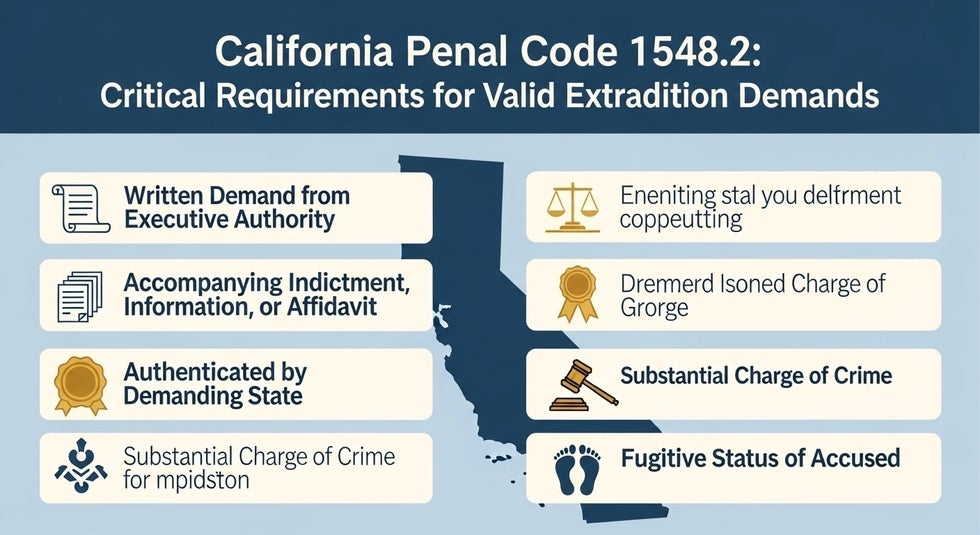
When another state seeks to extradite someone from California, they cannot simply make a verbal request or submit incomplete paperwork. California Penal Code Section 1548.2 establishes strict documentary requirements that demanding states must satisfy before the Governor will even consider an extradition request.
For defendants facing potential extradition, understanding these mandatory requirements provides crucial opportunities to challenge improper demands and protect constitutional rights.
Understanding the Foundation of Extradition Demand Requirements
California law takes extradition seriously, recognizing that removing someone from the state to face charges elsewhere represents a significant deprivation of liberty. Section 1548.2 creates a protective framework that ensures extradition demands meet minimum standards of legitimacy and procedural correctness before California's Governor takes action.
These requirements aren't mere formalities. They serve as essential safeguards against wrongful extradition, mistaken identity, and procedural abuse. From a defense perspective, each requirement in this statute represents a potential checkpoint where an improper extradition demand can be stopped before a client faces removal from California.
The Written Demand Requirement
The first fundamental requirement under Section 1548.2 states that no extradition demand will be recognized unless it comes in writing. This might seem obvious in our document-driven legal system, but the written requirement serves several important purposes that benefit defendants.
A written demand creates a permanent record of exactly what the requesting state alleges. Unlike verbal communications that can be misremembered or disputed, written demands establish clear terms that defense attorneys can examine, challenge, and use to hold the demanding state accountable for its representations.
The written nature of extradition demands also allows for careful scrutiny of the specific allegations. Defense counsel experienced in interstate extradition cases know that examining the precise language of these demands often reveals inconsistencies, procedural defects, or factual errors that can form the basis of successful challenges.
Proving Presence and Flight: Essential Allegations
California law requires that every extradition demand must allege two critical facts: that the accused was actually present in the demanding state when the alleged crime occurred, and that the person subsequently fled from that state.
These requirements create significant defense opportunities. Many extradition demands fail because the demanding state cannot adequately prove the defendant was physically present when the alleged crime occurred. In our interconnected world, people can be accused of crimes in states they've never visited, especially in cases involving internet-based allegations or complex financial transactions.
The flight requirement presents another crucial defense angle. Simply leaving a state doesn't constitute flight under extradition law. The demanding state must show that the person left with the intent to avoid prosecution or after being charged with a crime. Someone who moved from one state to another for legitimate reasons like employment, family, or education typically has not "fled" in the legal sense.
Defense attorneys can challenge extradition demands by demonstrating that the client never fled from the demanding state. Perhaps the person moved before any charges were filed, relocated for legitimate purposes without knowledge of an investigation, or has been living in California for years before the demanding state initiated prosecution. Each scenario potentially defeats the flight requirement and undermines the extradition demand.
Required Documentation: The Devil in the Details
Section 1548.2 specifies exactly what documents must accompany an extradition demand. These documentary requirements aren't suggestions; they're mandatory prerequisites that the demanding state must satisfy.
For defendants facing charges in another state, the demand must include either a copy of an indictment, a copy of an information, or a copy of an affidavit made before a magistrate in the demanding state, along with any warrant issued based on those charging documents.
From a defense standpoint, scrutinizing these documents for defects becomes essential. Does the indictment actually charge a crime under the demanding state's law? Is the information properly sworn? Was the affidavit made before someone with proper authority? Does the warrant contain all required elements? Any deficiency in these documents can potentially invalidate the entire extradition demand.
Documentation Requirements for Conviction Cases
When extradition involves someone who was previously convicted in the demanding state, different documentation applies. Section 1548.2 requires a copy of the judgment of conviction or sentence, together with a statement from the demanding state's executive authority explaining that the person escaped from confinement or violated bail, probation, or parole terms.
These requirements create specific defense opportunities in post-conviction extradition cases. Defense counsel can investigate whether the judgment of conviction is valid, whether proper procedures were followed in the original case, and whether the person actually violated confinement or supervision terms as alleged.
Sometimes people are accused of violating probation or parole based on technical violations or misunderstandings. Other times, the demanding state's allegation that someone "escaped" doesn't match the actual circumstances. Perhaps the person was released through proper channels, completed their sentence, or never actually absconded. Challenging these factual allegations can defeat an extradition demand even when a prior conviction exists.
The Substantial Charging Requirement
California law requires that the indictment, information, or affidavit must "substantially charge" the person with having committed a crime under the demanding state's law. This substantial charging requirement protects defendants from extradition based on vague, incomplete, or legally insufficient allegations.
Defense attorneys can challenge whether charging documents meet this standard. Does the indictment specify what crime was allegedly committed? Does it include essential elements of the offense? Does it provide enough detail for the defendant to understand what they're accused of doing?
The substantial charging requirement also allows defense counsel to examine whether the alleged conduct actually constitutes a crime in the demanding state. Sometimes charging documents describe behavior that might be problematic but doesn't actually violate the demanding state's criminal laws. Other times, the charging documents are so vague or conclusory that they don't substantially charge any specific crime.
This requirement connects to broader criminal defense principles about the right to know the charges against you and the prosecution's burden to specify criminal allegations with clarity and precision.
Authentication: Proving Document Legitimacy
Perhaps one of the most technically important requirements in Section 1548.2 is that all submitted documents must be certified as authentic by the executive authority making the demand. This authentication requirement ensures that documents are genuine and haven't been altered or fabricated.
From a defense perspective, authentication challenges can stop extradition proceedings. Defense attorneys should carefully examine whether documents bear proper certifications, whether signatures are authentic, whether official seals are present and correct, and whether the person certifying the documents actually had authority to do so.
Authentication issues arise more frequently than many people realize. Government offices sometimes submit documents with improper certifications, expired seals, or signatures from individuals who lack proper authority. Each of these defects can potentially invalidate an extradition demand.
Defense counsel should never assume that documents submitted by another state are properly authenticated simply because they appear official. Careful examination of authentication can reveal fatal flaws in extradition demands.
Procedural Defects as Defense Strategies
Every requirement in Section 1548.2 represents a potential basis for challenging an extradition demand. When demanding states fail to meet even one of these requirements, California's Governor should refuse to recognize the demand.
Experienced defense attorneys approach extradition cases by systematically examining whether the demanding state has satisfied each statutory requirement. This methodical approach often uncovers defects that less experienced counsel might overlook.
Common defects include missing documents, improper authentication, insufficient allegations of presence and flight, charging documents that don't substantially charge a crime, or documents that aren't properly certified. Each defect provides grounds for challenging the extradition demand.
The Governor's Discretion and Defense Arguments
While Section 1548.2 establishes mandatory requirements, it also recognizes the Governor's role in reviewing extradition demands. The statute states that the Governor will not "recognize" demands that fail to meet these requirements, but it also allows the Governor to exercise discretion in evaluating demands.
Defense attorneys can submit materials to the Governor's office explaining why an extradition demand should be denied. These submissions might address technical defects in the demand, constitutional concerns about the underlying charges, humanitarian considerations, or other factors that warrant refusing extradition.
The Governor's review provides an important opportunity for criminal defense advocacy outside the courtroom. While extradition proceedings ultimately involve judicial oversight, the Governor's initial decision about whether to recognize a demand can be influenced by well-crafted defense arguments.
Constitutional Protections Beyond Statutory Requirements
Section 1548.2 establishes minimum statutory requirements, but constitutional protections provide additional safeguards for defendants facing extradition. The United States Constitution guarantees due process, and extradition proceedings must respect fundamental fairness.
Even when a demanding state satisfies the documentary requirements in Section 1548.2, defendants can raise constitutional challenges. These might include arguments about mistaken identity, violations of double jeopardy, unconstitutional charging decisions, or other constitutional infirmities in the demanding state's case.
Defense attorneys must evaluate both statutory compliance under Section 1548.2 and constitutional protections to provide comprehensive representation in extradition cases. Sometimes the demanding state's documents satisfy technical requirements but the underlying case involves constitutional violations that warrant refusing extradition.
Time Sensitivity in Extradition Defense
One crucial aspect of defending against extradition demands involves acting quickly. Once California's Governor recognizes an extradition demand and issues a warrant, defendants face arrest and detention. Fighting extradition from custody is more difficult than preventing the Governor from recognizing the demand in the first place.
Experienced extradition defense counsel begins working as soon as they learn about a potential demand from another state. Proactive legal representation allows for early examination of documents, identification of defects, and submission of materials to the Governor's office before formal proceedings begin.
Defendants who wait until after arrest to seek legal help often find themselves at a significant disadvantage. The best defense strategies in extradition cases typically involve early intervention and aggressive challenges to the demanding state's documentation.
Why Experienced Legal Representation Matters
Extradition defense requires specific knowledge of interstate procedures, statutory requirements, and constitutional protections that most attorneys never encounter in their practices. The technical requirements in Section 1548.2 demand careful attention to detail and experience in identifying documentary defects.
For anyone facing potential extradition from California, securing counsel who understands these requirements provides essential protection. The difference between freedom and forced removal to another state often depends on whether your attorney knows how to identify and challenge defects in extradition demands.
Understanding California Penal Code Section 1548.2 empowers defendants and their families to recognize that extradition isn't automatic. Demanding states must satisfy specific requirements, and skilled defense counsel can exploit failures to meet those requirements to protect their clients' liberty and constitutional rights.
For a free consultation, call our law firm toll free at (888) 928-1609 or contact us by email.