
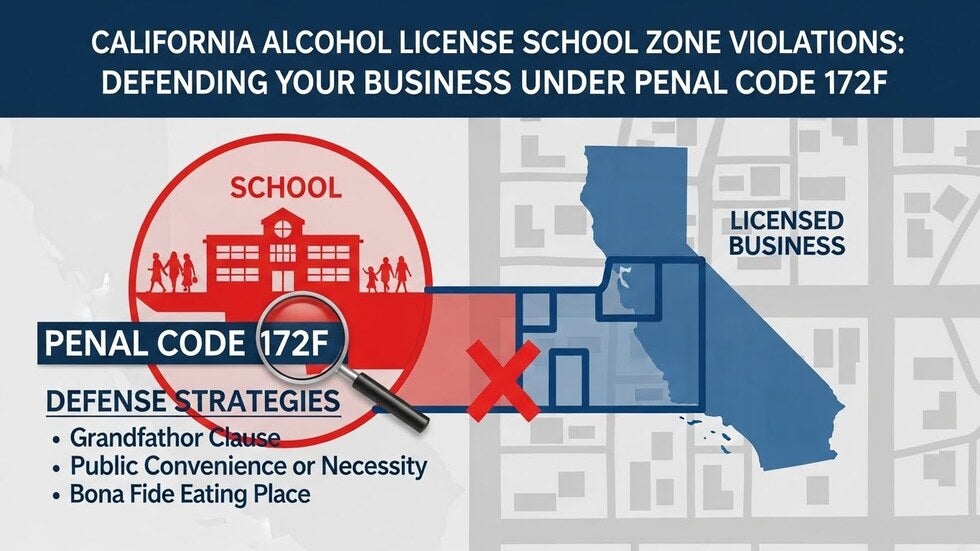
Operating an alcohol licensed business near California schools, colleges, or other educational institutions creates complex legal challenges that can threaten your livelihood. California Penal Code Section 172f provides crucial protections for existing license holders while establishing strict parameters for business operations and transfers.
Understanding these protections and their limitations becomes essential for defending your business against regulatory enforcement and criminal charges.
Many business owners discover too late that changing school boundaries, increased enrollment, or new institutional facilities have placed their previously compliant establishments within restricted zones.
The interplay between grandfathering provisions, transfer restrictions, and ongoing compliance obligations creates a legal minefield that requires careful navigation to avoid devastating consequences.
Understanding California's School Zone Alcohol Restrictions
California maintains strict prohibitions on alcohol sales near educational institutions through Penal Code Sections 172, 172a, 172b, 172d, and 172g. These statutes create buffer zones around schools, colleges, and other educational facilities where new alcohol licenses cannot be issued and existing unlicensed operations face criminal penalties.
The underlying policy seeks to protect students from alcohol related influences by limiting commercial alcohol availability near educational environments. However, these well intentioned restrictions can create harsh consequences for legitimate businesses that find themselves within restricted zones due to changing circumstances beyond their control.
Violations of school zone alcohol restrictions can result in criminal charges, license revocation, and significant financial penalties. The criminal nature of these violations means that business owners face potential jail time and permanent criminal records that extend far beyond business licensing consequences.
The complexity of determining exact boundaries, measuring distances, and understanding which institutions trigger restrictions creates frequent disputes between business owners and enforcement agencies. These technical legal questions require sophisticated analysis to resolve effectively.
Grandfathering Protections Under Section 172f
Penal Code Section 172f provides essential grandfathering protections for businesses holding valid Alcoholic Beverage Control Act licenses when school zone restrictions take effect. This protection recognizes that existing businesses should not face retroactive penalties for complying with the law at the time they obtained their licenses.
The grandfathering provision applies to licenses that were issued and in effect on the date Section 172f became effective or when amendments to Section 172g specified additional institutions. This timing requirement creates crucial cutoff dates that determine whether businesses qualify for protection.
Licensed premises that fall within restricted areas due to boundary extensions of educational institutions receive explicit protection under the statute. This provision prevents schools from effectively forcing existing businesses to close by expanding their physical boundaries into previously unrestricted areas.
Increased enrollment or resident student numbers at educational institutions also trigger grandfathering protections for existing license holders. This provision recognizes that businesses should not face penalties for enrollment changes that occur after they establish their operations in compliance with existing law.
The grandfathering protections extend beyond mere permission to continue operating, also preserving the right to transfer licenses subject to specific restrictions designed to prevent circumvention of the underlying policy goals.
License Transfer Rights and Restrictions
Section 172f allows grandfathered licenses to be transferred from person to person or from premises to premises, providing flexibility for business sales and relocations while maintaining policy protections. However, these transfer rights include important restrictions that limit how far licenses can move toward educational institutions.
The general rule prohibits license transfers to premises located closer to institution boundaries than the original licensed location. This restriction prevents businesses from using grandfathered status to gradually move closer to schools through successive transfers.
A limited exception allows one transfer to premises located up to 300 feet closer to institution boundaries than the original location. This one time exception provides some flexibility for business relocations while maintaining meaningful distance restrictions.
Once a license has been transferred to premises closer to an institution using the 300 foot exception, subsequent transfers cannot move the license any closer to institutional boundaries than the original premises. This provision prevents multiple incremental moves that would effectively circumvent distance requirements.
Understanding these transfer restrictions becomes crucial for business transactions involving grandfathered licenses, as violations can result in license revocation and criminal charges for all parties involved in prohibited transfers.
Defending Against School Zone Violation Allegations
Successful defense of school zone alcohol violations often centers on challenging the technical elements required for prosecution. These cases frequently involve complex distance measurements, boundary determinations, and institutional classifications that provide opportunities for effective challenge.
Boundary disputes represent a common source of defense opportunities, as determining exact institutional boundaries requires careful survey work and legal analysis of property descriptions. Prosecution errors in boundary determination can completely undermine their cases against defended businesses.
Distance measurement challenges focus on the specific methodologies used by enforcement agencies to determine whether businesses fall within restricted zones. Inconsistent measurement practices, failure to account for terrain features, and mathematical errors can provide grounds for challenging violation allegations.
Institutional classification disputes examine whether facilities actually qualify as educational institutions under the statutory definitions. Some facilities that appear educational may not meet the specific legal requirements that trigger alcohol sale restrictions.
Timing issues related to when restrictions took effect versus when licenses were issued can provide complete defenses for businesses claiming grandfathering protections. Careful analysis of regulatory timelines and license history often reveals protection that businesses did not realize they possessed.
Constitutional Challenges to Enforcement Actions
School zone alcohol restrictions may face constitutional challenges when applied in ways that violate due process, equal protection, or other fundamental rights. These constitutional issues often arise in enforcement actions that threaten established businesses with severe penalties.
Due process challenges may succeed when businesses receive inadequate notice of restriction changes or when enforcement agencies apply inconsistent standards in determining violations. The fundamental fairness required by due process can provide powerful defense tools.
Equal protection issues arise when similarly situated businesses face disparate treatment under school zone restrictions. Selective enforcement or discriminatory application of these laws may violate constitutional protections.
Taking claims may be viable when enforcement actions effectively destroy the economic value of existing businesses without providing just compensation. While regulatory takings claims face high legal hurdles, extreme cases may qualify for constitutional protection.
Vagueness challenges can succeed when statutory language fails to provide adequate guidance for compliance, particularly regarding boundary determinations and institutional classifications that affect business operations.
Regulatory Compliance Strategies
Maintaining compliance with school zone alcohol restrictions requires ongoing monitoring of institutional changes, enrollment data, and boundary modifications that could affect licensed operations. Proactive compliance strategies help businesses avoid violations while preserving their grandfathering protections.
Regular boundary surveys help ensure businesses maintain accurate distance measurements as institutional facilities expand or modify their boundaries. These surveys provide documentation crucial for defending against future violation allegations.
Enrollment monitoring allows businesses to track changes that might affect their grandfathering status or trigger new restrictions. Working with institutional administrators can provide early warning of changes that affect business operations.
Legal consultation before license transfers ensures compliance with the complex restrictions governing grandfathered licenses. These consultations can prevent inadvertent violations that could result in license revocation.
Documentation preservation becomes crucial for establishing grandfathering rights and defending against violation allegations. Maintaining complete records of license history, boundary surveys, and compliance efforts provides essential evidence for defense.
Impact on Business Transactions and Financing
School zone restrictions and grandfathering provisions significantly impact business valuations, financing options, and transaction structures for alcohol licensed businesses. Understanding these impacts helps business owners make informed decisions about their operations and future planning.
Lenders often view grandfathered licenses as higher risk investments due to transfer restrictions and potential enforcement actions. This perception can affect loan terms, interest rates, and financing availability for affected businesses.
Purchase agreements for grandfathered licenses require careful drafting to address compliance obligations, transfer restrictions, and potential enforcement risks. Buyers and sellers must understand their respective responsibilities and liabilities.
Insurance coverage may be affected by school zone compliance issues, as carriers assess the risks associated with regulatory violations and enforcement actions. Maintaining appropriate coverage requires disclosure of potential compliance issues.
Business succession planning becomes more complex for grandfathered licenses due to transfer restrictions and ongoing compliance requirements. Family businesses must plan carefully to preserve their grandfathering protections through generational transfers.
Working with Experienced Legal Counsel
School zone alcohol license issues require specialized knowledge of regulatory compliance, criminal defense, and business law that intersects in complex ways. Effective legal counsel must understand both the technical requirements of alcohol licensing and the defense strategies available when violations are alleged.
Early intervention often proves crucial in school zone cases, as businesses that address compliance issues proactively may avoid criminal charges and preserve their operating privileges. Waiting until enforcement actions commence limits available options and increases potential penalties.
Negotiation with regulatory agencies may result in compliance agreements or alternative resolutions that allow businesses to continue operating while addressing underlying policy concerns. These negotiations require understanding agency priorities and enforcement practices.
California's school zone alcohol restrictions serve legitimate policy goals but must be enforced fairly and within legal limits. Understanding your rights under Penal Code Section 172f and available defenses provides the best protection against unjust enforcement actions that could destroy your business and livelihood.
Contact the attorneys of Bulldog Law today, at (888) 928-1609 or send us an email.