
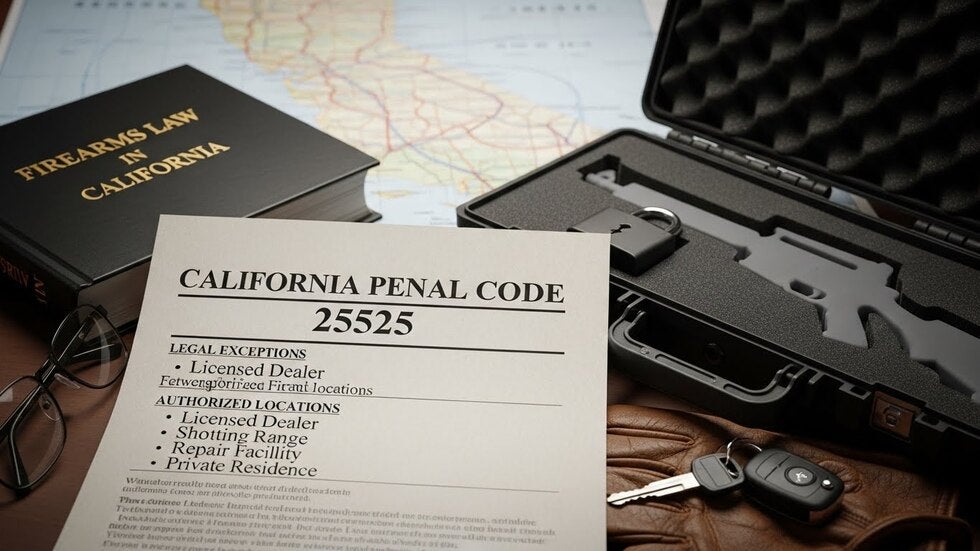
California's complex firearms regulations often confuse law-abiding gun owners who simply want to transport their weapons legally between authorized locations. While Penal Code Section 25400 prohibits carrying concealed firearms, Section 25525 provides critical exceptions that protect citizens engaging in lawful firearm transportation. Understanding these exceptions can mean the difference between facing criminal charges and exercising your legal rights. At Bulldog Law, we help clients navigate California's intricate firearms laws and defend against improper weapons charges.
Who Qualifies for Transportation Exceptions Under Section 25525
California Penal Code Section 25525 establishes specific eligibility requirements for individuals seeking to transport firearms without violating concealed carry laws. The statute protects any citizen of the United States or legal resident over the age of 18 years who resides or is temporarily within California. This protection extends to both permanent residents and individuals visiting the state, provided they meet all statutory requirements.
Critically, the law excludes individuals who fall within prohibited classes prescribed by specific statutory sections. These excepted classes include persons prohibited from possessing firearms under Chapter 2 (commencing with Section 29800) or Chapter 3 (commencing with Section 29900) of Division 9, as well as individuals subject to restrictions under Section 8100 or 8103 of the Welfare and Institutions Code. Common prohibited categories include convicted felons, individuals subject to domestic violence restraining orders, persons with certain mental health adjudications, and those convicted of specific misdemeanor offenses.
Before relying on transportation exceptions, individuals must honestly evaluate whether they fall within any prohibited category. Even minor criminal convictions or civil court orders may disqualify someone from lawful firearm possession, making the transportation exception unavailable. Understanding firearms possession eligibility requires careful review of your complete criminal and civil history with experienced legal counsel.
Authorized Locations for Lawful Firearm Transportation
Section 25525 protects firearm transportation directly between specific authorized locations. Understanding what qualifies as an authorized location and the requirement for direct transportation forms the foundation for legally moving firearms under this exception.
The statute identifies three primary authorized locations. First, the person's place of residence receives explicit protection. This includes your primary home, whether owned or rented, and extends to temporary residences in some circumstances. Second, the person's place of business qualifies as an authorized location. This encompasses any location where you conduct regular business activities, whether as an employee or business owner. Third, private property owned or lawfully possessed by the person constitutes an authorized location under the statute.
The requirement that transportation occur "directly between" authorized locations carries significant legal weight. This language suggests that individuals should travel by the most direct reasonable route without unnecessary stops or detours. While the statute does not prohibit all stops during transportation, extended delays, side trips to unauthorized locations, or activities unrelated to the transportation itself may jeopardize the exception's protection.
For example, transporting a firearm directly from your residence to your place of business clearly falls within the exception's scope. However, stopping for an extended social visit, conducting errands at multiple locations, or deliberately detouring to areas where firearms are prohibited may undermine your ability to claim the transportation exception if law enforcement discovers the weapon.
Transporting Firearms After Lawful Receipt
Subdivision (b) of Section 25525 provides an additional exception specifically addressing the period immediately following lawful firearm acquisition. This provision protects transportation from the place where a person lawfully received a firearm to their residence, place of business, or privately owned or lawfully possessed property.
This exception recognizes that newly purchased or transferred firearms must travel from the point of acquisition to an authorized storage location. California's extensive firearm transfer requirements, including background checks and waiting periods for most transactions, mean that lawful acquisition typically occurs at licensed firearms dealers. The transportation exception allows individuals to move newly acquired firearms from the dealer to authorized locations without violating concealed carry laws.
The requirement that the firearm was "lawfully received" carries important implications. Firearms acquired through illegal transfers, straw purchases, or transactions that violate California's registration and transfer requirements do not qualify for this exception. Additionally, the protection applies only when traveling directly to an authorized location, maintaining the same directness requirement discussed above.
Understanding what constitutes lawful receipt requires knowledge of California's comprehensive firearms transfer regulations. Most firearm transfers must occur through licensed dealers who conduct background checks and comply with registration requirements. Private party transfers also require dealer involvement in most circumstances, with limited exceptions for specific family transfers and other narrow categories. California firearms transfer requirements present complex legal issues that often require professional guidance to navigate properly.
Best Practices for Lawful Firearm Transportation
While Section 25525 provides important protections, following additional best practices can further reduce the risk of criminal charges and demonstrate lawful intent if law enforcement questions your activities. These practices go beyond strict legal requirements but provide additional layers of protection.
First, transport firearms unloaded whenever possible. While the transportation exception does not explicitly require firearms to be unloaded, doing so eliminates potential arguments about brandishing, criminal threats, or other weapons offenses. Unloaded firearms also demonstrate responsible gun ownership and peaceful intent.
Second, store firearms in locked containers during transportation. Although not strictly required by Section 25525, using locked cases or containers shows careful attention to safety and security. This practice also helps establish that the firearm was not readily accessible for immediate use, which can be relevant to various firearms offenses beyond concealed carry.
Third, keep ammunition separate from firearms during transport. While transporting both firearms and ammunition together does not necessarily violate the law, separating them provides additional evidence of lawful transportation rather than intent to use the weapon unlawfully.
Fourth, maintain documentation of lawful ownership and acquisition. Having purchase receipts, registration documents, or other proof of lawful possession readily available can quickly resolve law enforcement questions and demonstrate your right to transport the firearm.
Fifth, plan your route carefully and travel directly between authorized locations. Avoid unnecessary stops, detours through sensitive areas like schools or government buildings, and extended delays that might suggest purposes beyond simple transportation.
Common Law Enforcement Encounters During Firearm Transportation
Understanding how law enforcement encounters typically occur during firearm transportation helps individuals protect their rights and avoid inadvertently providing information that could lead to charges. Traffic stops represent the most common scenario where officers discover transported firearms, making proper handling of these situations critical.
If stopped while transporting a firearm, individuals face important decisions about disclosure and cooperation. Some states require immediate notification to officers about firearm presence, but California does not impose such a general requirement. However, if an officer asks whether you possess weapons, providing false information constitutes a separate offense.
Many experienced firearms attorneys recommend a measured approach: remain calm, be respectful, and avoid volunteering unnecessary information while complying with lawful orders. If an officer asks to search your vehicle, you have the right to refuse consent searches absent probable cause or other legal justification. However, if officers have independent probable cause to search, refusal will not prevent the search.
If officers discover a firearm during a lawful search, clearly but briefly explain that you are transporting it between authorized locations under Penal Code Section 25525. Avoid lengthy explanations or providing more information than necessary. Remember that anything you say can be used against you, so measured, factual responses serve your interests better than extensive volunteered information. Protecting your rights during police encounters requires understanding both what you must do and what you should avoid.
Limitations and Exceptions to the Transportation Exception
While Section 25525 provides valuable protection for lawful firearm transportation, important limitations restrict its scope. Understanding these boundaries helps gun owners avoid inadvertently violating other firearms laws while believing they remain protected by the transportation exception.
First, the transportation exception does not authorize carrying loaded firearms in vehicles in most circumstances. California Penal Code Section 25850 separately prohibits carrying loaded firearms in vehicles, with its own set of exceptions that may or may not align with Section 25525 protections. Gun owners must ensure compliance with both concealed carry and loaded firearm statutes.
Second, the exception does not override location-specific firearm prohibitions. Even while lawfully transporting a firearm between authorized locations, entering school zones, government buildings, airports, or other prohibited areas violates separate statutes. The transportation exception protects against concealed carry violations during transit but does not authorize bringing firearms into locations where they are otherwise prohibited.
Third, individuals subject to restraining orders or other court orders restricting firearm possession cannot rely on the transportation exception. These court orders typically prohibit all firearm possession, regardless of the purpose or location.
Fourth, the exception does not protect transportation of illegal weapons or firearms modified in violation of California's assault weapon or magazine capacity laws. Even when transporting between authorized locations, possessing illegal weapons or accessories constitutes separate offenses.
Defending Against Improper Charges Under Section 25525
Despite clear statutory protections, some individuals face criminal charges for firearm transportation that should fall within Section 25525 exceptions. Prosecutors may argue that transportation was not sufficiently direct, that the defendant does not qualify for the exception, or that other circumstances vitiate the protection.
Effective defense strategies require demonstrating that all statutory elements were satisfied. This includes establishing eligibility by showing United States citizenship or legal residency, age over 18, California residence or temporary presence, and absence of disqualifying prohibitions. Documentary evidence including identification, proof of residence, and background check records can establish these elements.
Proving that transportation occurred directly between authorized locations often requires mapping routes, documenting timing, and explaining any stops or delays. GPS data, witness testimony, and other evidence can demonstrate the direct nature of transportation and rebut prosecutorial arguments about detours or delays.
Establishing lawful receipt of firearms requires documentation of the acquisition circumstances, including dealer records, transfer documentation, and compliance with waiting periods and background checks. These records not only prove lawful receipt but also demonstrate the gun owner's good faith effort to comply with all legal requirements, in accordance with Federal Criminal Code Chapter 44 firearms provisions.
Seeking Legal Counsel for Firearm Transportation Issues
California's firearms laws present numerous opportunities for well meaning gun owners to inadvertently violate complex regulations despite attempting to comply with the law. The interaction between concealed carry prohibitions, loaded firearm restrictions, transportation exceptions, and location-specific bans creates a challenging legal landscape requiring careful navigation.
Individuals charged with firearms offenses while transporting weapons between authorized locations need immediate legal representation from attorneys experienced in California gun laws. Early intervention allows defense counsel to gather evidence, interview witnesses, and develop comprehensive defense strategies before prosecutors solidify their case theory.
Even before charges are filed, consulting with experienced firearms attorneys provides valuable guidance for gun owners seeking to understand their rights and responsibilities. Proactive legal consultation regarding firearms regulations can prevent violations and protect Second Amendment rights while ensuring compliance with California's extensive regulatory scheme.
Conclusion: Protecting Your Right to Transport Firearms Lawfully
California Penal Code Section 25525 provides essential protections for law abiding gun owners transporting firearms between authorized locations. Understanding the scope of these protections, eligibility requirements, and practical limitations enables responsible firearm owners to exercise their rights without fear of criminal prosecution.
We provide comprehensive legal guidance regarding California firearms laws and vigorous defense representation for individuals facing improper weapons charges. Our experience with concealed carry violations, transportation exceptions, and firearms regulations throughout California enables us to effectively protect our clients' rights and achieve favorable outcomes in complex weapons cases.
If you have questions about lawfully transporting firearms in California or face charges related to firearm transportation, contact our office to discuss your situation and explore your legal options. Protecting your Second Amendment rights while navigating California's complex regulatory environment requires knowledgeable legal counsel committed to defending your interests. Call Bulldog Law at (888) 928-1609 .