
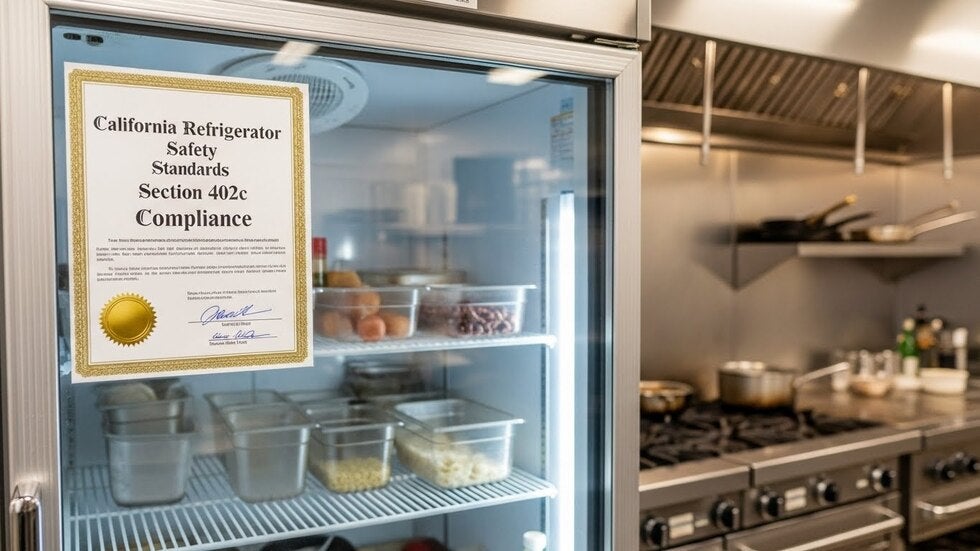
California Penal Code Section 402c establishes mandatory safety standards for refrigerators, iceboxes, and deep freeze lockers sold in the state. This statute, effective since 1970, makes it a misdemeanor to sell cooling appliances that cannot be opened from inside with minimal force.
While most modern appliances comply automatically through current manufacturing standards, retailers, resellers, and individuals selling refrigeration equipment must understand these requirements to avoid criminal liability. This comprehensive guide examines the law from a defense perspective, helping those facing charges understand their rights and available strategies.
The Legislative Intent Behind Section 402c
Section 402c emerged from the same public safety concerns that produced laws about abandoned appliances. During the 1950s and 1960s, children across America died in tragic incidents where they became trapped inside discarded or operating refrigerators unable to escape. Early refrigerator designs featured heavy doors with external latches that required significant force to open, even from outside.
Once closed, these doors created airtight seals that children could not break from inside.
The appliance industry responded to public pressure and regulatory requirements by redesigning refrigerator door mechanisms. Modern refrigerators use magnetic seals that hold doors closed during normal operation but release easily when pushed from inside. This design innovation eliminated most entrapment risks while maintaining the cooling efficiency that mechanical latches provided.
Section 402c codifies these safety standards in California law, ensuring that only properly designed refrigeration equipment reaches consumers through retail channels. The statute complements laws about properly disposing of old appliances by preventing the sale of new equipment that poses similar entrapment dangers.
Who Does Section 402c Apply To?
The statute specifically targets anyone who sells new refrigerators, iceboxes, or deep freeze lockers in California. The term "sells" encompasses various commercial transactions where ownership transfers from one party to another in exchange for payment. Retailers constitute the primary category of people subject to Section 402c requirements, whether operating large appliance stores, general merchandise outlets, or specialized refrigeration equipment suppliers.
The statute applies only to sales of new equipment rather than used appliances. This limitation recognizes that used appliance dealers often handle older equipment manufactured before modern safety standards took effect. Requiring compliance for used sales would effectively ban many older refrigerators from the resale market, limiting consumer options without meaningfully improving safety since consumers could still acquire the same appliances through private sales or other channels.
Manufacturers and distributors who sell equipment to retailers generally do not face direct liability under Section 402c since they sell to commercial purchasers rather than end consumers. However, manufacturers of non compliant equipment may face other regulatory penalties and civil liability, even if California's criminal statute focuses on retail sellers.
Individual sellers disposing of their own used refrigerators through private sales also fall outside Section 402c's scope. The statute targets commercial sales of new equipment rather than casual private transactions between individuals. However, these private sellers must still comply with laws about properly disposing of abandoned appliances if they discard equipment rather than selling it.
The Specific Safety Requirements
Section 402c establishes a precise technical standard for refrigerator door mechanisms. The statute requires that doors open from inside when someone applies 15 pounds of force against the latch edge. This specification provides an objective, measurable criterion that manufacturers and retailers can verify through testing.
Fifteen pounds represents a modest force that even young children can typically generate. By setting the threshold this low, California ensures that people of various ages, sizes, and physical capabilities can escape from inside refrigerators if they become trapped. The requirement accounts for the reality that children, who face the greatest entrapment risk, have less strength than adults.
The measurement point matters significantly. Force must be applied "against the latch edge of the closed door," meaning the side of the door opposite the hinges where latching mechanisms typically mount. This specification recognizes that doors open most easily when force applies to the edge farthest from the pivot point, maximizing mechanical advantage.
Modern magnetic seal systems easily satisfy this requirement since they typically release with far less than 15 pounds of force. Push the door from inside any contemporary refrigerator and it opens readily without significant resistance. The industry standard magnetic seal design makes compliance automatic for virtually all new refrigeration equipment manufactured in recent decades.
Appliances Covered by the Statute
Section 402c applies to refrigerators, iceboxes, and deep freeze lockers with capacities of two cubic feet or more. This capacity threshold excludes small compact refrigerators, mini fridges, and specialty cooling units too small to pose entrapment risks. A two cubic foot interior provides sufficient space for a small child to fit inside, triggering the safety concerns that motivated the legislation.
Refrigerators represent the most common appliance category covered by this statute. Whether standalone units, built in models, or refrigerator freezer combinations, all equipment designed to maintain refrigeration temperatures falls within the statute's scope when sold new and meeting the capacity requirement.
Iceboxes, though less common in modern commerce, refer to insulated boxes designed to preserve ice and keep contents cold. While antique iceboxes primarily serve decorative purposes today, any functional icebox sold as new equipment must comply with Section 402c standards.
Deep freeze lockers, also called chest freezers, represent specialized refrigeration equipment designed to maintain freezing temperatures for extended food storage. These appliances pose particular entrapment risks because their top opening lids can be heavy and difficult to push open, even from outside. Section 402c's force requirement applies equally to these units, though testing occurs differently given their distinct door configuration.
The statute excludes equipment with integral locks from the 15 pound force requirement. This exception recognizes that some commercial or specialized refrigeration equipment requires locking mechanisms for security purposes. However, equipment with integral locks faces different safety requirements and restrictions to ensure that locked doors do not create unacceptable entrapment risks.
Establishing a Violation
Prosecutors charging Section 402c violations must prove several elements beyond a reasonable doubt. First, they must establish that you sold the appliance. Sales documentation, transaction records, witness testimony, or other evidence demonstrating the transfer of ownership for payment supports this element.
Second, the prosecution must prove the appliance was new rather than used. Original packaging, manufacturer documentation, lack of wear or prior use indicators, or sales representations describing the equipment as new typically satisfy this requirement. Disputes sometimes arise regarding equipment sold as "refurbished" or "reconditioned," where classification as new versus used affects whether Section 402c applies.
Third, prosecutors must demonstrate that the equipment constitutes a refrigerator, icebox, or deep freeze locker with at least two cubic feet of capacity. Measuring interior dimensions and calculating volume provides straightforward proof, though occasionally disputes arise regarding irregular spaces or whether certain specialty equipment qualifies under these categories.
Fourth, the prosecution must prove the door could not be opened from inside with 15 pounds of force applied to the latch edge. This element requires expert testimony and testing evidence. Prosecutors typically present testimony from engineers or appliance safety specialists who tested the specific unit sold and measured the force required to open the door from inside.
Finally, the prosecution must establish that the equipment lacked an integral lock. Refrigerators without any locking mechanism clearly satisfy this element, while units with locks raise questions about whether the lock qualifies as "integral" under the statute's meaning.
Common Defense Strategies
Defending Section 402c charges requires examining each element of the offense and identifying weaknesses in the prosecution's evidence. Several defense approaches prove effective depending on case specifics.
Challenging whether the appliance qualifies as new provides a primary defense when equipment has any prior use history. Evidence that the unit served as a floor model, was previously owned, underwent reconditioning, or otherwise does not meet the definition of new equipment may establish that Section 402c does not apply. Sales documentation describing equipment as used, refurbished, or reconditioned supports this defense.
Disputing the force measurement presents technical defense opportunities. The prosecution's testing methods, equipment calibration, and measurement procedures all affect reliability of force readings. Defense experts can conduct independent testing using different methodologies and potentially reach different conclusions about whether the door opens with 15 pounds of force.
Testing conditions significantly impact results. Temperature, door position, seal condition, and numerous other variables affect how easily refrigerator doors open. Evidence that prosecution testing occurred under conditions differing from normal use may undermine their conclusions about whether the appliance violated safety standards.
Arguing that the appliance falls outside covered categories provides another defense avenue. Equipment that does not qualify as a refrigerator, icebox, or deep freeze locker escapes Section 402c requirements regardless of door mechanism. Specialty cooling equipment, display cases, or other items that prosecutors incorrectly categorize may not actually violate the statute.
Demonstrating that the equipment includes an integral lock eliminates the 15 pound force requirement entirely. Evidence of locking mechanisms, even if damaged or non functional at the time of sale, may establish that different safety standards govern the equipment.
The Role of Manufacturing Standards
Most Section 402c prosecutions involve unusual circumstances because current manufacturing standards ensure automatic compliance for virtually all new refrigeration equipment. Major appliance manufacturers universally employ magnetic seal door systems that open easily from inside, making violations rare in mainstream retail channels.
Violations typically occur in limited scenarios: sale of very old "new" equipment from inventory remaining since before modern safety standards took effect, importation of non compliant equipment manufactured overseas without regard to California requirements, sale of specialty or custom refrigeration equipment where manufacturers overlooked safety standards, or situations where equipment was damaged or improperly modified before sale in ways affecting door operation.
Understanding manufacturing standards helps evaluate whether charges appropriately apply to your situation. Modern appliances from reputable manufacturers presumptively comply with Section 402c, suggesting that either the equipment does not actually violate standards or unusual circumstances explain the non compliance.
Penalties for Section 402c Violations
Section 402c classifies violations as misdemeanors, California's intermediate offense category. Misdemeanor convictions can result in county jail sentences up to six months, fines reaching one thousand dollars, or both incarceration and monetary penalties.
Courts consider numerous factors when determining appropriate sentences, including whether anyone suffered injury from the non compliant equipment, your awareness of the safety deficiency, the number of units sold, your cooperation with authorities, and your criminal history. First time offenders with no aggravating circumstances often receive probation rather than jail time, while repeat violations or cases involving injuries result in harsher penalties.
Beyond formal criminal penalties, Section 402c convictions can devastate retail businesses through lost reputation, regulatory scrutiny, civil liability exposure, and potential license revocations. Product recalls, customer lawsuits, and regulatory enforcement actions may follow criminal prosecutions, multiplying consequences far beyond the misdemeanor penalties themselves.
Professional retailers must also consider how convictions affect business licensing, insurance coverage, vendor relationships, and industry reputation. The collateral consequences of conviction sometimes exceed direct criminal penalties, making vigorous criminal defense essential even for this seemingly minor offense.
Compliance Verification for Retailers
Retailers concerned about Section 402c compliance can take proactive measures to verify that equipment meets safety standards before offering it for sale. Purchasing from reputable manufacturers with established quality control processes provides substantial protection since major appliance makers universally comply with door safety requirements.
Testing sample units from inventory helps identify potential problems before criminal liability attaches. Simple testing involves closing an empty refrigerator door and pushing from inside to verify it opens easily. More rigorous testing uses force gauges or scales to measure precisely how much pressure the door requires to open, confirming compliance with the 15 pound threshold.
Maintaining documentation about equipment sources, manufacturer specifications, and compliance testing protects retailers if questions arise about whether particular units meet legal requirements. This documentation demonstrates good faith efforts to comply with safety standards and may influence prosecutorial charging decisions or judicial sentencing if violations occur.
Implementing quality control procedures that include door mechanism inspection before selling refrigeration equipment reduces violation risks substantially. Employee training about Section 402c requirements ensures that staff recognize potential compliance issues and escalate concerns appropriately.
The Relationship Between Criminal and Civil Liability
Section 402c violations create criminal misdemeanor liability for sellers but also connect to broader civil liability frameworks. If someone becomes trapped in a non compliant refrigerator and suffers injury or death, victims or their families may pursue civil lawsuits against sellers, manufacturers, and others in the distribution chain.
Criminal convictions under Section 402c do not automatically establish civil liability, but they provide powerful evidence supporting negligence or product liability claims. Civil plaintiffs can reference criminal convictions to demonstrate that defendants violated applicable safety standards, strengthening their cases for compensation.
Conversely, defending against criminal charges successfully may help avoid or minimize civil liability. Evidence establishing that equipment complied with Section 402c standards, that testing procedures were flawed, or that the equipment does not fall within covered categories serves both criminal defense and civil liability defense purposes.
Coordinating criminal and civil defense strategies requires careful planning since these parallel proceedings create complex interactions. Statements made in criminal proceedings may be used in civil litigation and vice versa. Experienced attorneys develop comprehensive strategies addressing both criminal charges and potential civil exposure simultaneously.
Moving Forward After Section 402c Charges
Facing criminal charges for selling refrigeration equipment often shocks retailers who had no knowledge of compliance issues and no intent to endanger anyone. However, strict liability aspects of product safety laws mean that good intentions and lack of awareness provide limited protection when violations occur.
Understanding Section 402c's requirements, testing methodologies, defense strategies, and penalty structures allows you to respond effectively to charges while protecting your business interests and personal freedom.
Whether challenging the prosecution's case through motion practice and trial, negotiating for reduced charges, or exploring alternative resolutions that minimize consequences, you need representation that understands both criminal defense and the product safety regulatory framework.
California's refrigerator safety law serves important child protection purposes through reasonable standards that the appliance industry universally embraces. While criminal prosecution for these violations remains rare given modern manufacturing practices, understanding your rights and obligations under Section 402c protects both public safety and your own legal interests when questions arise about equipment you have sold.