
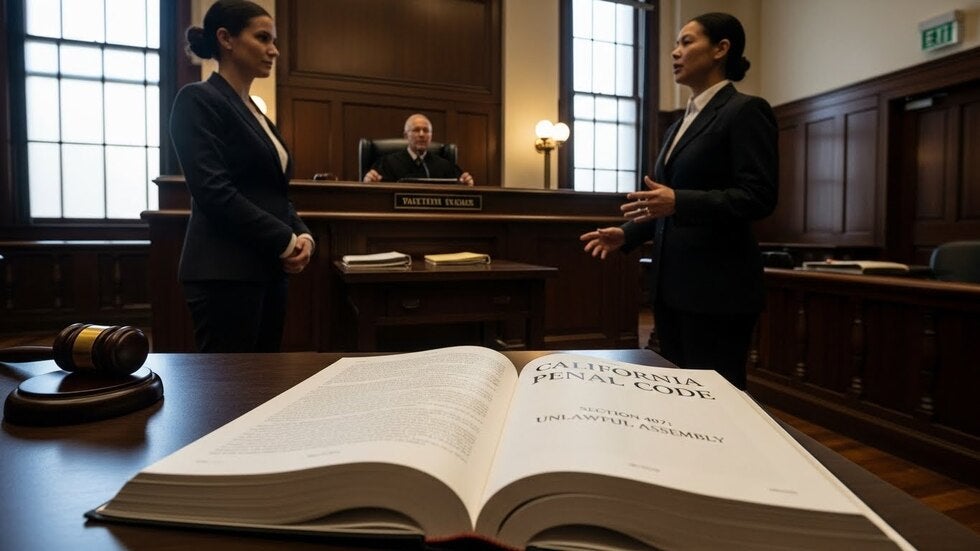
California Penal Code Section 407 defines unlawful assembly as two or more persons gathering to commit unlawful acts or performing lawful acts in violent, boisterous, or tumultuous manners. While this statute aims to prevent mob violence and public disorder, its vague language and broad scope frequently ensnare peaceful protesters, political demonstrators, and individuals exercising constitutional rights.
Understanding the specific elements prosecutors must prove and the robust defenses available becomes essential for anyone facing these charges that threaten both freedom and First Amendment rights.
What Constitutes Unlawful Assembly Under California Law
Penal Code Section 407 establishes two distinct pathways to unlawful assembly charges. The first involves two or more persons assembling to commit unlawful acts. The second addresses situations where people gather to perform lawful acts but do so in violent, boisterous, or tumultuous manners.
This dual structure means prosecutors can pursue unlawful assembly charges even when the underlying purpose of the gathering was entirely legal.
The statute's expansive language creates substantial risk of prosecutorial overreach and wrongful charges against individuals engaged in constitutionally protected activity. Terms like "boisterous" and "tumultuous" lack precise legal definitions, allowing subjective law enforcement judgments to determine what constitutes criminal assembly. This vagueness creates both constitutional concerns and significant defense opportunities.
Essential Elements the Prosecution Must Establish
Two or More Persons Assembling Together
Prosecutors must prove that at least two people assembled together. This requires more than coincidental presence at the same location. The law demands evidence of actual assembly, meaning people gathered with some degree of common purpose or coordination, not merely that multiple individuals happened to be nearby.
Defense attorneys challenge whether genuine assemblies existed. If people were simply in the same area pursuing individual activities without coordinating or gathering for shared purposes, no assembly occurred in the legal sense. This distinction protects individuals who were near others during incidents without actually assembling with them.
The assembly element also raises questions about timing and formation. At what point does mere proximity become assembly? How much coordination or shared purpose must exist? Defense counsel exploits these ambiguities to create reasonable doubt about whether assemblies actually formed.
Purpose to Commit Unlawful Acts or Manner of Performing Lawful Acts
The first pathway to unlawful assembly charges requires proving the assembly's purpose was committing unlawful acts. Prosecutors must establish that participants gathered with the specific objective of engaging in illegal conduct, not merely that illegal acts eventually occurred.
Defense attorneys argue that assemblies formed for entirely lawful purposes such as political protest, exercise of petition rights, or constitutionally protected expression. Even if some participants later engaged in unlawful conduct, this does not retroactively transform lawful assemblies into unlawful ones if the original purpose was legitimate.
The second pathway involves assemblies that pursue lawful objectives but use violent, boisterous, or tumultuous methods. This alternative creates significant constitutional concerns because it potentially criminalizes the manner of expression rather than its content, raising First Amendment issues about protecting robust political discourse.
Violent, Boisterous, or Tumultuous Manner
When prosecutors proceed under the second pathway, they must prove the assembly conducted itself in violent, boisterous, or tumultuous ways. These terms lack clear legal definitions and rely heavily on subjective characterizations of collective behavior.
What exactly constitutes boisterous conduct? Does enthusiastic chanting qualify? How about loud music or amplified speeches? The term "tumultuous" similarly defies precise definition. Does energetic protest become tumultuous simply because it makes others uncomfortable? These ambiguities create vagueness concerns and defense opportunities.
Defense counsel argues that conduct characterized as boisterous or tumultuous actually constituted protected political expression. Vigorous protest necessarily involves loud, passionate, and sometimes chaotic expression. The First Amendment protects such robust political discourse unless it crosses lines into genuine violence or true threats.
Powerful Constitutional Defenses to Unlawful Assembly Charges
First Amendment Protection for Speech and Assembly
The most critical defense in unlawful assembly cases involves First Amendment protection for freedom of speech and assembly. The Constitution protects citizens' rights to gather collectively to express political views, protest government actions, and engage in other expressive activities.
When unlawful assembly charges criminalize protected expression or assembly, they violate fundamental constitutional rights.
Defense attorneys present evidence that defendants gathered for constitutionally protected purposes such as political protest, social justice demonstration, labor organizing, or religious expression. Courts apply strict scrutiny to laws restricting these core First Amendment activities, requiring compelling governmental interests and narrowly tailored restrictions.
Even assemblies that others find offensive, disruptive, or uncomfortable receive constitutional protection. The First Amendment does not exist to protect only popular or non controversial expression. It particularly safeguards unpopular dissent and protests that challenge prevailing power structures. These principles prove decisive in many unlawful assembly defenses.
Vagueness Challenges to Statutory Language
Section 407's use of terms like "boisterous" and "tumultuous" raises serious constitutional vagueness concerns. Laws must provide clear notice of prohibited conduct and cannot be so vague that ordinary people must guess about their meaning. When statutes fail these requirements, they violate due process protections.
Defense counsel argues that Section 407's language is impermissibly vague, particularly when applied to political protests and demonstrations. If citizens cannot reasonably determine when energetic protest becomes unlawfully boisterous or when passionate demonstration crosses into tumultuous conduct, the statute fails constitutional standards.
Courts have long recognized that vague laws affecting First Amendment rights receive heightened scrutiny. When criminal statutes could chill protected expression because people fear prosecution for constitutionally protected conduct, vagueness challenges often succeed. These constitutional defenses parallel those used in other California cases involving free speech protections where vague statutory language threatens constitutional rights.
Overbreadth Doctrine
Beyond vagueness concerns, Section 407 may be unconstitutionally overbroad if it sweeps substantial amounts of protected speech and assembly within its prohibitions. The overbreadth doctrine allows defendants to challenge statutes that burden too much protected expression, even if their specific conduct might not be protected.
Defense attorneys argue that Section 407's broad language could be applied to countless lawful assemblies where participants express themselves enthusiastically, passionately, or loudly. This substantial overbreadth renders the statute facially invalid or requires narrow construction that excludes protected expression from its scope.
Challenging the Assembly Formation and Purpose
No Shared Purpose or Coordination
Defense counsel argues that defendants did not actually assemble with others for shared purposes. Perhaps they were individual protesters pursuing personal expression without coordinating with others. Maybe they were exercising individual rights that happened to occur simultaneously with others' exercises of similar rights.
Without proof of actual assembly involving shared purpose or coordination, the foundational element of unlawful assembly charges fails. This defense protects individuals who were simply in the same location as others without joining collective action.
Evidence supporting this defense includes testimony about defendants' independent decision making, lack of communication with others, individual objectives distinct from any group purpose, and absence of coordination or joint planning. This establishes that no assembly occurred in the legal sense.
Lawful Purpose Assembly
When prosecutors allege assemblies formed to commit unlawful acts, defense attorneys present evidence that the actual purpose was entirely lawful. Political protest, petition of government for redress of grievances, social justice demonstration, religious gathering, and similar objectives are not only lawful but constitutionally protected.
The fact that some individuals within larger gatherings may have engaged in unlawful conduct does not transform the entire assembly into an unlawful one. Defense counsel distinguishes between the assembly's legitimate purpose and any unauthorized criminal acts by individuals who may have exploited the gathering.
This defense requires presenting evidence of stated purposes, organizational planning documents, witness testimony about objectives, and other proof establishing that the assembly formed for lawful reasons even if some participants later acted unlawfully.
Distinguishing Protected Expression from Criminal Conduct
The Line Between Boisterous and Unlawfully Tumultuous
Political protest and demonstration necessarily involve energetic, loud, and sometimes chaotic expression. Defense attorneys argue that what prosecutors characterize as unlawfully boisterous or tumultuous actually constituted protected vigorous political expression.
The Supreme Court has long recognized that effective political expression often involves discord, disruption, and conduct that others find offensive or uncomfortable. Democracy depends on citizens' ability to express strong dissent and engage in robust debate. These constitutional principles constrain how broadly unlawful assembly statutes can be applied to political gatherings.
Defense counsel presents evidence that the assembly's conduct, while perhaps loud or energetic, remained within bounds of protected expression. Chanting, singing, amplified speeches, and passionate demonstrations do not become criminal simply because they are boisterous. Without genuine violence or true threats, such expression deserves constitutional protection.
Peaceful Assembly Disrupted by Others
Many unlawful assembly charges arise from situations where peaceful assemblies were disrupted by counter protesters, provocateurs, or law enforcement actions. Defense attorneys investigate whether defendants maintained peaceful conduct while others initiated violence or chaos.
If the assembly began peacefully and remained so until outside forces disrupted it, participants cannot be held criminally liable for others' unlawful actions. This defense requires careful evidence analysis showing that defendants did not participate in or encourage violence but were victims of disruption by others.
Video evidence frequently reveals that police tactics or counter protester violence transformed peaceful gatherings into chaotic situations. Defense counsel uses this evidence to establish that any violence or tumult was not inherent to the assembly but was imposed by external forces.
Mere Presence and Lack of Participation
Being Present Is Not Criminal
Perhaps the most fundamental principle in unlawful assembly defense is that mere presence at a gathering that becomes unlawful does not establish criminal liability. Prosecutors must prove defendants actually participated in the unlawful assembly, not simply that they were nearby when it occurred.
Defense attorneys present evidence that defendants were passive observers, bystanders caught in situations they did not create, or individuals attempting to leave when circumstances became problematic. Without proof of active participation in the assembly's unlawful aspects, guilt cannot be established.
This defense proves especially effective when video evidence shows defendants standing peacefully, trying to exit the area, or actively discouraging violence. Such evidence directly contradicts prosecution claims that defendants participated in unlawful assemblies.
Withdrawal and Dissociation
Even if defendants initially participated in assemblies that later became unlawful, evidence of withdrawal or dissociation provides a defense. Defense counsel presents testimony showing defendants left when situations escalated, verbally objected to unlawful conduct, or otherwise disengaged from problematic aspects of gatherings.
The law recognizes that people should not face criminal liability for others' subsequent actions after they ceased participation and distanced themselves from unlawful conduct. This withdrawal defense requires clear evidence of temporal separation between defendants' participation and any unlawful activity.
Selective Enforcement and Equal Protection
Investigating Prosecution Patterns
Defense attorneys investigate whether unlawful assembly charges are selectively brought against individuals based on political viewpoints, racial characteristics, or other impermissible factors. Evidence of selective prosecution violates equal protection guarantees and provides grounds for dismissal.
If similarly situated individuals who participated in assemblies with different political orientations faced no charges, or if prosecution patterns reveal bias against particular movements or viewpoints, this discriminatory enforcement defeats prosecution legitimacy. Defense counsel presents statistical analysis and comparative case studies establishing selective charging practices.
Viewpoint Discrimination
When unlawful assembly charges systematically target protesters expressing particular political views while ignoring identical conduct by those with different perspectives, viewpoint discrimination occurs. The First Amendment absolutely forbids government from suppressing expression based on the ideas or messages conveyed.
Defense attorneys document instances where right wing and left wing assemblies received disparate treatment, where police tolerated similar conduct from favored groups while arresting disfavored protesters, or where charging decisions reflected political bias. This evidence of viewpoint discrimination can result in dismissals or suppression of evidence obtained through discriminatory enforcement.
Police Conduct and Provocations
Unlawful Dispersal Orders
Many unlawful assembly cases involve police dispersal orders that may themselves be unlawful. Defense attorneys investigate whether officers had legitimate authority to issue dispersal orders, whether orders were clearly communicated, and whether people had reasonable opportunities to comply before arrests occurred.
If dispersal orders were unlawful, arrests following those orders may also be unlawful. This undermines prosecution cases because evidence of unlawful assembly often comes from circumstances surrounding arrests pursuant to invalid dispersal orders.
Police Escalation and Entrapment
Defense counsel examines whether police tactics escalated situations or entrapped defendants into unlawful conduct. If undercover officers or provocateurs encouraged violence, if police used unnecessary force that prompted defensive reactions, or if law enforcement created dangerous situations, this context becomes critical for defense.
Evidence that police provoked or manufactured unlawful assembly situations provides powerful defenses. The government cannot create crimes through its own misconduct and then prosecute those who responded to that misconduct.
Evidence Collection and Trial Strategy
Comprehensive Video Documentation
Modern protests and public gatherings are extensively documented through multiple video sources. Defense attorneys obtain all available footage from defendants, witnesses, media coverage, surveillance cameras, and police body cameras. This evidence often contradicts prosecution narratives about unlawful assemblies.
Video can definitively establish that assemblies remained peaceful, that defendants did not participate in unlawful conduct, or that police or counter protesters initiated violence. Defense counsel uses this powerful evidence to create reasonable doubt or secure pre trial dismissals.
Expert Testimony on Protest Dynamics
Defense attorneys sometimes present expert testimony from academics, civil rights advocates, or crowd dynamics specialists who can explain how protests develop, how police tactics affect crowd behavior, and how to distinguish lawful assembly from unlawful conduct.
These experts provide valuable context helping judges and juries understand that conduct prosecutors characterize as unlawful actually fell within normal bounds of protected political demonstration. Expert testimony proves particularly valuable in cases involving novel protest tactics or unfamiliar forms of collective expression.
Why Immediate Legal Representation Matters
Unlawful assembly cases involve complex constitutional issues, rapidly evolving factual scenarios, and significant stakes for defendants' freedom and First Amendment rights. Early legal representation allows defense attorneys to preserve evidence, identify witnesses, and begin constitutional challenges before cases progress too far. The defense strategies employed often mirror approaches used in other California protest related prosecutions where constitutional rights intersect with public order concerns.
Moving Forward After Unlawful Assembly Charges
Unlawful assembly charges do not automatically result in conviction. Prosecutors face substantial burdens proving assembly formation, unlawful purpose or manner, and defendant participation while respecting constitutional protections for speech and assembly.
First Amendment defenses, vagueness challenges, and participation disputes provide powerful tools for securing favorable outcomes including dismissals, acquittals, or reduced charges that protect your freedom and constitutional rights to engage in collective political expression.
Contact our firm today by email or by calling (888) 928-1609.