
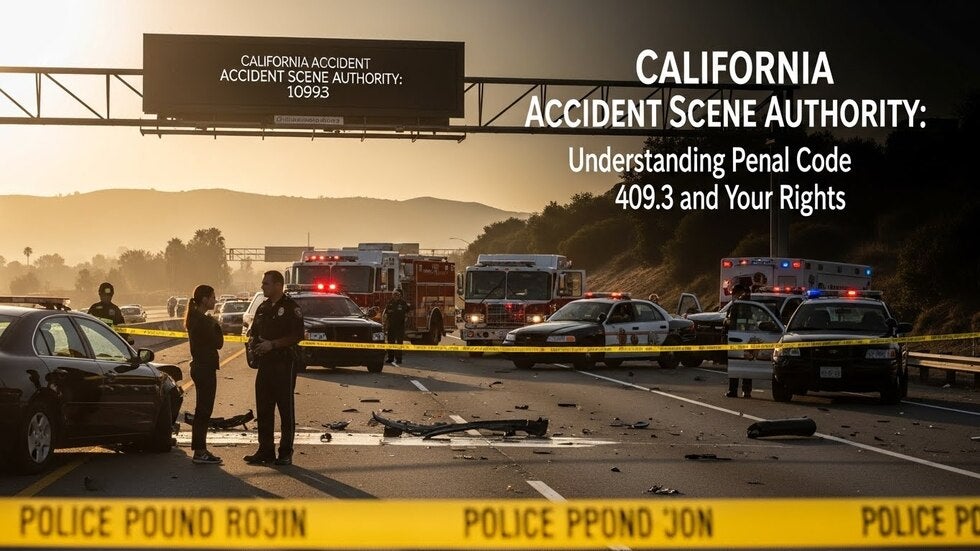
California Penal Code Section 409.3 establishes clear lines of authority when law enforcement and emergency medical personnel respond to accident scenes. This statute designates law enforcement as the primary coordinator of scene operations while preserving medical professionals' authority over patient care decisions.
Understanding this framework becomes essential when accidents lead to criminal investigations, disputes about evidence collection, or questions about whether responders exceeded their legal authority.
This comprehensive guide examines Section 409.3 from a defense perspective, exploring how accident scene management affects your rights and what protections exist when law enforcement actions at accident scenes lead to criminal charges.
The Division of Authority at Accident Scenes
Section 409.3 creates a dual authority structure recognizing that accident scenes require both operational coordination and specialized medical care. The statute addresses potential conflicts by clearly defining which agency controls different aspects of emergency response.
Law enforcement receives authority for managing the overall scene, meaning coordinating the various operations occurring at accident locations. This management role includes controlling traffic, securing perimeters, directing the positioning of emergency vehicles, coordinating communications between agencies, ensuring responder safety, and making decisions about when and how scenes should be cleared.
The operational authority vested in law enforcement reflects practical realities of emergency response. Police agencies have training, resources, and legal powers suited to managing chaotic situations involving multiple agencies, curious bystanders, traffic hazards, and potential criminal evidence.
Designating a single coordinating authority prevents confusion and conflicting directions that could compromise both responder safety and effective emergency operations.
However, Section 409.3 explicitly limits law enforcement's authority over patient care decisions. Medical treatment determinations remain with emergency medical personnel according to Health and Safety Code Section 1798.6, which establishes protocols for medical care at emergency scenes. This limitation recognizes that medical professionals possess specialized expertise that law enforcement officers typically lack and that patient welfare requires medical rather than law enforcement control over treatment decisions.
What Scene Management Authority Includes
The statute defines scene management as coordinating operations at accident locations, but this general description leaves questions about the specific powers law enforcement may exercise under this authority.
Understanding the scope and limits of these powers matters when evaluating whether officers exceeded their authority in ways affecting criminal cases.
Scene management authority typically includes establishing perimeters to keep unauthorized persons away from accident locations. Officers may cordon off areas using tape, cones, vehicles, or physical presence to create secure zones where emergency operations can proceed without interference.
These perimeters serve legitimate safety purposes by protecting responders and preventing contamination of potential evidence.
Traffic control represents another core component of scene management. Officers direct vehicles around accident locations, establish detours, close roads when necessary, and coordinate the flow of emergency vehicles arriving and departing. These traffic management functions prevent additional accidents and ensure emergency responders can access scenes efficiently.
Coordination between responding agencies falls squarely within law enforcement's management role. Officers communicate with fire departments, emergency medical services, tow truck operators, and other entities responding to accidents. This coordination ensures appropriate resources deploy effectively and that different agencies work together rather than at cross purposes.
Evidence preservation and collection occur within law enforcement's scene management authority when accidents involve potential criminal conduct. Officers photograph scenes, measure skid marks, document vehicle positions, collect physical evidence, and interview witnesses. This investigative work proceeds under the umbrella of coordinating operations at accident locations.
The Limits of Law Enforcement Authority
While Section 409.3 grants law enforcement significant scene management powers, important limitations protect individuals' rights and preserve other agencies' appropriate authority. Understanding these boundaries helps identify when officers exceeded their lawful authority in ways that might affect criminal prosecutions.
Law enforcement cannot override medical personnel's patient care decisions even when officers might prefer different treatment approaches. If paramedics determine that injured persons require immediate transport to hospitals, police cannot delay that transport to complete accident investigations or evidence collection. Patient welfare takes priority over law enforcement interests in preserving evidence or conducting thorough scene investigations.
The statute requires law enforcement representatives to consult with other response agencies to ensure proper resource utilization. This consultation requirement prevents unilateral police decision making that ignores the expertise and needs of fire departments, emergency medical services, and other responding entities. Officers who fail to consult appropriately may exceed their statutory authority.
Scene management authority does not eliminate constitutional protections against unreasonable searches and seizures. While officers may secure accident scenes and collect evidence visible in plain view, they cannot use accident response as a pretext for searches that would otherwise require warrants.
The Fourth Amendment continues applying at accident scenes despite law enforcement's coordinating role.
Officers cannot detain witnesses or involved parties longer than reasonably necessary for scene investigation and safety purposes. While some detention may be justified to identify witnesses, ensure they do not leave before providing contact information, or prevent interference with emergency operations, extended detentions transform into arrests requiring probable cause.
When Accident Scenes Become Criminal Investigations
Many accidents involve no criminal conduct, but some crashes result from driving under the influence, reckless driving, vehicular manslaughter, or other offenses. The transition from accident response to criminal investigation raises important questions about law enforcement authority and individuals' rights.
Section 409.3 provides law enforcement with legitimate access to accident scenes and authority to coordinate operations that naturally include investigating whether criminal conduct contributed to crashes.
Officers who observe evidence of intoxication, recklessness, or other criminal activity while managing accident scenes may investigate those potential crimes without exceeding their statutory authority.
However, the line between legitimate scene management and investigative overreach sometimes blurs. Defense attorneys examine whether officers used their coordinating authority as cover for investigations that extended beyond what accident scenes reasonably required. Evidence obtained through investigative activities exceeding reasonable accident scene management may be subject to suppression if officers violated constitutional rights.
DUI investigations frequently arise at accident scenes, and the intersection of medical care and law enforcement interests creates tensions. Officers want to conduct sobriety tests and collect evidence before medical treatment eliminates signs of intoxication. Medical personnel prioritize patient care regardless of whether treatment interferes with evidence collection.
Section 409.3's framework protects medical decision making authority, but officers sometimes pressure medical staff to delay treatment or allow evidence collection that compromises patient care.
Blood Draws and Medical Evidence
Accidents resulting in injuries often lead to questions about blood draws and medical evidence collected during emergency treatment. Understanding what law enforcement can and cannot access under Section 409.3 affects criminal defense strategies in cases involving this evidence.
Medical personnel draw blood for treatment purposes to assess injuries, determine appropriate care, and monitor patient conditions. These treatment based blood draws occur under medical authority rather than law enforcement direction. However, police often seek access to blood test results when investigating potential DUI or other criminal cases.
Law enforcement cannot compel medical personnel to draw blood for criminal investigative purposes without proper legal authorization. While Section 409.3 grants scene management authority, it does not override requirements that officers obtain warrants, consent, or operate within recognized exceptions to warrant requirements when seeking blood evidence.
Medical professionals' duty to patients takes precedence over law enforcement investigative interests. Doctors and nurses cannot delay necessary medical treatment to accommodate police evidence collection desires when such delays would compromise patient care. Section 409.3's explicit preservation of medical authority over patient care decisions protects this treatment priority.
Questions arise about whether blood drawn for medical purposes can be used as criminal evidence without warrants. Courts have addressed these issues in various contexts, with outcomes depending on factors including whether patients consented to testing, whether medical personnel acted independently versus at police direction, and whether obtaining warrants would have been feasible.
Challenging Evidence from Accident Scenes
When criminal charges arise from accidents, defendants may challenge evidence by arguing that law enforcement exceeded the authority Section 409.3 provides. Several grounds support such challenges depending on case circumstances.
Officers who override medical personnel's patient care decisions violate Section 409.3's framework and potentially the Fourth Amendment. Evidence obtained through such violations may be suppressible, particularly when officers coerced medical staff into delaying treatment, conducting tests, or providing information that medical judgment would not otherwise support.
Searches extending beyond what accident scene management reasonably requires may violate constitutional protections. While officers may document scenes and collect evidence in plain view, they cannot conduct detailed vehicle searches, inventory belongings beyond what safety requires, or use accident response as pretext for investigations unrelated to the crashes.
Extended detentions at accident scenes sometimes cross the line from legitimate scene management into arrests requiring probable cause. Defense attorneys argue that officers who detained clients for extended periods, transported them to police stations, or otherwise restricted their freedom beyond what accident coordination required transformed permissible detentions into unlawful arrests, tainting any resulting evidence.
Failures to consult with other response agencies as Section 409.3 requires may indicate that officers exceeded their authority or acted unreasonably. Evidence that police ignored or overrode other agencies' expertise and recommendations suggests that officers abused their coordinating role rather than properly managing multi agency responses.
Medical Personnel as Witnesses
Healthcare providers who treat accident victims often become important witnesses in criminal cases, and their testimony about accident scenes, patient statements, and treatment decisions significantly affects prosecution and defense strategies.
Medical personnel can testify about patients' physical conditions, injuries observed, statements made during treatment, and their professional assessments of how injuries occurred. This testimony often proves crucial in cases involving disputed facts about accident causation, driver identity, or whether injuries resulted from crashes or other causes.
However, medical witnesses' loyalty lies with patients rather than prosecution or defense. Healthcare providers focus on delivering appropriate care rather than building criminal cases. This medical priority sometimes frustrates law enforcement when doctors or nurses prioritize treatment over evidence preservation or refuse to conduct tests or procedures primarily serving investigative rather than medical purposes.
Defense attorneys value medical testimony showing that officers interfered with appropriate care, pressured medical staff inappropriately, or otherwise compromised the treatment process. Healthcare providers who testify that police demands delayed necessary treatment or created conflicts with medical judgment support arguments that officers exceeded their authority and violated defendants' rights.
The Interplay with Other Accident Scene Statutes
Section 409.3 operates alongside other California statutes governing accident scenes, and understanding how these provisions interact provides complete context for evaluating law enforcement authority and individual rights.
Penal Code Section 409 authorizes law enforcement to close areas around disasters, riots, and emergency scenes to protect public safety and preserve evidence. This general authority complements Section 409.3's specific framework for accidents, providing broader closure powers extending beyond the immediate accident locations when circumstances require.
Vehicle Code provisions require drivers involved in accidents to stop, exchange information, and report crashes meeting specified criteria. These statutory duties exist independently of Section 409.3's authority structure, creating obligations that apply regardless of whether officers exercise scene management powers.
Health and Safety Code Section 1798.6, referenced in Section 409.3, establishes detailed protocols for emergency medical services operations. This parallel statute creates the medical authority framework that Section 409.3 explicitly preserves, preventing law enforcement scene management from interfering with appropriate patient care.
Practical Implications for Accident Participants
Understanding Section 409.3 helps individuals involved in accidents navigate interactions with law enforcement and protect their rights during what are often traumatic and confusing situations.
Recognize that officers coordinating accident scenes have legitimate authority to control traffic, establish perimeters, and direct various response operations. Cooperating with reasonable directions serves both public safety and your own interests.
Refusing to follow lawful instructions can result in additional charges for obstructing officers even when you violated no laws related to the accident itself.
However, scene management authority does not eliminate your constitutional rights. You retain rights against unreasonable searches, rights to decline answering questions beyond basic identification information, and rights to request medical care without police interference. Asserting these rights respectfully but firmly protects your interests when accidents lead to criminal investigations.
If you need medical treatment, communicate that need clearly to both medical personnel and law enforcement. Section 409.3 prioritizes your medical care over police investigative interests, but you must make your need for treatment known. Medical professionals will advocate for appropriate care, but they need to understand your conditions and concerns.
Document your interactions with law enforcement and medical personnel to the extent possible given your circumstances. Mental notes about what officers said, what medical care you received, timing of various events, and other details help your attorney evaluate whether responders acted within their authority if criminal charges later arise.
Defending Against Charges Arising from Accident Scenes
When accidents lead to criminal charges for DUI, reckless driving, vehicular manslaughter, or other offenses, examining how law enforcement exercised its Section 409.3 authority provides important defense opportunities.
Review whether officers properly balanced their scene management role with your constitutional rights. Evidence obtained through searches, seizures, or questioning exceeding reasonable accident response may be suppressible. Criminal defense attorneys carefully analyze what authority officers properly exercised versus when they crossed into investigative territory requiring additional legal justification.
Examine interactions between police and medical personnel to identify instances where officers improperly influenced medical decisions or evidence collection. Healthcare providers who testify that officers pressured them to conduct tests, delay treatment, or provide information they would not otherwise disclose support arguments that evidence should be excluded.
Challenge the foundational facts officers claim justified their actions. If police assert that you appeared intoxicated, drove recklessly, or engaged in other criminal conduct, demanding proof beyond their subjective observations forces prosecution to provide concrete evidence rather than relying on officer opinions made during chaotic accident responses.
Investigate whether alternative explanations account for evidence that prosecutors claim demonstrates criminal conduct. Medical conditions, accident trauma, prescription medications, or other lawful factors sometimes create appearances that officers misinterpret as intoxication or criminal behavior.
Moving Forward After Accident Related Charges
Facing criminal charges arising from accidents creates enormous stress as you simultaneously deal with potential injuries, vehicle damage, insurance issues, and the criminal justice system. Understanding how Section 409.3 structured the emergency response that led to your charges helps you and your attorney identify whether responders acted appropriately or exceeded their authority in ways affecting your case.
While California law gives law enforcement important scene management powers at accidents, those powers remain limited by constitutional protections, medical personnel's independent authority, and requirements that officers coordinate reasonably with other responding agencies. When officers exceed these boundaries, evidence they collect may be challengeable, and charges they recommend may not withstand scrutiny.
Whether your case involves DUI allegations, vehicular manslaughter charges, or other criminal counts arising from accidents, thorough examination of how law enforcement exercised its Section 409.3 authority provides essential context for developing effective defense strategies. Officers who properly managed accident scenes while respecting constitutional rights and medical authority conducted lawful investigations.
Those who used coordinating authority as cover for rights violations or who interfered with appropriate medical care exceeded their lawful powers in ways that should benefit your defense.
Understanding these principles and working with attorneys who recognize the limits on law enforcement accident scene authority protects your rights during what may be one of the most difficult experiences of your life.
Contact the attorneys of Bulldog Law today, at (888) 928-1609 or send us an email.