
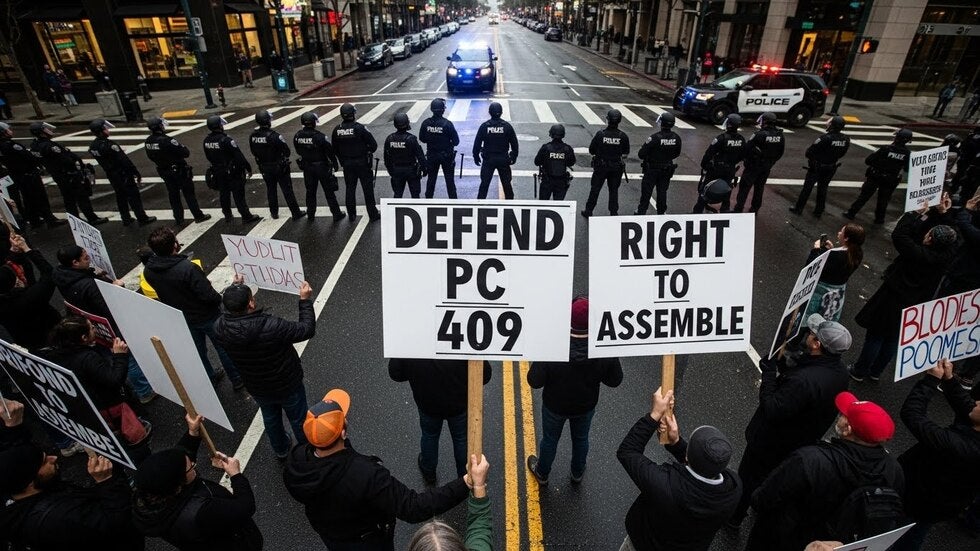
California Penal Code Section 409 criminalizes remaining at the location of a riot, rout, or unlawful assembly after receiving lawful warning to disperse. This misdemeanor charge frequently arises during protests, demonstrations, and civil disturbances, often sweeping up peaceful protesters, journalists, legal observers, and residents simply trying to navigate their neighborhoods. Understanding the specific elements prosecutors must prove and the constitutional defenses available becomes essential for protecting your rights and freedom when facing these charges.
Understanding California's Failure to Disperse Law
Penal Code Section 409 makes it a misdemeanor to remain present at riot, rout, or unlawful assembly locations after receiving lawful dispersal warnings. The statute exempts public officers and persons assisting them in dispersal efforts. While this law aims to enable law enforcement to safely clear dangerous situations, its application frequently violates constitutional rights and punishes individuals engaged in protected activity.
The statute's enforcement depends entirely on underlying determinations that riots, routs, or unlawful assemblies exist. If those foundational characterizations are incorrect, all subsequent dispersal orders and arrests become unlawful. This creates substantial defense opportunities by challenging whether situations truly warranted dispersal orders in the first place.
Critical Elements the Prosecution Must Prove
Existence of a Riot, Rout, or Unlawful Assembly
Prosecutors must first establish that an actual riot, rout, or unlawful assembly was occurring. This requires satisfying all elements of those underlying offenses, including specific numbers of participants, types of conduct, and other statutory requirements. Without proving the foundational disorder, Section 409 charges cannot be sustained.
Defense attorneys vigorously challenge whether situations truly constituted riots, routs, or unlawful assemblies. Many dispersal orders are issued against peaceful protests, lawful demonstrations, or constitutionally protected assemblies that do not meet legal definitions of disorder requiring dispersal. If the underlying gathering was lawful, dispersal orders were invalid and compliance was not required.
This defense requires understanding the precise legal definitions of riots, routs, and unlawful assemblies under California law. Defense counsel presents evidence that gatherings were peaceful, that participants engaged in protected expression, or that conduct did not satisfy elements of the underlying offenses prosecutors claim justified dispersal.
Lawful Warning to Disperse
The statute requires that dispersal warnings be lawful. This element demands more than simply that officers issued warnings. The warnings must have been legally justified, properly communicated, and reasonable under the circumstances. Unlawful dispersal orders provide no basis for Section 409 prosecution.
Defense attorneys investigate whether officers had legitimate authority to issue dispersal orders given actual circumstances. If situations did not genuinely constitute riots, routs, or unlawful assemblies, dispersal orders lacked legal foundation regardless of what officers claimed at the time.
The warning must also be clearly communicated in ways that people present could actually receive and understand. Warnings shouted over loudspeakers drowned out by crowd noise, issued in languages participants don't understand, or given from locations where they couldn't be heard do not constitute lawful warnings for Section 409 purposes.
Remaining Present After Warning
Prosecutors must prove defendants remained present after receiving lawful dispersal warnings. This requires establishing that defendants actually heard and understood warnings, had reasonable opportunities to leave, and chose to stay rather than immediately attempting to comply.
Defense counsel challenges whether defendants actually received warnings. In chaotic situations with noise, confusion, and crowds, many people never hear dispersal orders. Without proof that specific defendants received warnings, the remaining present element cannot be satisfied.
Additionally, defense attorneys present evidence that defendants were attempting to leave when arrested. Police often give inadequate time for compliance, fail to provide clear exit routes, or arrest people who are actively trying to disperse. If defendants were making good faith efforts to comply when arrested, they were not unlawfully remaining present.
Defendant Was Not Exempt
The statute exempts public officers and persons assisting them in dispersal efforts. Additionally, courts recognize implicit exemptions for other categories including journalists covering events, legal observers monitoring police conduct, medical personnel providing aid, and residents trying to reach homes.
Defense attorneys argue that defendants fell within recognized exemptions. Journalists have First Amendment rights to document public events including police dispersal actions. Legal observers serve vital oversight functions. Residents cannot be criminally punished for trying to reach their homes. These exemptions limit Section 409's scope and protect important societal interests.
Powerful Constitutional Defenses
First Amendment Protection for Protest and Assembly
The most critical defense involves First Amendment protection for freedom of speech and assembly. Citizens possess constitutional rights to protest, demonstrate, and collectively express political views. When Section 409 prosecutions effectively criminalize protected expression, they violate fundamental constitutional rights.
Defense counsel presents evidence that defendants were engaged in peaceful protest, political demonstration, or other constitutionally protected assembly. Even if police issued dispersal orders, those orders cannot lawfully compel cessation of protected First Amendment activity absent compelling justification and narrowly tailored means.
Courts apply strict scrutiny to laws restricting First Amendment rights, requiring government to prove compelling interests and demonstrate that restrictions are necessary and narrowly tailored. Many dispersal orders fail these requirements because they broadly suppress protected expression rather than targeting specific unlawful conduct.
The First Amendment particularly protects political protest and dissent against government actions. When dispersal orders systematically silence protesters criticizing police or government, serious constitutional violations occur. Defense attorneys highlight these First Amendment concerns when challenging Section 409 prosecutions arising from political demonstrations. These constitutional protections appear throughout California cases involving protest rights where government authority collides with expressive freedoms.
Fourth Amendment Challenges to Unlawful Detention
Section 409 arrests must be supported by probable cause under the Fourth Amendment. Defense attorneys argue that arrests lacked probable cause when dispersal orders were unlawful, when defendants were attempting to comply, or when officers arrested people who never received warnings.
If arrests violated Fourth Amendment protections, evidence obtained through those unlawful arrests should be suppressed. This can result in case dismissals when prosecution cases depend on evidence obtained during or after unconstitutional arrests.
Due Process and Vagueness Concerns
Section 409's application raises due process concerns when dispersal orders are vague, contradictory, or impossible to obey. If people of common intelligence cannot determine what compliance requires, due process violations occur.
Defense counsel presents evidence that dispersal orders were confusing, that police provided conflicting directions about where to go, or that exit routes were blocked making compliance impossible. When government creates situations where law abiding citizens cannot reasonably comply with orders, prosecuting them violates fundamental fairness.
Challenging the Lawfulness of Dispersal Orders
No Underlying Riot, Rout, or Unlawful Assembly
The most powerful defense often involves proving that no riot, rout, or unlawful assembly actually existed to justify dispersal orders. Defense attorneys present video evidence, witness testimony, and expert analysis establishing that gatherings were peaceful, lawful, and constitutionally protected.
If the underlying gathering was lawful, dispersal orders were invalid regardless of what officers claimed. Police cannot transform lawful assemblies into unlawful ones simply by declaring them riots and ordering dispersal. The actual character of gatherings determines whether dispersal authority exists.
This defense requires careful analysis of what actually occurred versus what police characterized in reports or testimony. Video evidence frequently reveals that police described peaceful protests as riots or characterized lawful demonstrations as unlawful assemblies without factual basis.
Disproportionate Response to Minor Disorder
Even if some unlawful conduct occurred within larger gatherings, dispersal of entire assemblies may be constitutionally impermissible if disproportionate to actual disorder. Courts recognize that minor violations by individuals within otherwise lawful assemblies do not justify wholesale suppression of protected assembly rights.
Defense attorneys argue that isolated incidents of unlawful conduct should be addressed through targeted arrests of specific violators rather than mass dispersal orders affecting hundreds of peaceful protesters. This proportionality principle protects First Amendment rights from excessive government suppression.
Pretextual Dispersal Orders
Defense counsel investigates whether dispersal orders were pretextual attempts to suppress protected expression rather than legitimate responses to genuine disorder. If evidence shows that police issued dispersal orders to silence protesters or prevent criticism rather than address actual safety concerns, constitutional violations occurred.
Patterns of dispersal orders consistently targeting particular political viewpoints, issued against peaceful protests while ignoring similar gatherings with different messages, or deployed to prevent media coverage of police conduct all suggest pretextual motivation that violates First Amendment rights.
The Warning Requirement and Its Limitations
Adequacy of Warning Communications
Lawful warnings require clear communication that people present can actually receive and understand. Defense attorneys challenge adequacy of warning communications through evidence about noise levels, crowd sizes, warning methods, and whether defendants could reasonably have heard or understood orders.
Many dispersal situations involve loud crowds, ambient noise, and chaotic circumstances making it impossible for many people to hear warnings. If warnings were inadequate to reach defendants, they cannot be prosecuted for failing to comply with orders they never received.
Defense counsel presents expert testimony about sound propagation, crowd dynamics, and communication effectiveness in protest environments. This evidence establishes that purported warnings could not have reached significant portions of crowds, defeating prosecution claims that everyone present received lawful warnings.
Reasonable Time for Compliance
Even when warnings are adequately communicated, people must receive reasonable time to comply before arrests occur. Defense attorneys present evidence that police gave inadequate compliance time, arrested people immediately after warnings, or failed to account for difficulties dispersing through crowded areas.
What constitutes reasonable time depends on circumstances including crowd size, available exit routes, and physical barriers to movement. Defense counsel argues that arrests occurring minutes after warnings, when hundreds of people were trying to disperse through limited exits, violated reasonable compliance time requirements.
Blocked Exit Routes and Impossible Compliance
Police frequently issue dispersal orders while simultaneously blocking exit routes, a tactic called "kettling" that makes compliance impossible. Defense attorneys present evidence that officers blocked streets, prevented people from leaving areas, or created situations where compliance was physically impossible.
When government makes compliance impossible and then arrests people for non compliance, fundamental fairness is violated. These situations demonstrate that arrests were not about enforcing legitimate dispersal orders but rather about punishing protected expression or mass arresting protesters.
Exemptions and Special Status Defenses
Journalists and Media Representatives
Journalists possess First Amendment rights to document public events including police actions and protest dispersals. Courts recognize that arresting journalists under Section 409 raises serious constitutional concerns about press freedom and public accountability.
Defense attorneys present evidence of press credentials, professional journalism activities, and news gathering purposes establishing that defendants were engaged in protected journalistic work. Even without formal credentials, individuals engaged in documentary activities or citizen journalism may receive similar protections.
The public interest in documenting police conduct during protests and dispersals weighs heavily against Section 409 prosecutions of journalists. Defense counsel argues that arresting media representatives violates press freedom and deprives the public of vital information about government actions.
Legal Observers and Civil Rights Monitors
Legal observers who monitor police conduct during protests serve important oversight functions protecting constitutional rights. Defense attorneys argue that arresting legal observers under Section 409 interferes with vital civil rights protections and accountability mechanisms.
Organizations like the National Lawyers Guild train legal observers to document police interactions with protesters. These observers provide crucial evidence about police conduct, help prevent rights violations, and support accountability for police misconduct. Prosecuting them under Section 409 undermines these important functions.
Residents and Property Owners
People who live or work in areas where dispersal orders are issued cannot be criminally punished for trying to reach their homes or businesses. Defense attorneys present evidence that defendants were residents attempting to access property, workers trying to reach employment, or individuals with legitimate reasons for being in areas beyond attending protests.
The government cannot issue dispersal orders that effectively imprison residents in their homes or prevent them from accessing property. Defense counsel argues that arresting residents for being in their own neighborhoods violates basic property rights and liberty interests.
Medical Personnel and Aid Providers
People providing medical assistance during protests may be exempt from Section 409 prosecution. Defense attorneys present evidence that defendants were medics, first aid providers, or individuals assisting injured people, activities that serve important humanitarian purposes.
Arresting medical personnel interferes with life saving activities and creates dangerous situations where injured people cannot receive necessary care. Courts recognize strong policy interests in protecting medical providers from prosecution when they assist injured protesters or others affected by civil disturbances.
Evidence and Investigation Strategies
Video Documentation Analysis
Modern protests are extensively documented through multiple video sources. Defense attorneys obtain all available footage from defendants, witnesses, media, police body cameras, and surveillance systems. This evidence often contradicts prosecution claims about riots, dispersal warnings, or defendant conduct.
Video can definitively establish that assemblies were peaceful, that defendants were attempting to leave when arrested, that warnings were inadequate, or that police blocked exit routes. Defense counsel uses this powerful evidence to secure dismissals, acquittals, or favorable plea agreements.
Witness Testimony About Conditions
Witnesses who were present provide crucial testimony about actual conditions, whether warnings were audible, what exit routes existed, and how police conducted dispersals. Defense attorneys identify and interview witnesses whose accounts support defenses or create reasonable doubt about prosecution claims.
These witnesses can testify that defendants were trying to comply, that warnings were inaudible, that police prevented dispersal, or that no riot or unlawful assembly actually occurred. Compelling witness testimony often proves decisive in Section 409 cases.
Selective Enforcement and Discriminatory Prosecution
Political Viewpoint Discrimination
Defense attorneys investigate whether Section 409 charges are selectively brought against individuals expressing particular political views. Evidence of viewpoint discrimination violates First Amendment and equal protection guarantees.
If protests with different political orientations receive disparate treatment, with police tolerating some assemblies while aggressively dispersing others, this discriminatory enforcement defeats prosecution legitimacy. Defense counsel documents these patterns through statistical analysis and comparative case studies.
Why Experienced Legal Representation Is Essential
Section 409 cases involve complex constitutional issues, factual disputes about chaotic events, and significant implications for First Amendment rights. Early legal representation allows comprehensive investigation, evidence preservation, and constitutional challenges that dramatically improve outcomes. The defense strategies mirror those used in other California cases protecting protest and assembly rights where constitutional freedoms intersect with criminal charges.
Moving Forward After Section 409 Charges
Section 409 charges do not automatically result in conviction. Prosecutors face substantial burdens proving underlying disorder, lawful warnings, actual notice to defendants, and reasonable compliance opportunities while respecting constitutional protections. First Amendment defenses, warning inadequacy challenges, and impossibility of compliance arguments provide powerful tools for securing dismissals, acquittals, or favorable resolutions that protect your freedom and right to engage in political expression. If you are facing Section 409 charges, contact Bulldog Law to speak with experienced criminal defense attorneys who understand how to challenge unlawful arrests and protect your constitutional rights.