
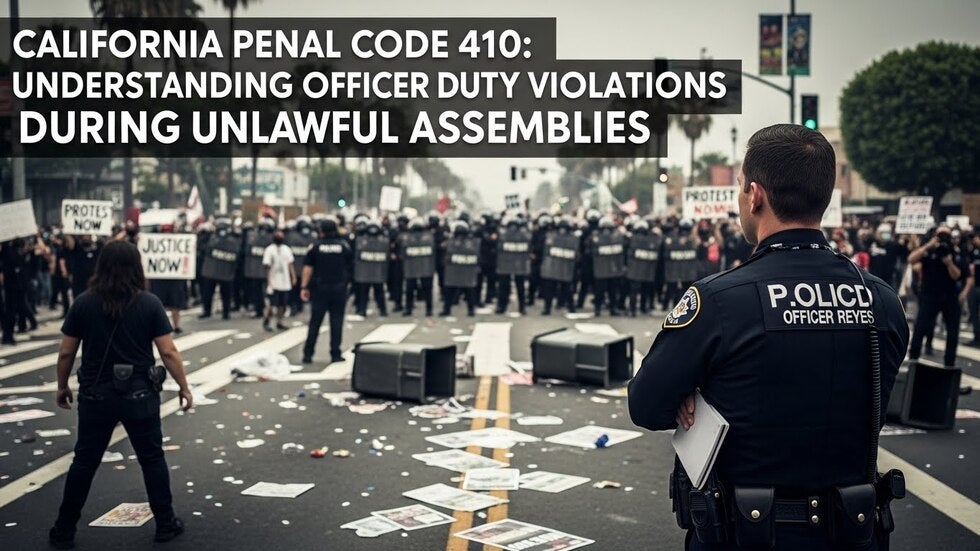
California Penal Code 410 addresses a unique situation: when law enforcement officers or magistrates fail to respond to unlawful assemblies. While this statute targets official misconduct rather than citizen behavior, understanding it provides crucial context for defending various assembly related charges and reveals important limitations on government authority during civil disturbances.
What Does Penal Code 410 Actually Say?
This statute creates criminal liability for magistrates and officers who neglect their duty to respond to unlawful or riotous assemblies. When these officials receive notice of such gatherings and fail to proceed to the location or exercise their authority to suppress the assembly and arrest offenders, they commit a misdemeanor.
The law's existence reveals important principles about how California law views unlawful assemblies and the obligations placed on government officials. These principles create defense opportunities for individuals charged with assembly related offenses.
Historical Context and Modern Application
Penal Code 410 originated in an era when local magistrates held significant responsibility for maintaining public order. While the statute remains on the books, its practical application has evolved dramatically as law enforcement became professionalized and organized.
Modern law enforcement operates through established chains of command, deployment protocols, and resource allocation decisions. Officers typically cannot unilaterally decide whether to respond to reported assemblies. This organizational reality affects how courts interpret and apply Section 410.
Understanding this historical context matters for defense because it illuminates the relationship between government duty and citizen rights during assemblies. The statute presumes that authorities have obligations when assemblies occur, creating corresponding limits on their discretion.
Who Falls Under This Statute's Scope?
The law applies specifically to magistrates and officers with authority to suppress unlawful assemblies and arrest offenders. Identifying who qualifies under these categories helps establish when the statute applies.
Magistrates in this context historically meant judicial officers with authority to maintain order. In modern California, this includes judges and commissioners with relevant jurisdiction. However, Section 410 rarely applies to judicial officers today because they don't typically respond directly to assemblies.
Officers covered by this statute include peace officers as defined throughout California's Penal Code. This encompasses police officers, sheriff's deputies, California Highway Patrol officers, and other sworn law enforcement personnel with arrest authority and responsibility for maintaining public order.
The statute doesn't apply to every government employee. Civilian personnel, administrative staff, and officials without law enforcement authority fall outside its scope. This limitation matters when analyzing whether anyone violated duties triggering Section 410.
Elements That Must Be Proven
Like any criminal statute, Section 410 requires prosecutors to prove specific elements beyond reasonable doubt. Understanding these elements reveals the statute's practical limitations and defense applications.
Notice of the Assembly
Officials must have received notice of an unlawful or riotous assembly. This notice requirement is crucial. Officers cannot violate Section 410 for failing to respond to assemblies they didn't know about.
What constitutes adequate notice? Direct reports from citizens, dispatch communications, supervisor orders, and personal observation all qualify. Vague rumors or secondhand information may not satisfy this requirement, creating ambiguity in marginal cases.
The quality and specificity of notice matters. An officer who receives information about a large gathering has different notice than one who hears specific details about violence or property destruction. Courts consider whether the notice conveyed that an unlawful assembly was occurring, not just that people were gathering.
Neglect to Proceed or Exercise Authority
The statute requires that officials "neglect" their duties. Neglect implies more than simple failure to act. It suggests a culpable disregard of known obligations.
Officers must neglect to proceed to the assembly location or as near as they can safely approach. The safety qualification is significant. Officers don't violate Section 410 by declining to enter situations where they would face unreasonable danger.
Additionally, the statute requires neglect to exercise authority for suppressing the assembly and arresting offenders. This means officers who respond but fail to take appropriate action might still violate Section 410.
The Assembly Must Be Unlawful or Riotous
Section 410 only applies when the gathering constitutes an unlawful or riotous assembly as defined elsewhere in California's Penal Code. If the assembly was lawful, officers have no duty to suppress it, and Section 410 doesn't apply.
This element creates important defense implications for individuals charged with participating in unlawful assemblies. If the gathering wasn't actually unlawful, then officers didn't violate Section 410 by not suppressing it, which supports arguments that the assembly was lawful all along.
Defense Applications of Penal Code 410
While Section 410 targets official misconduct, understanding it helps defend citizens charged with assembly related offenses in several ways.
Challenging Unlawful Assembly Determinations
If you're charged with participating in an unlawful assembly, but law enforcement didn't respond or attempt to disperse the gathering, this raises questions about whether officials truly believed an unlawful assembly existed.
Officers who genuinely witness unlawful assemblies have a duty under Section 410 to respond. Their failure to do so suggests either that the assembly wasn't actually unlawful or that circumstances made response impractical. Either scenario undermines prosecution claims that you participated in criminal activity.
This defense theory works best when documented evidence shows law enforcement observed the gathering but took no action for extended periods. If officers watched peacefully and only declared an unlawful assembly hours later after specific incidents, this timeline challenges whether the entire gathering was unlawful.
Establishing Lack of Notice to Participants
Section 410's notice requirement for officers parallels notice requirements for charging participants. If officers lacked sufficient notice that a gathering was unlawful, participants likely lacked notice as well.
California law generally requires that people have clear notice before they can be convicted of unlawful assembly participation. You cannot knowingly participate in an unlawful assembly if you didn't know it was unlawful. Evidence about what law enforcement knew and when they knew it helps establish what participants could reasonably understand about the gathering's nature.
Safety Justifications Apply to Everyone
Section 410 excuses officers from responding when doing so would be unsafe. This same principle applies to dispersal orders given to assembly participants.
If conditions made it unsafe for trained, equipped officers to approach an assembly, those conditions also affected participants' ability to safely disperse when ordered. You cannot be convicted for failing to disperse if dispersing would have been dangerous, just as officers aren't required to enter dangerous situations.
This defense requires evidence about conditions at the time. Testimony from participants, video footage, and even law enforcement reports about why they delayed response all support this argument.
Practical Realities of Law Enforcement Response
Modern policing involves complex tactical decisions during civil disturbances. Understanding these realities helps contextualize Section 410 and related defenses.
Resource Allocation Decisions
Law enforcement agencies must prioritize limited resources when multiple incidents occur simultaneously. Officers may be aware of an assembly but assigned to more urgent matters. These allocation decisions generally don't violate Section 410 because they represent reasonable exercise of discretion rather than neglect.
However, resource constraints that prevent adequate response to assemblies may support defenses for participants. If law enforcement lacked capacity to manage a situation properly, this undermines claims that participants should have immediately complied with dispersal orders or that the assembly was properly controlled.
Tactical Considerations
Modern crowd control doctrine sometimes involves monitoring situations rather than immediately intervening. Officers may observe assemblies to gather intelligence, assess threat levels, and plan appropriate responses.
These tactical delays rarely violate Section 410 because officers are exercising their authority, just not through immediate suppression. However, extended monitoring periods while gatherings remain peaceful support arguments that assemblies were lawful until specific incidents changed their character.
De-escalation Approaches
Contemporary law enforcement increasingly emphasizes de-escalation over aggressive suppression. Officers might choose to facilitate peaceful assembly while monitoring for problems rather than immediately declaring gatherings unlawful.
These approaches align with constitutional protections for peaceful assembly. When law enforcement takes this stance, it contradicts later claims that gatherings were unlawful from the beginning. Defense attorneys can highlight these inconsistencies when challenging assembly charges.
Relationship to Other Assembly Statutes
Section 410 exists within a broader statutory framework governing assemblies. Understanding how it connects to related laws strengthens defense strategies.
California's unlawful assembly statutes require that participants have specific intent and knowledge. Section 410's focus on official notice and duty helps establish what participants could reasonably know about an assembly's lawfulness.
Riot statutes impose even stricter requirements. If a situation didn't warrant officer response under Section 410, claiming it constituted a riot becomes difficult to sustain.
Failure to disperse charges depend on lawful orders to disperse. Section 410's safety provisions for officers inform analysis of whether dispersal orders were reasonable given actual conditions.
When Section 410 Actually Gets Prosecuted
While the statute remains valid law, prosecutions under Section 410 are extremely rare. This rarity stems from several factors.
Proving neglect requires showing that officers knew about an unlawful assembly and culpably failed to respond. Given modern law enforcement's organizational structure, individual officers typically follow orders rather than making unilateral decisions about responding to assemblies.
Law enforcement agencies have internal disciplinary procedures for officers who neglect duties. These administrative remedies usually address any failures without criminal prosecution.
Political reality also affects enforcement. Prosecutors work closely with law enforcement and rarely charge officers with misdemeanors for tactical decisions during civil disturbances.
Using Section 410 in Civil Rights Claims
Even though criminal prosecutions under Section 410 rarely occur, the statute's existence supports civil rights litigation. When officers fail to respond appropriately to unlawful assemblies, various parties may suffer harm.
Victims of violence during unlawful assemblies may claim that law enforcement's failure to respond violated their rights to protection. Section 410 helps establish that officers had duties they allegedly breached.
Property owners whose businesses were damaged during civil disturbances sometimes sue law enforcement for failing to protect property. Section 410 articulates official duties relevant to these claims.
These civil applications, while outside criminal defense scope, show that Section 410 remains relevant in modern legal practice despite rare criminal prosecutions.
Strategic Considerations for Defense Attorneys
Defense lawyers representing clients charged with assembly related offenses should consider Section 410's implications during case preparation.
Discovery requests should seek information about when law enforcement learned of assemblies, what actions they took, and why they made specific tactical decisions. This information helps establish timelines and assess whether gatherings were truly unlawful from inception or became problematic only after specific events.
Expert testimony about law enforcement practices and crowd control tactics can contextualize officer behavior. If law enforcement's response was consistent with an initially lawful assembly that later deteriorated, this supports defenses for participants present during lawful phases.
Cross examination of officer witnesses should explore why they didn't take certain actions if they believed an unlawful assembly was occurring. Forcing officers to explain these decisions either reveals that the assembly wasn't initially unlawful or establishes that conditions prevented effective response, helping defendants who claim they couldn't safely disperse.
Moving Forward With Your Defense
If you're facing charges related to assembly participation, Section 410 provides important context even though you're not charged under that specific statute. The principles underlying it affect various defenses available to you.
Law enforcement's response to an assembly reveals much about its actual character. When officers observe gatherings without intervening, this suggests the gatherings were lawful or that conditions made intervention impractical. Either scenario helps your defense.
Understanding official duties during assemblies helps establish what participants could reasonably know and do. You cannot be expected to recognize situations as unlawful if trained law enforcement didn't treat them as such.
Every assembly case involves unique facts requiring individual analysis. Section 410's principles combine with other legal doctrines to create comprehensive defense strategies tailored to your specific circumstances.
Call (888) 928-1609 or contact us through the website. We offer free initial consultations to answer your questions and see how we can be of service.