
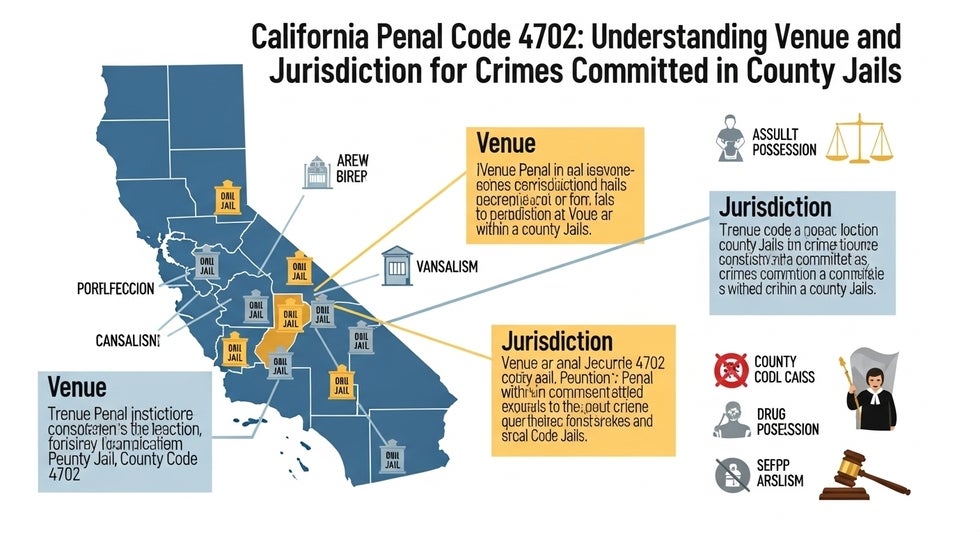
When a person faces criminal charges for offenses committed while incarcerated in a county jail, questions of where the trial should occur and who bears the financial responsibility become critically important.
California Penal Code Section 4702 addresses these jurisdictional issues, establishing clear rules about venue and costs when crimes occur within jail facilities. Understanding this statute can significantly impact defense strategy and case outcomes.
What Penal Code 4702 Establishes
California Penal Code 4702 creates specific rules for prosecuting crimes that occur inside county jail facilities. The statute applies when a prisoner confined in a jail maintained by one county commits an offense within that jail or attempts to escape from that facility.
The law establishes two key principles. First, it determines where the trial must take place, known legally as venue. Second, it assigns financial responsibility for prosecution costs. Both elements matter greatly when building a defense strategy for someone charged with crimes committed while incarcerated.
The Venue Rule Explained
Under Penal Code 4702, when a prisoner commits a crime inside a county jail or attempts escape, the trial must occur in the county that establishes and maintains that jail facility. This rule applies even if the prisoner originally came from a different county or committed their underlying offense elsewhere.
For example, imagine someone arrested in Los Angeles County gets transferred to a jail facility maintained by San Bernardino County. If that person commits assault against another inmate or attempts to escape from the San Bernardino facility, the trial for those new charges must occur in San Bernardino County, not Los Angeles County.
This venue requirement creates certainty about where prosecution will occur, which affects everything from jury selection to witness availability and defense preparation.
Why Venue Matters in Your Defense
The location where your trial takes place can significantly influence the outcome of your case. Different counties maintain different approaches to prosecution, sentencing, and plea negotiations. Understanding the venue rules under Penal Code 4702 helps you and your defense attorney prepare appropriately.
Local Knowledge and Resources
When your trial occurs in the county where the jail is located, your criminal defense attorney needs familiarity with that county's court system, prosecutors, and judges. An attorney who regularly practices in that jurisdiction brings valuable insights about local practices, tendencies, and expectations.
If you retained an attorney in your home county but face charges in a different county under Penal Code 4702, your lawyer may need to associate local counsel or obtain permission to appear in the new jurisdiction. These logistics can affect case preparation and strategy.
Jury Pool Considerations
The county where your trial occurs determines the jury pool from which your jury will be selected. Different communities maintain different attitudes toward crime, punishment, and law enforcement. A jury in one county might view your case differently than a jury in another county would.
Your defense team should understand the demographics, values, and perspectives common in the trial county. This knowledge informs jury selection strategy and helps predict how different arguments and evidence might resonate with jurors.
Witness Access and Evidence Gathering
Venue affects practical matters like witness availability and evidence collection. If witnesses to the alleged jail offense live near the facility or work there as corrections staff, they can easily appear in the local county court. However, if your defense requires witnesses from your home county or elsewhere, bringing them to a distant venue creates logistical challenges and additional expenses.
Similarly, gathering evidence, conducting investigations, and visiting the scene of the alleged crime becomes more straightforward when everything occurs in a single county rather than across multiple jurisdictions.
Types of Offenses Covered by Penal Code 4702
The statute applies to specific categories of crimes committed by prisoners in county jail facilities. Understanding which offenses fall under this rule helps clarify when the venue and cost provisions apply.
Crimes Committed Inside the Jail
Penal Code 4702 covers any offense committed within the jail facility itself. Common charges arising in jail settings include assault on inmates or staff, possession of contraband, drug offenses, and destruction of property.
These charges often stem from the challenging environment of incarceration, where tensions run high and conflicts can escalate quickly. From a defense perspective, understanding the context of jail life can provide important mitigation evidence even when the underlying facts are not disputed.
Escape and Attempted Escape
The statute specifically addresses escape and attempted escape charges. When a prisoner tries to leave custody without authorization or actually succeeds in escaping, those charges must be prosecuted in the county maintaining the jail facility.
Escape charges carry serious consequences, often adding significant time to existing sentences. However, defending against escape allegations requires careful examination of what actually occurred, whether the person had the specific intent to escape, and whether their actions truly constitute an escape attempt under California law.
Financial Responsibility Under Penal Code 4702
Beyond determining venue, Penal Code 4702 establishes which county bears the costs of prosecution. The statute assigns financial responsibility to the county that establishes and maintains the jail facility where the crime occurred.
Why Cost Allocation Matters
This cost assignment might seem like an administrative detail that does not affect individual defendants. However, financial considerations can influence prosecutorial decisions in ways that impact your case.
Counties operating under budget constraints may approach certain prosecutions differently than counties with more resources. Understanding the financial dynamics can sometimes inform plea negotiations or charging decisions, particularly in cases involving less serious offenses.
Intergovernmental Cooperation and Conflicts
When a prisoner from one county commits an offense in another county's jail, questions can arise about coordination between jurisdictions. The county holding the prisoner may want them returned after the new case concludes, while the county prosecuting the new charges needs the prisoner available for court appearances.
These intergovernmental issues typically get resolved through established protocols, but they can occasionally create complications that affect case timelines and logistics. Your defense attorney should monitor these coordination efforts to ensure they do not prejudice your rights or case preparation.
Defense Strategies for Jail Crime Charges
Facing criminal charges for offenses allegedly committed while incarcerated presents unique challenges and opportunities for defense. Several strategic considerations apply specifically to these cases.
Examining the Evidence Carefully
Jail offenses often occur in environments with limited independent witnesses and significant surveillance. Security cameras may capture relevant events, but footage quality, camera angles, and coverage gaps can all affect what evidence actually exists.
Your defense team should immediately request preservation of all video evidence and review it thoroughly. Sometimes footage contradicts witness statements or shows that events unfolded differently than alleged. In other cases, the absence of video evidence can raise reasonable doubt about what actually occurred.
Challenging Witness Credibility
Many jail crime prosecutions rely heavily on testimony from corrections officers or other inmates. Both categories of witnesses present potential credibility issues that skilled defense attorneys can explore.
Corrections staff may have biases, incomplete observations, or motivations to support certain narratives. Inmates who testify against you might receive benefits for their cooperation, such as reduced charges, better housing assignments, or other incentives that call their truthfulness into question.
Investigating Underlying Circumstances
Context matters enormously in jail crime cases. Was the alleged assault actually self defense against an aggressor? Did the supposed contraband actually belong to someone else? Was the escape attempt a confused response to a mental health crisis rather than willful criminal conduct?
Thorough investigation into the circumstances surrounding the alleged offense can reveal defenses, mitigation factors, or alternative explanations that cast doubt on the prosecution's theory.
The Relationship Between Penal Code 4702 and Your Underlying Case
When you face new criminal charges for offenses committed while in jail awaiting trial or serving a sentence, these charges can affect your underlying case in several ways.
Impact on Pending Cases
If you were in jail awaiting trial on other charges when the new offense allegedly occurred, the jail crime charges can complicate your pending case. Prosecutors may view the new charges as evidence of dangerous behavior or disregard for rules, potentially affecting plea negotiations or bail considerations.
However, your defense attorney can argue that jail crimes should be evaluated separately from underlying charges and that the stressful, confined environment of incarceration contributes to conflicts that would not occur in free society.
Sentencing Considerations
For defendants already serving sentences when new jail offenses occur, additional convictions mean additional punishment. These new sentences might run consecutively to existing sentences, substantially extending incarceration time.
Defending vigorously against jail crime charges becomes even more critical when the consequences include significant sentence enhancements. Even obtaining a reduction in charges from felony to misdemeanor level can dramatically affect total time served.
Your Rights Remain Protected in Jail Crime Prosecutions
Despite the unique setting of jail crime prosecutions, your constitutional rights remain fully protected. You maintain the right to competent legal representation, the right to remain silent, the right to confront witnesses, and all other protections afforded to criminal defendants.
Never speak with investigators, prosecutors, or jail staff about alleged offenses without your attorney present. Statements made in jail settings can be used against you, and the informal atmosphere may make you forget that you are still the target of a criminal investigation.
Working with Your Attorney on Venue and Jurisdiction Issues
When facing charges under circumstances covered by Penal Code 4702, discuss venue and jurisdiction issues with your criminal defense lawyer early in the case. Understanding where the trial will occur allows for better preparation and strategic planning.
Your attorney should investigate whether venue is properly established in the prosecuting county. Although Penal Code 4702 creates a clear rule, factual disputes can sometimes arise about where an offense actually occurred or which county maintains the facility in question.
Conclusion
California Penal Code Section 4702 establishes clear rules about where jail crime cases must be prosecuted and which county bears the associated costs. For defendants facing charges arising from alleged offenses in county jail facilities, understanding these venue requirements provides essential context for case preparation and defense strategy.
The county maintaining the jail facility where the alleged crime occurred must prosecute the case in its courts and absorb the associated expenses. This rule creates certainty about jurisdiction while raising important strategic considerations regarding local practices, jury pools, and resource availability.
If you or a loved one faces criminal charges for offenses allegedly committed in a county jail, securing experienced legal representation should be your first priority. An attorney knowledgeable about both the substantive criminal charges and the procedural requirements of Penal Code 4702 can protect your rights and pursue the best possible outcome under challenging circumstances.
Jail crime charges carry serious consequences that can extend incarceration and create additional criminal records. Every defendant deserves a thorough defense that examines the evidence, challenges questionable testimony, and ensures that constitutional protections remain fully enforced regardless of where the alleged offense occurred.