
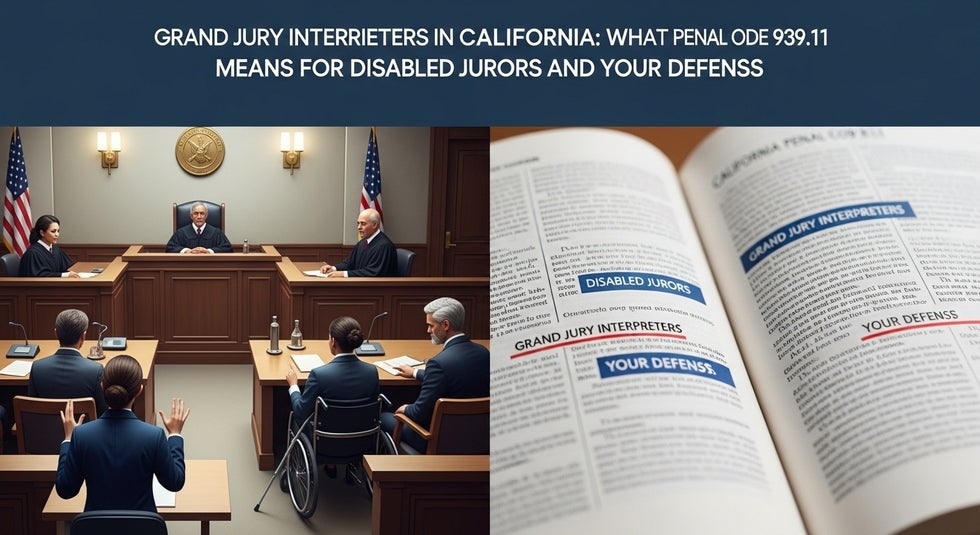
A Grand Jury Seat Should Never Depend on Ability to Hear, See, or Speak
The grand jury is one of the most powerful institutions in the California criminal justice system. It decides whether the evidence against someone is sufficient to bring formal charges. The people who sit on that jury carry enormous responsibility, and the law takes seriously the idea that qualified jurors should not be excluded from that responsibility simply because they experience the world differently.
California Penal Code 939.11 reflects that principle directly. It establishes a clear process for grand jury members who have a hearing, sight, or speech disability to request interpreter services when those services are necessary to carry out their duties. The statute is straightforward in its goal: make full participation possible without compromising the secrecy and integrity that grand jury proceedings depend on.
For anyone facing a grand jury investigation, this law is more relevant than it might first appear. The makeup of the grand jury and the fairness of its process directly affect whether an indictment is legally sound. Understanding how 939.11 works gives defendants and their attorneys a sharper lens for evaluating the legitimacy of proceedings.
What Penal Code 939.11 Actually Requires
The statute begins with the juror. A grand jury member who has a hearing, sight, or speech disability and needs interpreter assistance to fulfill their duties can make a formal request. That request goes to the superior court, not to the district attorney or the grand jury foreperson. This routing matters because it keeps the process judicial and neutral from the start.
Once the request is filed, a judge reviews it. If the court finds that interpreter services are genuinely necessary, an order is issued. The court may also compel attendance by issuing a subpoena to bring a qualified interpreter before the grand jury. This is not a casual or informal accommodation. It carries the weight of a court order.
The statute then draws a careful and deliberate line around the interpreter's role. The court must instruct both the grand jury and the interpreter that the interpreter is present only to facilitate communication. The interpreter plays no part in deliberations beyond bridging the communication gap between the disabled juror and the rest of the panel.
Finally, the interpreter is placed under oath. That oath binds the interpreter to secrecy regarding all grand jury matters, including witness testimony, statements made by any juror, and the votes of individual jurors. Disclosure is prohibited except in the proper course of judicial proceedings.
Why the Oath of Secrecy Is More Than a Formality
Grand jury secrecy is not a bureaucratic preference. It serves concrete purposes that protect everyone involved in the process, including the person being investigated. Secrecy prevents witnesses from coordinating their stories. It protects the reputations of people who are investigated but never charged. It shields jurors from outside pressure. And it preserves the integrity of the evidence gathering process.
Bringing an interpreter into that environment creates an obvious tension. An outside individual now has access to some of the most sensitive proceedings in the justice system. Penal Code 939.11 addresses that tension by treating the interpreter as functionally equivalent to a juror when it comes to secrecy obligations.
From a defense standpoint, the oath matters because a violation of it could become significant in a legal challenge. If an interpreter disclosed information from grand jury proceedings in a way that influenced witnesses, tainted the jury pool, or otherwise compromised the investigation, that disclosure could form the basis of a serious legal argument. Courts take grand jury secrecy violations seriously, and defense attorneys should too.
If you are navigating a grand jury matter and have questions about procedural integrity, the Bulldog Law Blog covers a range of issues related to how the grand jury process can affect your defense.
The Interpreter's Limited Role Protects the Integrity of the Verdict
The instruction that an interpreter may not participate in CC in any manner except to facilitate communication is worth examining closely. Grand jury deliberations are where jurors weigh the evidence and decide whether probable cause exists to indict. That is a function reserved exclusively for the jurors themselves.
An interpreter who begins influencing that process, even subtly, crosses a line the statute is specifically designed to prevent. If an interpreter were to express opinions, emphasize certain testimony through the manner of translation, or otherwise insert judgment into the communication, the neutrality of the process breaks down.
This is not merely theoretical. Translation involves choices. Word selection, emphasis, and tone can all carry meaning. Courts and legislatures are aware of this, which is why the instruction to the grand jury and the interpreter alike is explicit and must come directly from the court. Both parties are placed on notice that the interpreter's function is mechanical, not evaluative.
For defendants, this raises a legitimate question worth exploring with counsel: was the interpreter in a given case properly instructed, and did they stay within those boundaries? It is the kind of procedural detail that a thorough defense attorney will examine when reviewing the grand jury record.
Disability Accommodations and the Right to a Fair Grand Jury
Penal Code 939.11 exists within a broader framework of accessibility in the courts. The Americans with Disabilities Act and California's own civil rights statutes reflect a consistent legislative commitment to ensuring that disability does not exclude qualified people from civic participation. A grand jury seat is a position of civic authority, and the law protects the right of disabled jurors to fill that seat fully and effectively.
From a defense perspective, this matters in a different but equally important way. A grand jury that improperly excludes or marginalizes a disabled juror because interpreter services were denied or handled poorly is a grand jury whose composition and process may be subject to challenge. The constitutional right to a fair and properly constituted grand jury is not a minor procedural technicality. It is foundational.
If interpreter services were requested and denied without proper judicial review, or if an interpreter participated in deliberations beyond the scope permitted by law, those are facts a defense attorney needs to know about. The earlier counsel gets involved in reviewing the grand jury process, the more options exist for raising and preserving these arguments.
For more on how defense attorneys analyze grand jury proceedings, visit the Bulldog Law Blog for practical insights built around real criminal defense strategy.
What This Means If You Are Under Grand Jury Investigation
Grand jury proceedings happen without you in the room. They happen without your attorney being able to object in real time or cross examine witnesses. The law gives prosecutors significant advantages at this stage, which is exactly why defense counsel needs to scrutinize the process after the fact.
Penal Code 939.11 is one of several procedural statutes that govern how a grand jury must operate. When those rules are followed correctly, the system works as intended. When they are not, the resulting indictment may be vulnerable to legal challenge.
If a grand jury was impaneled in your case, your attorney should be reviewing every aspect of how that jury was constituted and how it operated. That includes confirming that any accommodation requests were handled properly, that interpreters were appropriately sworn and instructed, and that no outside influence crept into the deliberation process through an improperly managed interpreter relationship.
These details can feel technical, but they carry real weight. Grand jury indictments are not automatically valid simply because they were issued. Procedural defects matter, and a skilled defense attorney knows where to look for them.
The Takeaway
California Penal Code 939.11 is a statute about accessibility and fairness. It ensures that a grand jury member with a disability can participate fully and effectively without that participation undermining the secrecy the grand jury process depends on. The law accomplishes this through a structured court process, a carefully defined role for the interpreter, and a binding oath of secrecy.
For defendants, the statute is a reminder that the grand jury process is governed by rules, and those rules exist to be followed. When they are not, the defense has standing to say so.
Your situation may seem hopeless, but you do have rights and defenses. Call immediately at (888) 928-1609 or email our law firm to arrange a free consultation.