
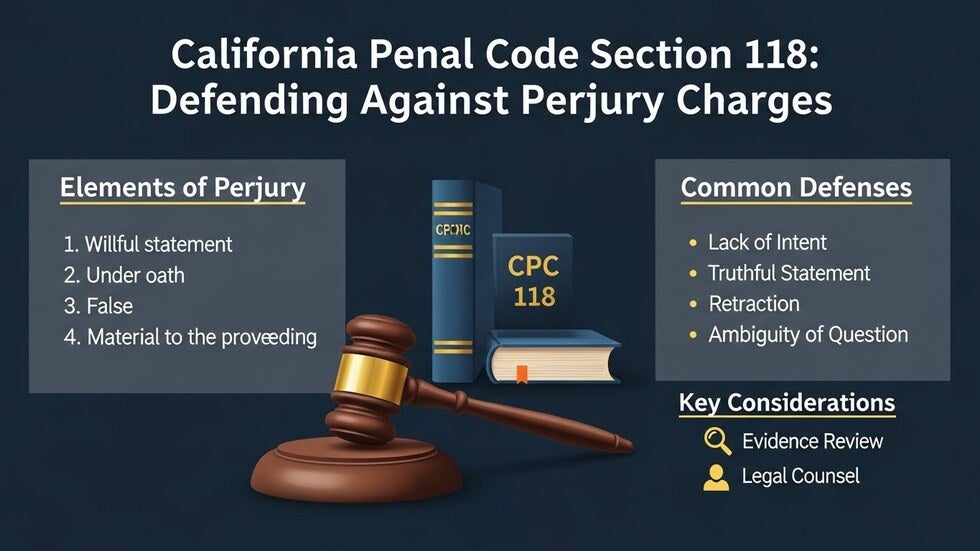
Perjury charges represent some of the most serious threats to individual liberty within the criminal justice system, striking at the heart of judicial proceedings and sworn testimony. California Penal Code Section 118 defines this grave offense and establishes the framework for prosecuting those accused of lying under oath. Understanding the statute's specific requirements, built-in protections, and potential defenses is essential for anyone facing these charges or involved in legal proceedings where truthful testimony is required.
Understanding California Penal Code Section 118
California Penal Code Section 118 criminalizes perjury by defining it as willfully stating as true any material matter that the person knows to be false, after having taken an oath to testify truthfully before a competent tribunal, officer, or person authorized by California law to administer such oaths. This comprehensive definition encompasses various legal settings where sworn testimony occurs.
The statute's broad application extends to testimony given within or outside California, recognizing that perjury's harm to judicial integrity transcends geographical boundaries. This expansive scope reflects the legislature's commitment to protecting the oath's sanctity regardless of where the false testimony occurs.
Understanding each element of this definition is crucial for both recognizing potential perjury exposure and developing effective defense strategies. The statute requires several specific components that prosecutors must prove beyond a reasonable doubt, creating opportunities for skilled defense attorneys to challenge the state's case.
Essential Elements of Perjury Under Section 118
Successful perjury prosecution requires the state to establish multiple specific elements, each presenting potential defense opportunities. Understanding these requirements helps defendants and their attorneys identify weaknesses in the prosecution's case.
Taking a Lawful Oath
The prosecution must prove that the defendant took a proper oath to testify truthfully before a competent tribunal, officer, or person authorized by California law to administer such oaths. This element requires evidence showing that proper legal procedures were followed in administering the oath.
Defense attorneys should examine whether the oath was properly administered according to legal requirements. Defects in oath administration, questions about the authority of the person administering the oath, or procedural irregularities may provide grounds for challenging this element.
Willful False Statement
The statute requires that defendants willfully made false statements, meaning they intentionally lied rather than made innocent mistakes or errors in memory. This willfulness requirement distinguishes perjury from honest mistakes, memory lapses, or inadvertent inaccuracies.
Evidence showing that defendants genuinely believed their statements were true, even if mistaken, can undermine the willfulness element. Similarly, evidence of confusion, memory problems, or reliance on incorrect information provided by others may support defenses based on lack of willful intent.
Knowledge of Falsity
Prosecutors must prove that defendants knew their statements were false when they made them. This knowledge requirement means that defendants cannot be convicted for statements they honestly believed to be true, regardless of whether those statements were actually accurate.
This element creates significant defense opportunities, as proving someone's state of mind at the time they made statements can be extremely difficult. Defense attorneys can present evidence showing defendants' reasonable belief in their statements' truthfulness, even if those beliefs were ultimately incorrect.
Materiality Requirement
Perhaps most importantly, the false statement must be material to the proceedings. Materiality means the false statement must be capable of influencing the outcome of the legal proceeding or be relevant to the issues being decided.
The materiality requirement provides a crucial defense tool, as many false statements in legal proceedings may not actually affect the case's outcome. Defense attorneys should carefully analyze whether allegedly false statements were truly material to the proceedings or merely tangential details that couldn't influence the decision.
The Critical Single Witness Protection
One of Section 118's most important protections is the single witness rule, which states that a person cannot be convicted of perjury if the proof of falsity relies solely on the contradictory testimony of a single witness other than the defendant. This protection reflects the legislature's recognition that perjury convictions shouldn't rest on simple credibility contests between two witnesses.
This rule requires prosecutors present corroborating evidence beyond just one witness's contradictory testimony. Such corroboration might include documentary evidence, physical evidence, testimony from multiple witnesses, or other forms of proof that support the claim of falsity.
Strategic Implications of the Single Witness Rule
Defense attorneys should carefully analyze the prosecution's evidence to determine whether it relies improperly on single witness testimony. If the state's case depends primarily on one witness contradicting the defendant's sworn statement, this may provide grounds for dismissal or acquittal.
However, prosecutors can overcome this protection by presenting additional evidence corroborating the claim of falsity. Defense attorneys must examine all evidence, not just witness testimony, to determine whether adequate corroboration exists.
Proving Falsity Through Direct and Indirect Evidence
Section 118 specifically allows falsity to be established through either direct or indirect evidence, giving prosecutors flexibility in how they present their cases. Understanding these different types of evidence helps defendants and their attorneys prepare comprehensive defense strategies.
Direct Evidence of Falsity
Direct evidence might include documents, recordings, photographs, or other materials that directly contradict the defendant's sworn statement. For example, if a defendant testifies under oath that they were in a specific location at a particular time, but security footage shows them elsewhere, this would constitute direct evidence of falsity.
Indirect Evidence of Falsity
Indirect evidence involves circumstances or facts that, when combined, suggest the defendant's statement was false. This might include witness testimony, timeline analysis, financial records, or other evidence that creates inferences about the statement's falsity.
Defense attorneys should carefully examine both types of evidence to identify potential challenges to authenticity, reliability, or interpretation. Even seemingly strong evidence may have weaknesses that skilled attorneys can exploit.
Common Defense Strategies for Perjury Cases
Defending against perjury charges requires careful analysis of the prosecution's evidence and creative application of the statute's requirements and protections. Several defense strategies may prove effective depending on specific case circumstances.
Challenging Materiality
The materiality requirement provides one of the strongest defense opportunities in perjury cases. Defense attorneys should carefully analyze whether allegedly false statements were truly material to the proceedings or merely inconsequential details.
Evidence showing that false statements couldn't have influenced the outcome, were irrelevant to the issues being decided, or concerned trivial matters may support materiality challenges. This defense can be particularly effective when false statements involve peripheral details rather than central case facts.
Attacking the Knowledge Element
Since perjury requires knowledge of falsity, defense attorneys can present evidence showing defendants honestly believed their statements were true. This might include evidence of reasonable reliance on information from others, memory problems, confusion about facts, or other circumstances suggesting honest mistake rather than willful deception.
Exploiting the Single Witness Rule
Defense attorneys should carefully examine whether the prosecution's case relies improperly on single witness testimony without adequate corroboration. If so, this may provide grounds for dismissal or create reasonable doubt about the falsity of the defendant's statements.
Constitutional and Procedural Challenges
Various constitutional issues may arise in perjury prosecutions, including due process challenges, Fifth Amendment self-incrimination issues, and Sixth Amendment confrontation rights. Defense attorneys should examine whether proper procedures were followed and whether constitutional protections were respected throughout the investigation and prosecution.
The Relationship Between Perjury and Other Offenses
Perjury charges often arise in connection with other legal proceedings, creating complex relationships between different criminal charges or civil matters. Understanding these connections helps defendants and their attorneys develop comprehensive defense strategies.
Perjury in Criminal Cases
When perjury charges stem from testimony in criminal proceedings, defendants may face both the underlying criminal charges and separate perjury charges. This creates strategic complications, as defending against one set of charges might impact the other.
Perjury in Civil Proceedings
Perjury charges can arise from testimony in civil cases, depositions, or administrative proceedings. These cases may involve different strategic considerations, particularly regarding the interaction between criminal defense and ongoing civil litigation.
Penalties and Long-Term Consequences
Perjury convictions carry serious penalties including imprisonment, fines, and permanent criminal records. Beyond immediate punishment, perjury convictions can have devastating effects on professional licenses, employment opportunities, and personal reputation.
For professionals whose careers depend on credibility and trustworthiness, such as attorneys, doctors, or financial advisors, perjury convictions can be career-ending. Understanding these collateral consequences helps defendants appreciate why aggressive defense representation is essential.
The Importance of Careful Testimony Preparation
While this article focuses on defense strategies, it's worth noting that proper preparation for sworn testimony can help prevent perjury charges from arising. Individuals preparing to testify should work closely with their attorneys to ensure they understand their obligations and the potential consequences of false statements.
Federal vs. State Perjury Prosecutions
Perjury can be prosecuted under both state and federal law, depending on the circumstances. Defense attorneys should consider whether federal prosecution might be possible and how this affects defense strategy.
The interaction between state and federal perjury statutes can create both risks and opportunities for defendants, particularly in cases involving federal proceedings or interstate conduct.
For anyone facing potential perjury charges under California Penal Code Section 118, immediate consultation with experienced criminal defense counsel is essential. These cases require attorneys who understand both the statute's technical requirements and the broader strategic implications of perjury prosecutions in various legal contexts.
To protect your rights and your future, contact Bulldog Law today or call (888) 928-1609 for a confidential consultation. Early legal intervention can be decisive in perjury cases.