
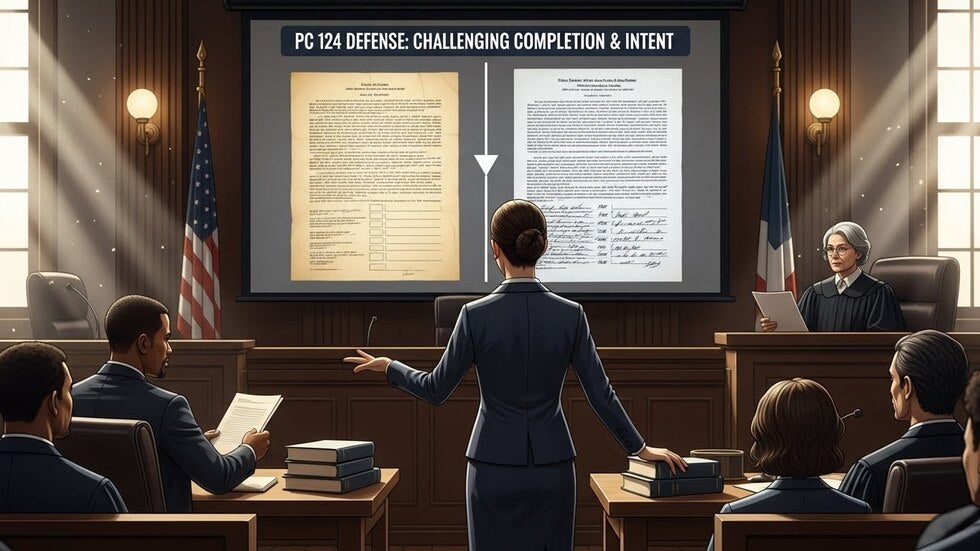
California Penal Code Section 124 establishes a critical threshold for when false document charges become complete, creating both prosecutorial opportunities and defense challenges that can determine case outcomes. This statute defines the moment when depositions, affidavits, or certificates are deemed legally complete for criminal purposes, focusing on delivery with intent for publication as true. Understanding these timing and intent requirements becomes essential for mounting effective defenses against document-related criminal charges.
Understanding the Critical Timing Element in Section 124
California Penal Code Section 124 establishes that document-related offenses become complete upon delivery to another person with intent for publication as true, rather than at the moment of document creation or signing. This timing distinction creates significant implications for both prosecution and defense strategies in false document cases.
The statute's focus on delivery timing reflects legislative recognition that merely creating false documents, without more, doesn't necessarily constitute completed criminal conduct. The law requires an additional step - actual delivery to another person - before criminal liability attaches fully.
From a defense perspective, this timing requirement creates opportunities to challenge prosecutions where documents were created but never delivered, or where delivery occurred without the requisite intent for publication. Many defendants face charges based on document creation alone, without prosecutors proving the delivery element Section 124 requires.
The delivery requirement also distinguishes between different types of document preparation activities. Draft documents, works in progress, or materials prepared for internal review may not satisfy Section 124's completion requirements until actual delivery with publication intent occurs.
Understanding these timing nuances allows defense attorneys to challenge prosecutorial theories that assume criminal liability attaches at document creation rather than delivery, potentially resulting in dismissal of charges that don't meet statutory requirements.
The Intent for Publication Requirement: A Critical Defense Avenue
Section 124's requirement that delivery occur "with the intent that it be uttered or published as true" creates perhaps the most important defense opportunity in false document cases. This specific intent element demands that prosecutors prove defendants intended their documents to be presented or published as truthful statements.
The publication intent requirement goes beyond simple delivery, requiring proof that defendants specifically intended for documents to be used as truthful representations. When defendants delivered documents for other purposes - such as review, correction, or internal processing - these circumstances may not satisfy Section 124's intent requirements.
Defense attorneys frequently challenge the publication intent element by demonstrating that clients delivered documents for legitimate purposes unrelated to their publication as true statements. Administrative corrections, draft reviews, or internal consultations often lack the publication intent Section 124 requires.
The distinction between delivery for publication and delivery for other purposes proves particularly important in complex business, legal, or administrative contexts where documents routinely change hands for various reasons unrelated to their ultimate publication.
Challenging prosecutorial assumptions about defendants' intent often requires careful examination of the circumstances surrounding document delivery, including the relationship between parties, the context of delivery, and any communications about the documents' intended use.
Key Case Law: Understanding Judicial Interpretation
The cases of Collins v. Superior Court, 89 Cal. App. 4th 1244, People v. Robles, 117 Cal. 681, and People v. Pierce, 66 Cal. 2d 53, provide crucial guidance for understanding how California courts interpret Section 124's requirements in practice.
Collins v. Superior Court established important precedent regarding the delivery and intent requirements, clarifying that prosecutors must prove both elements beyond a reasonable doubt. The court's analysis provides defense attorneys with authority for challenging cases where either element is inadequately proven.
People v. Robles contributed to the understanding of what constitutes sufficient evidence of intent for publication, establishing standards that defense counsel can use to challenge prosecutorial theories about defendants' mental state at the time of document delivery.
People v. Pierce further developed the jurisprudence around Section 124's completion requirements, providing additional precedent for defense arguments about timing and intent issues in false document cases.
These cases collectively establish that Section 124's elements must be proven with specificity rather than assumed from general circumstances, creating opportunities for defense challenges when prosecutorial evidence falls short of statutory requirements.
The judicial interpretation of Section 124 through these cases emphasizes that both delivery and publication intent must be established through concrete evidence rather than speculation or assumption about defendants' motivations.
Common Defense Strategies Under Section 124
Challenging the delivery element represents a fundamental defense approach when Section 124 issues arise. Defense attorneys must carefully examine whether actual delivery occurred and whether prosecutors can prove this element beyond a reasonable doubt.
The timing of alleged delivery often provides defense opportunities, particularly when defendants retained control over documents or when transfer occurred for purposes other than publication. Internal processing, review procedures, or administrative handling may not constitute the type of delivery Section 124 contemplates.
Intent challenges prove particularly effective when defendants delivered documents for legitimate business, legal, or administrative purposes. The statute requires specific intent for publication as true, not merely intent to transfer documents for any purpose.
Constitutional defenses occasionally arise in Section 124 cases, particularly involving due process concerns when the distinction between criminal and non-criminal document handling becomes unclear. Vague prosecutorial theories about intent can raise constitutional issues about fair notice.
The relationship between Section 124 and other document-related statutes creates opportunities for defense arguments about prosecutorial charging decisions and the appropriate legal framework for specific conduct.
The Intersection of Section 124 with Business and Professional Practices
Modern business and professional practices often involve complex document handling procedures that create challenges for applying Section 124's requirements. Defense attorneys must understand how legitimate business activities relate to the statute's delivery and intent elements.
Standard business practices such as draft circulation, review processes, and administrative handling often involve document delivery that lacks publication intent. These routine activities require protection from criminal liability through careful application of Section 124's requirements.
Professional contexts including legal practice, accounting, and consulting frequently involve document preparation and delivery for purposes other than publication as true statements. Understanding these professional practices proves crucial for effective defense representation.
The intersection of Section 124 with regulatory compliance creates additional complexity when businesses must provide documents to government agencies or other entities as part of routine compliance activities rather than voluntary publication.
Procedural Considerations and Motion Practice
Section 124's specific requirements create opportunities for pretrial motion practice designed to challenge prosecutorial theories before trial. The legal nature of delivery and intent requirements makes them particularly suitable for resolution through demurrer or motion to dismiss.
Discovery practice in Section 124 cases must focus on obtaining evidence about the circumstances of document delivery, the relationship between parties, and any communications that might reveal defendants' actual intent regarding publication.
The timing requirements of Section 124 can create statute of limitations issues when prosecutors attempt to establish completion dates that extend limitation periods beyond statutory requirements.
Expert testimony about business practices, document handling procedures, and industry standards may prove valuable in Section 124 cases where the context of document delivery affects interpretation of defendants' intent.
Strategic Considerations for Complex Cases
Section 124 cases often involve multiple defendants, complex business relationships, and extensive document production that creates strategic challenges for defense counsel. Understanding how the statute applies to multi-party transactions requires careful analysis of each defendant's specific conduct.
The relationship between Section 124 and conspiracy theories can create additional complexity when prosecutors attempt to establish that document completion by one defendant affects liability for others involved in the same scheme.
International business transactions and cross-border document delivery can create jurisdictional issues and questions about how Section 124's requirements apply to conduct spanning multiple legal systems.
The intersection of criminal liability under Section 124 with civil litigation, regulatory proceedings, and professional discipline creates strategic considerations that extend beyond immediate criminal consequences.
Protecting Business and Professional Interests
Understanding Section 124's requirements becomes crucial for businesses and professionals who routinely handle documents that might become subject to criminal scrutiny. The statute's specific timing and intent requirements provide important protections when properly understood and applied.
Defense strategies in Section 124 cases must consider both immediate criminal consequences and broader implications for business operations, professional licensing, and regulatory compliance that can result from document-related charges.
The importance of early legal intervention in Section 124 cases cannot be overstated. The technical nature of delivery and intent requirements often creates opportunities for favorable resolution when experienced counsel intervenes promptly.
Developing Comprehensive Defense Strategies
Effective defense representation in Section 124 cases requires understanding both the statute's technical requirements and the practical contexts in which document-related charges typically arise. Defense attorneys must appreciate how legitimate business and professional activities relate to criminal liability.
The intersection of Section 124 with other areas of law, including contract disputes, regulatory compliance, and professional responsibility, creates opportunities for comprehensive defense strategies that address multiple aspects of clients' legal exposure.
Client counseling in Section 124 cases must address both criminal liability and collateral consequences that can affect business operations, professional licenses, and personal reputation.
Conclusion: Navigating Section 124's Complex Requirements
California Penal Code Section 124 creates specific timing and intent requirements that can significantly affect the outcome of document-related criminal cases. Understanding both the statute's protections and limitations becomes crucial for effective defense representation.
The delivery and publication intent requirements provide important defense opportunities for clients who may have been charged based on inadequate prosecutorial theories about when document-related crimes become complete.
If you're facing charges involving Section 124 or document-related criminal allegations, the technical nature of these requirements demands experienced legal representation that understands both the statutory elements and practical contexts in which these cases arise.
Contact qualified criminal defense counsel immediately to analyze whether prosecutorial theories meet Section 124's specific requirements and to develop comprehensive defense strategies that protect both your immediate freedom and long-term interests. Call Bulldog Law at (888) 928-1609 or to speak with an experienced criminal defense attorney who can evaluate your case and begin protecting your rights right away.