
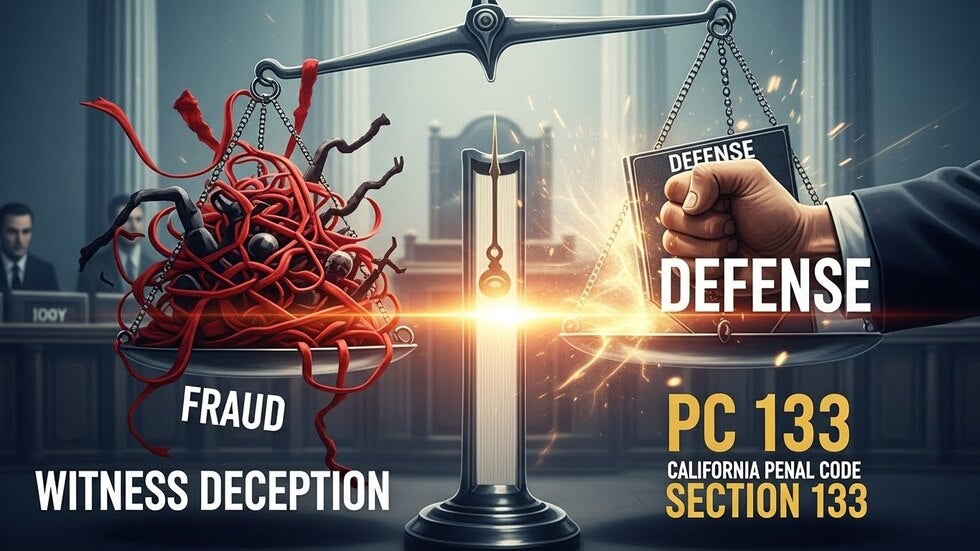
California Penal Code Section 133 criminalizes fraudulent or deceptive conduct toward witnesses with intent to affect their testimony, creating misdemeanor liability that can still devastate careers and reputations. While classified as a misdemeanor, these charges often arise in high-stakes legal proceedings where the consequences extend far beyond immediate criminal penalties. Understanding both the statute's specific elements and available defense strategies becomes crucial when facing allegations that you attempted to improperly influence witness testimony through deception or fraud.
Understanding the Scope of California Penal Code Section 133
California Penal Code Section 133 targets individuals who practice fraud or deceit toward witnesses or prospective witnesses in legal proceedings, establishing criminal liability for conduct designed to affect testimony through deceptive means. This statute serves as part of California's comprehensive framework protecting the integrity of legal proceedings and ensuring that witness testimony remains free from improper influence.
The statute applies to "any trial, proceeding, inquiry, or investigation authorized by law," creating broad coverage that encompasses criminal trials, civil litigation, administrative hearings, regulatory proceedings, and virtually any formal legal process where witness testimony might be relevant. This expansive scope means that Section 133 can apply to communications with witnesses in diverse legal contexts.
The law criminalizes various forms of deceptive conduct including practicing fraud or deceit, making false statements, creating false representations, using false tokens, or exhibiting false writings to witnesses. This comprehensive coverage reflects legislative recognition that deceptive influence can take many different forms in modern legal practice.
From a defense perspective, Section 133's broad language creates opportunities to challenge prosecutorial theories that criminalize legitimate witness communication, case preparation activities, or normal litigation strategy discussions. The statute requires specific intent to affect testimony through deceptive means, distinguishing criminal conduct from proper legal representation.
Understanding these boundaries becomes essential for effective defense, particularly for attorneys and other legal professionals who regularly communicate with witnesses as part of legitimate case preparation and representation duties.
Critical Elements: Intent and Deception Requirements
The most important element for defense purposes is Section 133's requirement that defendants act "with the intent to affect the testimony" of witnesses through deceptive means. This specific intent element creates significant opportunities for defense when clients engaged in legitimate communication without intent to improperly influence testimony.
The intent requirement demands proof that defendants specifically intended to affect witness testimony through fraudulent or deceptive conduct, not merely that their communications might have influenced witnesses or involved case-related discussions. This distinction protects legitimate attorney-client communications, witness preparation, and case strategy development from criminal liability.
Prosecutors must prove both deceptive conduct and specific intent to affect testimony, creating a dual burden that defense counsel can challenge through various strategies. When clients engaged in honest communication, provided accurate information, or acted without intent to deceive, these circumstances can support complete defense against Section 133 charges.
The deception element requires proof of actual fraud, deceit, false statements, false representations, false tokens, or false writings. Legitimate communications that contain opinions, strategic advice, or accurate information typically don't satisfy Section 133's deception requirement even when they might influence witness testimony.
Defense attorneys must carefully analyze both the content of alleged communications and defendants' intent to determine whether prosecutorial theories can withstand scrutiny under Section 133's demanding elements.
The Distinction Between Legitimate Communication and Criminal Conduct
Section 133 creates important distinctions between legitimate witness communication and criminal conduct, recognizing that legal proceedings necessarily involve extensive communication between attorneys, clients, and witnesses. Understanding these boundaries proves crucial for effective defense representation.
Legitimate witness preparation activities include discussing case facts, reviewing testimony, explaining legal procedures, and providing general guidance about testifying. These activities serve important functions in ensuring that witnesses understand their obligations and can provide clear, accurate testimony.
The statute doesn't criminalize providing witnesses with accurate information, correcting misunderstandings, or engaging in truthful discussions about case facts and legal issues. These activities fall within the proper scope of legal representation and case preparation when conducted honestly and transparently.
However, the line between legitimate preparation and criminal deception can become blurred when communications involve complex factual scenarios, disputed evidence, or strategic considerations about testimony presentation. Defense counsel must understand how courts distinguish between proper and improper witness communication.
The timing and context of witness communications significantly affect their interpretation under Section 133. Communications that occur during normal case preparation periods and follow established professional practices typically receive more favorable treatment than secretive or unusual approaches to witness contact.
Key Case Law: People v. Fernandez and People v. Pereira
The cases of People v. Fernandez, 106 Cal. App. 4th 943, and People v. Pereira, 207 Cal. App. 3d 1057, provide important guidance for understanding how Section 133 relates to other witness-related offenses and how courts interpret the statute's requirements in practice.
People v. Fernandez helps establish the boundaries between Section 133 violations and more serious offenses such as witness intimidation or bribery. The court's analysis demonstrates that Section 133 targets deceptive influence rather than coercive conduct, creating different legal standards and penalties.
People v. Pereira contributes to understanding how Section 133 applies to specific factual scenarios and what types of conduct satisfy the statute's deception and intent requirements. These precedents provide defense attorneys with authority for challenging prosecutorial theories that overreach Section 133's proper scope.
Both cases emphasize that Section 133 requires specific proof of deceptive conduct and intent to affect testimony, not merely evidence of witness communication or potential influence on testimony. This requirement creates opportunities for defense challenges when prosecutorial evidence falls short of statutory standards.
The judicial interpretation of Section 133 through these cases establishes that the statute must be applied carefully to avoid criminalizing legitimate legal activities while still protecting the integrity of witness testimony.
Common Defense Strategies for Section 133 Charges
Challenging the intent to affect testimony represents the most fundamental defense approach in Section 133 cases. Defense attorneys must demonstrate that clients' communications served legitimate purposes rather than improper attempts to influence witness testimony through deception.
The absence of deceptive conduct provides another crucial defense avenue. When communications contained accurate information, honest opinions, or legitimate case-related discussions, these circumstances can support arguments that no fraud or deceit occurred under Section 133's requirements.
Good faith communication defenses argue that defendants engaged in honest, transparent discussions with witnesses based on reasonable understanding of facts and legal obligations. These defenses recognize that legitimate case preparation necessarily involves extensive witness communication.
Constitutional challenges occasionally arise in Section 133 cases, particularly involving First Amendment protections for speech and Sixth Amendment rights to effective assistance of counsel. When prosecutions criminalize legitimate attorney-client communications or case preparation activities, constitutional concerns may support dismissal.
Professional practice defenses address situations where defendants followed accepted professional standards in communicating with witnesses, even when those communications might have influenced testimony preparation or presentation.
The Intersection with Professional Ethics and Standards
Section 133 frequently affects attorneys and other legal professionals whose work necessarily involves extensive witness communication. Understanding how criminal liability relates to professional ethical obligations becomes crucial for effective defense representation.
Professional rules of conduct provide important context for interpreting Section 133's requirements, as these rules establish accepted standards for attorney-witness communication and case preparation activities. Conduct that complies with professional ethical standards typically doesn't constitute criminal deception under Section 133.
The attorney-client privilege and work product doctrine create additional considerations in Section 133 cases when prosecutions attempt to use privileged communications as evidence of deceptive conduct or improper intent.
Professional licensing implications require defense strategies that consider both criminal consequences and potential discipline by professional regulatory bodies. Section 133 convictions can trigger professional discipline even when criminal penalties are minimal.
Procedural Defenses and Constitutional Considerations
Section 133's application to attorney-client communications and legal practice creates various constitutional issues that experienced defense counsel can exploit to protect their clients' interests.
First Amendment challenges may arise when prosecutions attempt to criminalize speech that falls within protected attorney-client communications or legitimate advocacy activities. The constitutional right to effective assistance of counsel can be compromised when Section 133 is applied too broadly to legal representation.
Due process concerns occasionally surface when prosecutorial theories about deceptive conduct are vague or when defendants couldn't reasonably understand that their communications violated Section 133's requirements.
Privilege protection issues frequently complicate Section 133 prosecutions when prosecutors attempt to use attorney-client communications or work product materials as evidence of criminal conduct.
Strategic Considerations for Defense Counsel
Early case evaluation proves crucial in Section 133 cases where the distinction between legitimate communication and criminal conduct often determines case outcomes. Comprehensive investigation can reveal evidence supporting defense theories about good faith conduct and proper professional practice.
The relationship between Section 133 charges and underlying legal proceedings creates strategic considerations about timing, evidence preservation, and coordination between criminal defense and the original legal matters that gave rise to witness communications.
Professional reputation and career implications require defense strategies that address both immediate criminal consequences and long-term professional standing. Section 133 charges can create lasting damage to professional reputations even when criminal consequences are minimal.
Expert Witnesses and Professional Practice Evidence
The intersection of Section 133 with professional practice standards often requires expert testimony about accepted professional conduct, ethical obligations, and standard practices in legal representation and case preparation.
Legal ethics experts can provide valuable testimony about professional standards for witness communication and demonstrate that defendants' conduct fell within accepted professional practices rather than criminal deception.
Communication experts occasionally contribute to Section 133 defenses by analyzing recorded conversations or written communications to demonstrate their legitimate rather than deceptive nature.
Mitigation and Alternative Resolutions
Even when technical defenses prove challenging, Section 133 cases often involve significant mitigation opportunities based on defendants' good faith intentions, professional reputation, and lack of harm to legal proceedings.
The misdemeanor classification creates opportunities for alternative sentencing approaches that recognize defendants' overall character and professional standing while addressing prosecutorial concerns about witness communication standards.
Character evidence and professional reputation frequently prove valuable in Section 133 cases where defendants' overall integrity can support arguments for favorable resolution.
Protecting Professional Practice and Rights
Understanding Section 133's requirements becomes crucial for attorneys and other legal professionals who regularly communicate with witnesses in legal proceedings. The statute's broad application demands careful attention to communication practices and professional standards.
Preventive strategies include maintaining detailed records of witness communications, following established professional practices, and ensuring that all witness interactions comply with ethical obligations and legal requirements.
The importance of understanding both criminal liability and professional ethical standards cannot be overstated when engaging in witness communication activities that might trigger Section 133 scrutiny.
Conclusion: Defending Against Witness Communication Charges
California Penal Code Section 133 creates criminal liability for deceptive conduct toward witnesses, but the statute's specific intent and deception requirements also create significant defense opportunities for experienced counsel. Understanding the distinction between legitimate professional communication and criminal conduct becomes crucial for effective representation.
The technical nature of intent and deception elements, combined with professional practice contexts in which Section 133 cases typically arise, requires comprehensive defense strategies that address both legal elements and practical realities of legal representation.
If you're facing Section 133 charges or investigation involving witness communication, the potential impact on both criminal liability and professional standing demands immediate legal assistance from counsel experienced in professional practice and witness-related prosecutions.
Contact qualified criminal defense attorneys immediately to analyze the intent and communication elements in your case while developing strategies that protect both your immediate freedom and professional reputation.
This article provides general information about California Penal Code Section 133 from a defense perspective. Every case involves unique circumstances requiring individualized legal analysis and strategy development by qualified criminal defense attorneys experienced in professional practice and witness-related charges.
For guidance specific to your situation, contact Bulldog Law at thebulldog.law or call (888) 928-1609 to speak with an experienced criminal defense attorney who can protect your rights and professional future.