
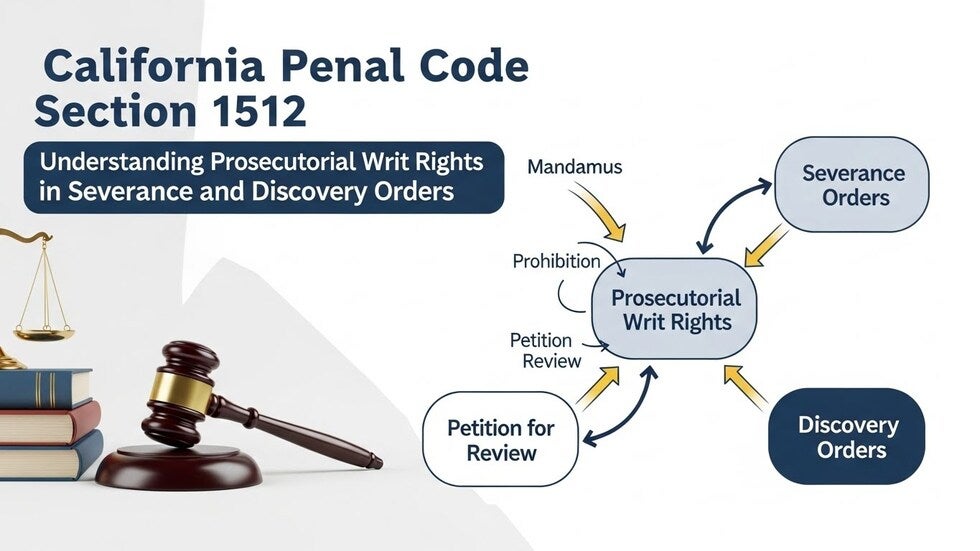
Criminal defendants often view the prosecution as holding all the advantages in the justice system. However, California law does provide prosecutors with specific appellate remedies when trial courts rule against them on certain pretrial matters. California Penal Code Section 1512 grants prosecutors the authority to seek immediate appellate review of orders granting defense motions for severance or discovery. Understanding this statute helps defense attorneys anticipate prosecutorial strategies and prepare for potential delays in cases where courts rule favorably for defendants.
What California Penal Code Section 1512 Actually Does
California Penal Code Section 1512 expands the prosecution's ability to challenge trial court rulings through the writ process. While prosecutors already possess certain writ rights under other statutes and case law, Section 1512 specifically addresses two categories of orders that frequently arise in criminal cases: severance orders and discovery orders.
By codifying prosecutorial writ rights in these contexts, the legislature created a clear procedural path for the government to seek immediate appellate review when trial courts grant defense motions in these areas.
This statute operates as an exception to the general rule that only final judgments are immediately appealable. Pretrial orders typically cannot be reviewed until after trial concludes and a defendant appeals from a conviction. Section 1512 allows prosecutors to bypass this normal limitation and seek immediate review when severance or discovery rulings go against them.
Severance Motions and Their Strategic Importance
Severance motions represent one of the most powerful tools in criminal defense. These motions ask the court to separate charges or defendants that the prosecution has joined together in a single case. California law permits joinder of multiple charges against a single defendant when those charges are of the same class or are connected in their commission. Similarly, multiple defendants can be joined when they are charged with conspiracy or when they participated in connected crimes.
However, joinder is not always appropriate, even when technically permitted. Defense attorneys file severance motions arguing that trying multiple charges or defendants together would unfairly prejudice their clients. This prejudice can take many forms. When multiple serious charges are tried together, jurors may improperly use evidence from one charge to convict on another. When multiple defendants are tried together, a jury may struggle to evaluate each defendant's guilt separately or may be influenced by evidence admissible against one defendant but not another.
Why Prosecutors Oppose Severance
From the prosecution's perspective, trying multiple charges or defendants together offers significant advantages. Joint trials allow the government to present a comprehensive narrative of criminal activity, create efficiency in witness testimony, and avoid the expense and burden of multiple trials. When courts grant severance motions, prosecutors must proceed with separate trials, duplicating effort and potentially facing inconsistent results across different juries.
More importantly, severance can weaken the prosecution's case. Evidence that seems compelling when presented alongside multiple related charges may appear less persuasive when a jury considers only a single offense. Similarly, when defendants are tried separately, the prosecution cannot benefit from the spillover effect of one defendant's incriminating evidence influencing the jury's view of codefendants.
Discovery Orders and Prosecutorial Disclosure Obligations
Discovery in criminal cases involves the exchange of information between the prosecution and defense before trial. California law, along with constitutional principles established in cases like Brady v. Maryland, requires prosecutors to disclose certain evidence to the defense. This includes exculpatory evidence that might help prove the defendant's innocence, impeachment evidence that could undermine prosecution witnesses, and other materials specified by California's discovery statutes.
Defense attorneys routinely file discovery motions seeking disclosure of evidence they believe the prosecution possesses but has not voluntarily provided. These motions might seek police reports, witness statements, forensic testing results, personnel records of officers involved in the case, or information about informants. When trial courts grant these motions, they order prosecutors to turn over specific categories of evidence or information.
Why Prosecutors Challenge Discovery Orders
Prosecutors may seek writ review of discovery orders for several reasons. Sometimes they believe the requested materials are not legally discoverable under California law or constitutional principles. In other situations, prosecutors may argue that disclosure would compromise ongoing investigations, endanger witnesses, or reveal confidential law enforcement techniques.
The prosecution might also contend that the trial court's discovery order exceeds the scope of what defense counsel legitimately needs for trial preparation. Prosecutors sometimes view broad discovery orders as fishing expeditions that impose unreasonable burdens on law enforcement agencies and prosecutors' offices. Section 1512 provides prosecutors with a mechanism to challenge these orders before complying with them.
The Writ Process Under Section 1512
When a trial court grants a severance or discovery motion, prosecutors must decide whether to accept the ruling or seek immediate appellate review through a writ petition. A writ of mandate commands the trial court to perform a specific action required by law, while a writ of prohibition prevents the court from taking action that exceeds its jurisdiction. Prosecutors typically file these petitions in the California Court of Appeal with jurisdiction over the trial court.
The writ petition must demonstrate that the trial court's order represents an abuse of discretion or legal error. Appellate courts give trial judges substantial discretion in ruling on severance and discovery motions, so prosecutors face a significant burden in establishing that the trial court's decision warrants reversal. The petition must include a detailed factual record, legal argument, and explanation of why immediate review is necessary rather than waiting until after trial.
Impact on Defense Strategy and Case Timeline
When prosecutors file writ petitions under Section 1512, the immediate effect is delay in the criminal proceedings. Trial courts typically stay the underlying case while the Court of Appeal considers the writ petition. This pause can last weeks or months, depending on the complexity of the issues and the appellate court's calendar.
For defendants, this delay cuts both ways. On one hand, it postpones resolution of the case and may extend the period during which defendants face restrictions on their liberty, whether through bail conditions or pretrial detention. The uncertainty of pending charges continues, along with the stress and disruption to defendants' lives. For defendants who are confident in their innocence or who have strong defenses, delays in reaching trial can be particularly frustrating.
On the other hand, delay sometimes benefits the defense. Witnesses' memories fade over time, making effective cross examination easier. Complaining witnesses may lose interest in prosecution or become unavailable. Law enforcement officers may transfer to different assignments or retire, complicating the prosecution's ability to present testimony. Defense attorneys must evaluate these competing considerations when courts grant favorable severance or discovery rulings that prosecutors might challenge.
The Legislative History Note in Section 1512
Section 1512(b) contains an unusual provision regarding legislative intent. It specifically states that courts should not draw inferences from a 1989 legislative amendment that deleted reference to a particular California Supreme Court case. This subsection exists because legislators wanted to clarify that removing the case citation did not signal disapproval of that decision or change the substantive law.
This type of legislative clarification, while technical, matters in how courts interpret statutes. Attorneys arguing about the scope of prosecutorial writ rights under Section 1512 cannot claim that the amendment somehow limited those rights or overruled prior case law. The legislature explicitly foreclosed that argument by including subsection (b).
Relationship to Other Prosecutorial Writ Rights
Section 1512 operates in addition to, not instead of, other statutory and case law provisions authorizing prosecutorial writs. California law grants prosecutors writ rights in various contexts beyond severance and discovery orders. For example, prosecutors can seek writs challenging orders suppressing evidence, dismissing charges, or reducing bail. Section 1512 simply adds severance and discovery to this list of immediately reviewable orders.
This cumulative approach means defense attorneys must consider the full range of prosecutorial writ options when trial courts rule in their clients' favor. A favorable ruling is not necessarily final, and strategic planning must account for the possibility of prosecutorial writ petitions and the resulting delays.
Defending Against Prosecutorial Writ Petitions
When prosecutors file writ petitions challenging severance or discovery orders, defense counsel must decide whether to file opposition briefs. In many cases, vigorous opposition is essential to preserving the trial court's favorable ruling. Defense attorneys must explain why the trial court acted within its discretion, why the order correctly applies California law, and why immediate appellate intervention is unnecessary.
Effective opposition briefs emphasize the trial court's firsthand knowledge of the case and the deference appellate courts should give to trial court discretion. They also highlight the prejudice to defendants from further delay and the absence of any extraordinary circumstances warranting immediate appellate review. In some cases, defense counsel may also argue that the prosecution has not exhausted alternative remedies or has not demonstrated that the claimed error cannot be corrected through normal post conviction appeal.
Practical Implications for Criminal Defense
Understanding Section 1512 helps defense attorneys set realistic expectations with clients about case timelines and potential obstacles. When courts grant severance or discovery motions, defense counsel should advise clients that prosecutors may seek writ review and explain the implications of such petitions. This communication helps clients understand why cases may not proceed immediately to trial even after favorable pretrial rulings.
Defense attorneys should also use knowledge of Section 1512 to inform their motion practice. In some situations, the likelihood of prosecutorial writ petitions might influence decisions about which motions to file, how to frame arguments, or how aggressively to pursue certain forms of relief. Strategic litigation requires anticipating the opposition's responses and planning accordingly.
Protecting Your Rights Through Every Stage of Criminal Proceedings
California's criminal justice system involves complex procedural rules that can significantly impact case outcomes. Provisions like California Penal Code Section 1512 illustrate how prosecutorial remedies can affect the pace and course of criminal cases, even when trial courts rule in favor of defendants. Successfully navigating these procedures requires experienced legal counsel who understand both the substantive criminal law and the intricate appellate processes that can arise during pretrial litigation.
The criminal defense team at The Bulldog Law has extensive experience handling all aspects of criminal defense, including opposing prosecutorial writ petitions and protecting favorable trial court rulings. We understand how to anticipate prosecutorial strategies and develop effective responses that preserve our clients' rights and favorable rulings.
If you are facing criminal charges and need attorneys who can navigate complex pretrial motions and appellate procedures, contact our experienced defense team for a consultation about your case.